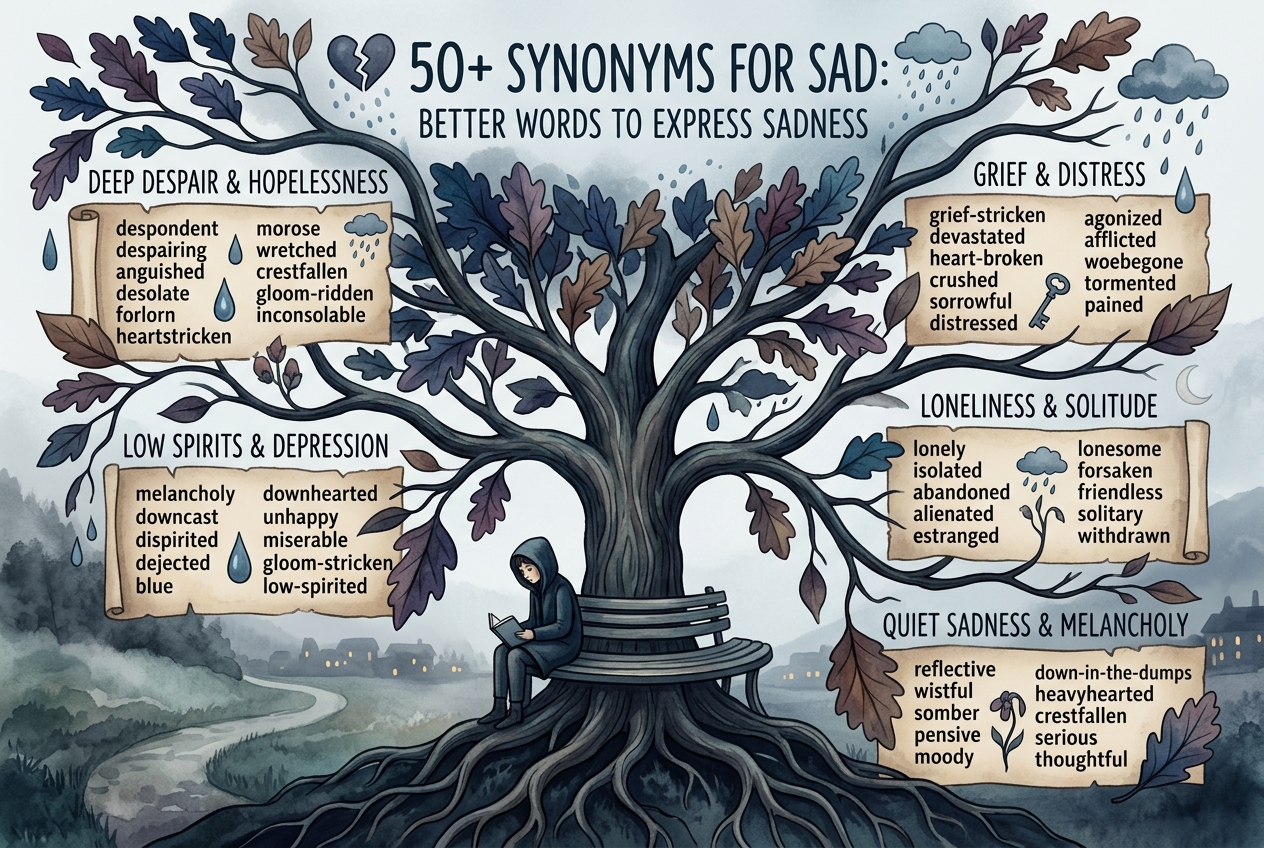
50+ Synonyms for Sad: Better Words to Express Sadness
Sadness can be expressed in countless ways. Sometimes it’s more subtle than others, and some days it’s just more intense than usual. However, most people use the same adjective over and over to describe these varying degrees of sadness. While ‘sad’ is an adequate word for expressing this emotion, it’s probably not as precise as one might hope.
Having a large array of words to describe something like sadness can be important for a number of reasons. By having alternative terms, one not only improves their ability to convey their emotions but also increases the accuracy of their description. With this in mind, the following list of over 50 synonyms for sad has been compiled in order to help facilitate the task of finding the right word. Words have been categorized by intensity and context for convenience.
What Does “Sad” Really Mean?
Before moving on to the alternatives, let us first isolate the meaning that this word is conveying. In general, it is used to describe an emotional state of unhappiness, sorrow, or grief,
typically resulting from loss, disappointment, or something that has not come to fruition.
The term “sad” in this sense, however, is very broad, and could be used to describe everything from:
- a moment of passing sadness (not getting on the bus),
- prolonged grief (the death of a loved one),
- a feeling of general bland unhappiness with no real reason or cause, or
- an empathic sadness for the plight of another.
Since the word is so broad, it can often be difficult to find the right shade of meaning that one is looking for. Thus, different words have been created to describe different feelings and extents of such emotions, which is why the word “sad” (and its synonyms) are so prevalent in the language and needed to distinguish between the feelings conveyed by the words.
Why Precise Words for Sadness Matter
This isn’t a lesson in vocabulary. A rich vocabulary can make you sound fancy, but it can also help you be understood, and can even help you to understand yourself!
- In writing: A character who is feeling ‘sad’ is not as interesting as one who is ‘despondent’ or ‘wistful’, as it gives the reader a better idea of the character’s personality and better insight into the direction the story is going.
- In everyday life: Saying that ‘I’m feeling melancholy today’ doesn’t have the same meaning as expressing that ‘I’m absolutely devastated’, and will probably garner a different response.
- In self-analysis: It has been shown that being able to label your emotions using specific words (known as ’emotional granularity ‘) is a huge factor in a person’s ability to regulate their emotions and deal with situations. If you only know that you’re feeling sad, then you can’t tell what is making you sad, but if you know that you’re feeling ‘disillusioned’, then odds are you can pinpoint exactly what is making you feel that way.
With all that being said, let’s learn some words!
Mild Sadness: Synonyms for a Light, Passing Feeling
These words work well for everyday disappointments, small letdowns, or a subdued mood that isn’t overwhelming.
| Word | Best Used When |
| Down | General low mood, casual tone |
| Blue | Informal, often temporary sadness |
| Low | Describing energy and mood together |
| Glum | A sulky, quiet kind of sadness |
| Downcast | Physical or emotional posture of defeat |
| Unhappy | Broad, neutral dissatisfaction |
| Dispirited | Lacking motivation or hope, mildly |
| Disheartened | After a small setback or discouragement |
| Wistful | Nostalgic sadness, often bittersweet |
| Pensive | Quiet, thoughtful sadness |
Example in context: “She felt a little blue after the trip ended, nothing serious, just the usual post-vacation slump.”
Notice how “blue” here does more work than “sad” would. It signals something temporary and mild without sounding dramatic.
Moderate Sadness: Words for a Noticeable, Sustained Low
These apply in those situations where the sadness is lingering or coloring your day, or it is obvious to everyone around you.
- Melancholy – a thoughtful sadness, not always with a reason
- Sorrowful – sadness associated with a particular loss or something that has happened
- Mournful – sadness associated with grief, which is open for everyone to see
- Dejected – sadness resulting from being cast down
- Despondent – sadness associated with hopelessness.
- Forlorn – sadness associated with feeling forsaken
- Woeful – sadness associated with self-pity and self-dramatization
- Doleful – a mournful look on one’s face
- Crestfallen – sudden sadness associated with something that has just occurred
- Heavyhearted – a sadness associated with the heart being weighed down
- Example – “He was crestfallen when he saw the exam results; he had been so sure he had passed”
This explains the sudden sadness due to the results, and “crestfallen” can’t be replaced by “sad”.
Extremely Sad Synonyms: Words for Intense, Overwhelming Sorrow
When the sadness is too strong for soft words, like when someone is hurting from grief or disaster, try these. A range of more intense synonyms for sadness are presented below:
- Devastated – extremely sad about some loved one or important thing in your life
- Heartbroken – being sad about the loss of something/someone dear to you
- Grief–stricken – being sad, especially as a result of a death or loss
- Anguished – being extremely sad and suffering at the same time
- Despairing – being sad and hopeless at the same time
- Inconsolable – being too sad to be consoled
- Wretched – being in a sorry or sad state
- Distraught – being agitated and sad.
- Desolate – being in a sad and lonely state
- Broken – colloquial for being emotionally shattered to pieces
Example in context: The family was inconsolable after the accident.
If you are looking for a synonyms for sad for a creative writing assignment, then the best options would be “anguished” or “grief-stricken,” because the other options may be too strong for some everyday uses.
A warning note – the examples above, such as “devastated” or “inconsolable,” are very strong words; using them to describe mild inconveniences, like when your coffee shop reservation is canceled, would be an incorrect overuse of them.
Words for Sadly: Adverb Alternatives
Sometimes it’s not enough to simply throw an adjective into the mix. Sometimes you need to describe the action or speech that took place. Here are some possible adverbs in place of “sadly”:
- mournfully
- sorrowfully
- gloomily
- dejectedly
- wistfully
- regretfully
- ruefully
- despondently
- miserably
- Heavily (as in “he sighed heavily”)
Example in context: “She spoke ruefully about the friendship they’d lost touch with.”
“Ruefully,” in this case, implies that the narrator feels regret about the lost friendship (or at least feels responsible for it), while “sadly” would give no such connotation.
Sadness Related to Loneliness or Isolation
Not all sadness comes from loss. Some comes from disconnection. These words are useful when isolation is the root cause.
- Lonesome — sadness from lack of companionship
- Alienated — sadness from feeling disconnected or excluded
- Isolated — sadness paired with physical or social separation
- Bereft — sadness from being deprived of something or someone
- Empty — a hollow, numb version of sadness
Sadness Tied to Disappointment or Regret
Useful when the sadness stems from unmet expectations rather than loss.
- Disillusioned — sadness after realizing something wasn’t what you believed.
- Discontented — a low-grade dissatisfaction
- Frustrated-sad (often expressed as “deflated”) — sadness mixed with letdown
- Regretful — sadness over a past decision or missed opportunity
- Chagrined — embarrassment mixed with sadness or annoyance
How to Choose the Right Word: A Simple Framework
Rather than picking a synonym at random, ask yourself three questions:
- How intense is the feeling? Mild (blue, glum) → Moderate (melancholy, dejected) → Severe (devastated, anguished)
- What caused it? Loss (grief-stricken, heartbroken), disappointment (disillusioned, crestfallen), loneliness (forlorn, bereft), or no clear cause (melancholy, wistful).
- What’s the tone of your writing or speech? Casual conversation calls for words like “down” or “blue.” Formal or literary writing suits “despondent” or “forlorn” better. Clinical or descriptive contexts might call for “low mood” or “dejected.”
Common Mistakes When Using Sadness Synonyms
Mistake 1: Using overly dramatic words for the little things. Calling a canceled picnic devastating simply makes the word less valuable for when you really need it.
Mistake 2: Not paying attention to connotation. “Wistful” has a much different connotation than “wretched” and would completely change the intended meaning of a sentence.
Mistake 3: Using the same synonym for a single word repetitively. If every sad character in your book is merely “melancholy,” then you’re not varying your vocabulary enough. It’s important to change up your thesaurus searches based on context.
Mistake 4: Using clinical terms for everyday things. Synonyms that are typically used in a psychiatric eval, such as despondent maybe better left for a character who is in a mental institution.
Mistake 5: Not using physical descriptions alongside synonyms. Oftentimes, a change in body language or pace can show the same emotion a synonym might convey. Pairing a synonym with an accompanying phrase will produce better results than the word alone.
A Note on Mental Health
If the sadness you are trying to describe is more than just a passing emotion and is weighing you down for weeks or even months, it is time to speak with your doctor or a mental health professional. Depression, hopelessness, or loss of interest in activities you once enjoyed can be things that only a professional can help you with.
Final Thoughts
Synonyms for sad, and English has quite a few words related to the concept. The point is not to use complicated words for the sake of being sophisticated but to be able to convey the feeling and emotion in a better and more precise way. A specific term will help you or your characters to describe their feelings and emotions accurately in text, so that you can get from the narrative as much as a single word “sad” may provide. The next time you need a word to describe something sad (or, for that matter, happy), you may want to use this list for reference. For more words related to happiness and joyful feelings, see [INTERNAL TOPIC: synonyms for happy and joy].
Frequently Asked Questions(FAQs)
What is another word for sad but not as harsh?
“Down,” “blue,” or “glum” can be suitable alternatives to “sad” for mild and non-dramatic contexts.
What is a synonyms for sad related to grief?
“Grief-stricken,” “devastated,” or “heartbroken” can be appropriate alternatives to “sad” for cases of loss, depending on the context and cause of grief.
Is there a difference between “melancholy” and “depressed”?
“Melancholy” generally refers to a detached sadness or even a certain type of pleasant longing, while “depressed” refers to a clinical diagnosis with specific criteria, and the two words are not interchangeable.
What is a synonym for sad that is more formal?
“Regrettable,” “disheartening,” or “unfortunate” can be fitting successors for “sad” in a professional environment, although they convey a meaning closer to not favorable outcomes rather than sadness.