60+ Best Synonyms for People in Different Contexts
Read through any draft you have written and count how many times you have used the word ‘people’. You’ll find it has been used extensively and in a variety of places, from emails through to product descriptions. The reason for this is that it’s a safe, short, and effective word that rarely needs defining. The problem is that it’s also a lazy word. Simply stating that ‘people attended the event’ tells the reader very little. Were these guests, delegates, customers, volunteers, or a crowd?
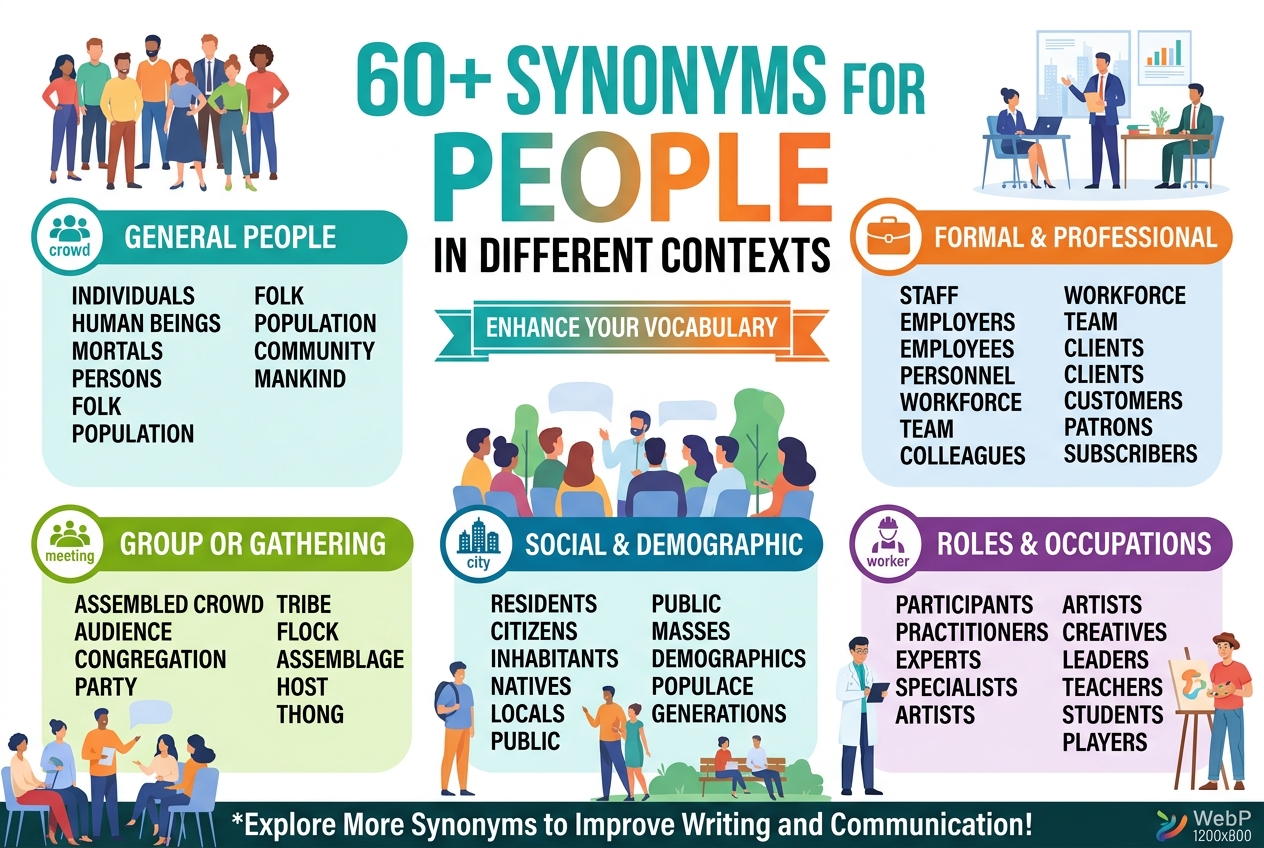
This guide contains over 60 synonyms for people, organised into different categories to help select the most appropriate word for your needs. Within each category, we’ve also included a brief note on the tone and style, as we believe choosing the right synonym is less about having a large vocabulary and more about using the correct word for the context. The same word can sound out of place in a legal document that it would be perfectly suited to in a personal email, and vice versa.
Quick Answer: The Most Useful Alternatives
If you only need a fast swap, these cover most situations:
- Individuals:neutral and slightly formal
- Folks:warm and casual
- Humans:emphasizes humanity, often in contrast to machines or animals.
- The public:people in general, usually in news or policy writing
- Community:people connected by place or shared interest
- Participants, customers, users, residents:use these when you know the specific role
The rest of this article explains how to choose between them.
Why “People” Is Not Always the Best Word
The word “people” is a decent word to use as a default, but it has some problems.
- It’s vague; it doesn’t specify anything about the people or what they’re doing. A more specific noun would do a better job of telling the reader exactly what you need.
- It’s repetitive; because it’s such a commonly used word, your writing will run the risk of becoming monotonous if you use it too often in the same paragraph.
- It’s a plural with a singular love interest.Person, the singular of people, is a word that most writers cringe at using, and as such they’ll look for other words to substitute for it.
Another word for people is peoples. No, really, peoples is actually a word. Peoples refers not to a group of people, but rather to multiple ethnic groups or nations. “The indigenous peoples of the region”, for example, would refer to multiple tribes or countries in one area. Peoples is not to be used as a synonym for people, and should only be used in contexts referring to multiple ethnicities or countries.
General Synonyms for People
These are interchangeable in most cases.
- Individuals: Plural of ‘individual,’ stresses the separation between things. ‘Several individuals have complaints.’
- Persons: More formal, and found mostly in legal or official documents. ‘Persons under 18 must be accompanied.’
- Humans: Focuses on the commonality of mankind, and is especially useful in contrast with technology or animals. ‘The system’s designed to interface with humans.’
- Human beings: A more emphatic way of saying ‘humans,’ found mostly in ethical discussions.
- Folks: An informal term, with a friendly sound. ‘Good folks live on this street.’
- Folk: More old-fashioned than folks, and with a slightly rustic feel. Common in expressions like ‘country folk.’
- Everyone/everybody: For referring to all members of a group. ‘Everybody has an opinion about this.’
- Others: For contrasting one group against another, or yourself against others. ‘Others disagree.’
- Souls: Informal, and with a slightly archaic or poetic sound. ‘Fifty souls is living in that village.’
- Beings: Uncommon in most everyday writing, but crops up occasionally in science-fiction and philosophical discussions.
A quick note of advice: ‘Individuals’ should be your default for any situation where you think you might need it, but it’s often inappropriate in informal writing. ‘Individuals’ is not a word casually used among friends, except as an insult.
Formal and Professional Synonyms
When you are writing reports, communicating, or writing official letters, you will normally want a word that defines a role.
- Personnel: Employees or staff, often of an organisational or military nature
- Staff: Employees of an organisation
- Employees: People on a payroll
- Workforce: Mainly used in economic or human resource writing, this word refers to the overall group of workers
- Colleagues: People working together or people that are employed alongside each other
- Team members: People working towards a common goal
- Stakeholders: Any person, organisation, or group that has an interest in a certain project or organisation.
- Representatives: People who represent a certain company, organisation, or group
- Members: An umbrella term referring to people who are an official part of an organisation or club
- Attendees: People who attend a meeting or event
- Delegates: People who are sent to represent someone else
- Parties: Used mainly in legal writing, this word refers to groups or people that share interests or that are at odds with one another
One thing to note is that the word stakeholders is often used as an umbrella term and can be seen as a buzzword in business writing; if possible, it is better to specify which group of people you are referring to rather than using stakeholders. Examples of stakeholders are investors, residents, suppliers, etc…
Casual and Conversational Synonyms
These terms are used in blog posts, dialogues, social media, and everyday communication.
- Folks – refers to people and is used in friendly addresses.
- Guys – a slang term used by many people during conversations. Some people prefer it for mixed groups of people, but it may appear offensive to some, so it should be used carefully in different contexts.
- Crowd – a large group of people
- Bunch – an informal term that refers to a group of people. Example: “A bunch of us went hiking”
- Gang – usually refers to friends, but can have other meanings, so it should be used carefully.
- Crew – a group of people who work together or spend time together
- Lot – an informal and possibly rude way of saying “a group of people.” Example: “That lot arrived late.”
- Everyone – the simplest and most informal term
- Peers – people who are considered to be in the same social group
- Pals and mates– terms used for friends; mates is a more British/Australian equivalent of guys.
Synonyms for Groups of People
Sometimes ‘people’ actually refers to a collective. These terms tend to be more apt when you’re describing aggregates.
- Community: The collective of people that share a locale, hobby, or identity
- Public: The general body of people, usually contrasted against a particular institution
- Population: A given area’s total body of people
- Society: The civic body of people that share institutions
- Citizens/citizenry: The body of people that share citizenship in a country
- Residents: The body of people that reside in a particular region
- Inhabitants: A slightly more formal synonym for residents
- Locals: The body of residents as contrasted against other residents that have temporarily visited the region
- Populace: A formal synonym for the population
- Townspeople: Similar to locals, but usually referring to a town instead of a city or village
- Humanity/humankind: The total body of people, as opposed to other lifeforms
- Audience: A gathering of people to watch an event of some sort
- Congregation: An audience, specifically at a church or watching another religious institution
- Electorate: The body of people eligible to vote
The term ‘mankind’ is now usually replaced with ‘humankind’ in modern style guides, as it’s considered a slightly more inclusive term. It isn’t an absolute rule, and you should check the style guide of your publication or work to see if it’s preferred in its context.
Synonyms for People in Business and Marketing
When it comes to the people who buy your products, there is one word that should never be used, and that is users.
So here are the words you should always use when talking about the people on the other end of your business
- Customers – people who purchase your product
- Clients – people who buy from you
- Users – someone who uses a particular product
- Consumers – the person who buys a product or service and is more general.
- Patrons – people who buy at your shop or restaurant regularly.
- Shoppers – people who go shopping at stores or online.
- Visitors – people who come into your business.
- Subscribers – people who have subscribed to your website, newsletter, or service.
- Followers – people who follow your account on social media.
- Leads/prospects– people who could potentially buy from you.
Do not make the mistake of using the word users when writing copy that is supposed to sound friendly because it can make you sound like an engineer. Instead, say readers, members, or customers.
Synonyms for People in Academic and Research Writing
Research writing often demands precision in language, and the word you would select may signify your attitude toward the people you are investigating.
- Participants: The most preferred term for people who participate in a research study for many years.
- Respondents: People who reply to a questionnaire.
- Subjects: An outdated word in research studies. The preferred word today for human research is a participant, so it is wise to double-check your institutional style guide to ensure that subjects are not supposed to be changed to participants for your field of study.
- Informants: People who can offer information about a particular group, most common for anthropologists and linguists.
- Cohort: Demographic group of people who share common traits.
- Sample: A set of research subjects selected from the population.
- Demographic: A breakdown of the population according to a certain category.
- Population: A collective of people or objects, animals, or phenomena that researchers aim to study.
For any formal piece, it is advisable to go over the preferred language in your style guide because there are various terms and conventions that have changed over time and may vary from field to field.
Literary and Poetic Synonyms
Fiction and creative writing allow more color.
- Mortals:Emphasizes human limits and the passing of time
- Souls:Adds emotional weight
- Kin / kindred:People connected by family or close bond
- Denizens:People who inhabit a particular place, often with a slightly dramatic flavor
- Folk:Gives a storytelling or traditional tone
- Humankind:Has a sweeping, reflective feel
- Passersby:People who happen to walk past
Use these sparingly. A single “mortals” can set a tone, but three in a paragraph feels theatrical.
Another Word for Person (Singular Synonyms)
If you are looking for a synonym for person, here are the singular options.
- Individual: Neutral and common
- Human/human being: Emphasizes humanity
- Soul: Informal or poetic
- Character: For someone with a distinct personality, or in fiction
- Figure: For someone prominent or distant
- Adult/child: For age-specific contexts
- Citizen/resident: For legal or locational specificity
- Someone/somebody: When the person is unnamed
- Party: In legal contexts only
- Being: For philosophical or fictional contexts
What About “Those” Synonym Searches?
Some readers search for a “those” synonym when they want to avoid repeating the word in sentences like “those who attended.” “Those” is a pronoun, not a noun, so the best replacements depend on what it refers to.
- “Those who voted” becomes votersor anyone who voted.
- “Those in attendance” becomes attendeesor the audience.
- “Those people” becomes these individuals, such people, or they
- “Those of us” becomes some of usor we
- “Those affected” becomes affected residentsor the people affected.
Often the cleanest fix is to name the group directly. “Those who work here” can simply become “employees.”
Quick Reference Table
| Situation | Best choices | Avoid |
| Formal report | individuals, personnel, stakeholders | guys, bunch |
| Customer-facing copy | customers, members, readers | subjects, units |
| Research paper | participants, respondents | folks |
| Casual blog post | folks, everyone, crowd | persons |
| Fiction | souls, mortals, folk | stakeholders |
| News and policy | the public, residents, citizens | gang, lot |
Common Mistakes to Avoid
- Avoiding common gender terms like “persons” in a casual blog post sounds unprofessional,
- treating different synonyms as the same, and overusing labels that make people sound like a characteristic.
- Using “persons” in a casual conversation makes one sound like they are writing an official government document.
- While “citizens” and “residents” may be used interchangeably, one cannot assume all residents are citizens, or vice versa. It is also important to avoid using “elderly”, “poor”, etc. as a blanket term for people, as most style guides now use “older adults” and “persons experiencing poverty” respectively. It is best to go off of what the target audience is most used to seeing, or what the people being discussed would like to be referred to.
- It can be easy to overcorrect.
- While it is good to switch up synonyms to avoid sounding repetitive, it can make the text sound unnatural if there isn’t a word that fits as well. “People” should be used when describing more than one person, but it is a good idea to switch it up if one is looking to put more thought into the writing. However, there are some cases where “people” is the best option.
- Some synonyms are better than others.
- Putting an alternate word every chance you get can make the text difficult to read, so it is good to repeat the same synonym. It sounds better than using different ones that make the text sound forced.
Key Takeaways
- Specific words are better than general words; use “students” instead of “people.”
- In a more formal tone or context, use “individuals” or “participants” for “people.” Use “individual,” “human,” or “someone” instead of “person” if another word for person is needed. Use “those” to refer to a particular group of people instead of “those people.”
- Always remember to use respectful language, and refer to your style guide for your specific field.
Frequently Asked Questions(FAQs)
What is another word for people in a formal context?
“Individuals”, “persons”, “personnel”, and “stakeholders” are all viable options, with selection hinging on nuances of the word’s context within the text. “Personnel” is best for staff, and “persons” is used in legal or regulatory contexts.
What is a more casual way to say people?
“Folks”, “everyone”, and “crowd” are all casual terms for people. “Guys” is a ubiquitous casual term for people, though some audiences may find it unduly familiar.
Is “peoples” correct?
Yes, but it means something else. “Peoples” is the correct plural of “people” in the sense of “peoples of the world” or “different ethnic groups”.
Is “humans” a good synonym for people?
“Humans” is a decent synonym for people in a general sense, but it has a specific meaning in the context of technology or animal husbandry that may give your writing an unintended flavor. It might sound clinical or unnecessarily jargon-heavy in everyday use cases.
What is the best synonym for people in an essay?
It depends on the context, but in most cases, you’ll want to use the most specific synonym possible that still fits the evidence. “Participants”, “citizens”, “residents”, or “workers” will usually be much better options than a generic synonym.