Synonyms for Shows: 55+ Words to Use Instead of “Shows”
“Shows” is one of the most versatile words in the English language. You’ll find it in scientific research, product descriptions, resumés, academic essays, and even casual instant messaging. Each time, it has a subtly different meaning. This versatility is also the word’s curse: A text that uses five different definitions of the same word sounds bland and imprecise.
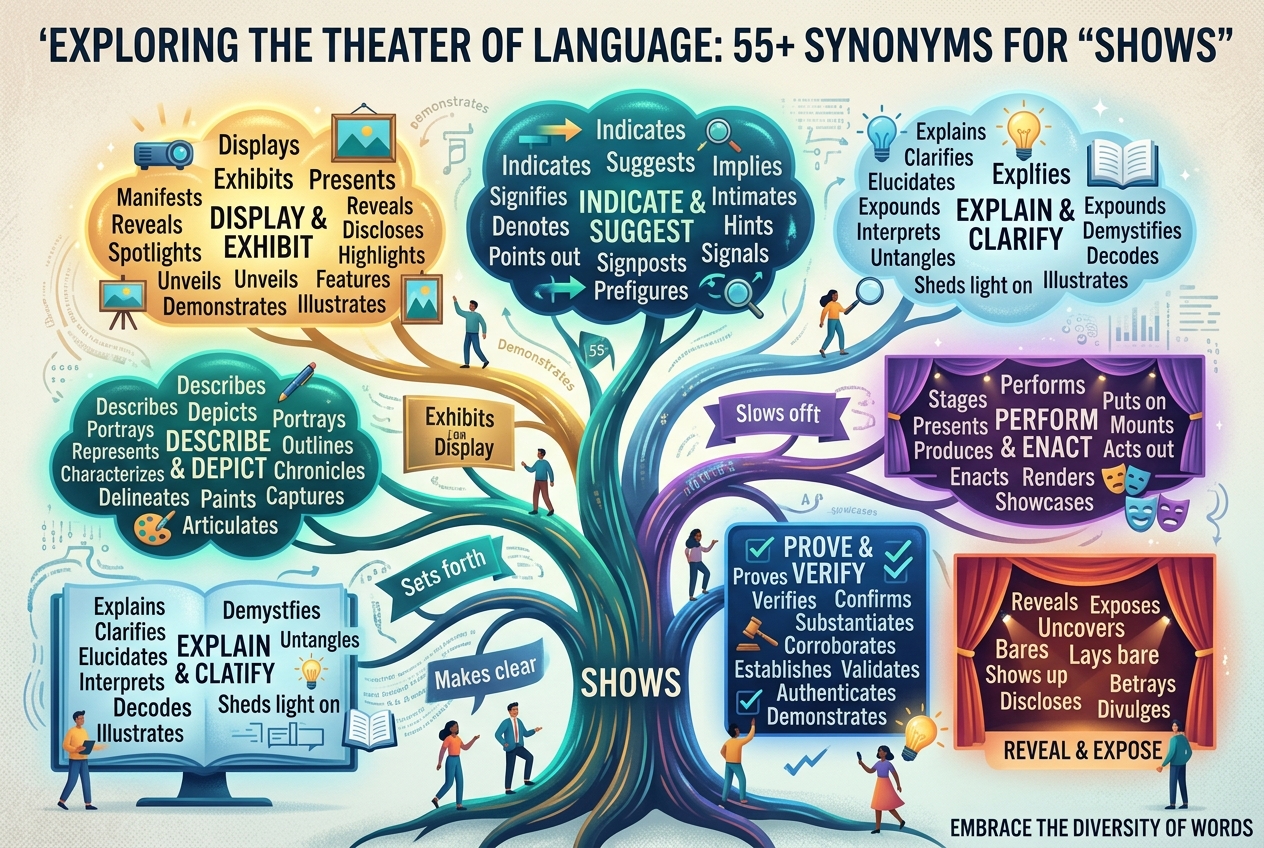
This thesaurus offers more than 55 synonyms for shows. But rather than a single list, you’ll find several different groupings of the word’s various meanings. This happens because the best synonym for your writing will often depend on “shows” specific context within a sentence. You’ll also find plenty of helpful notes and examples, as well as guidance concerning the word’s tone and register, common errors, and how to choose the right synonym for your writing–fast.
Show Meaning: Why One Word Needs So Many Replacements
Before choosing a synonym, it is essential to understand which meaning of the word show is intended. There are several uses of the word show, most of which are captured below:
- Make visible: the map shows the river.
- Prove: the results show that the method works.
- Explain: she showed him how to log on.
- Display or express: his face showed his relief
- (Noun) a programme or entertainment: we went to see a great show last night
- Appear: he did not show up (informal)
A particular synonym may work well for one or more meanings of the word, but not for all. For instance, ‘proves’ would not be a good synonym for the first sense of shows in the sentence ‘the map shows the river’. Remember this when looking at the following sets of synonyms.
Quick Answer: The Best Another Word for Shows
If you need a quick substitute, these cover most of the situations:
- Demonstrates: works in almost any formal context
- Indicates: best in data, signs, and evidence that leads somewhere
- Reveals: best when some things were kept secret or invisible
- Illustrates: best in examples, diagrams, and explanations
- Displays: best in anything presented physically or visually
For the full story, keep reading.
Synonyms for Shows When You Mean “Proves” or “Provides Evidence”
This group of words is usually used in academic writing, mostly in essays and research papers. Notice how varied the words are in terms of their strength. It’s easy to make a mistake and choose the word that is too strong.
- Demonstrates: “The pilot program demonstrates that shorter meetings can improve attendance.”
- Proves: “The receipt proves the purchase was made in March.”
- Confirms: “The second test confirms the first result.”
- Establishes: “The witness statements establish a clear timeline.”
- Verifies: “The audit verifies that the figures are accurate.”
- Validates: “Customer feedback validates the new design.”
- Substantiates: “The photographs substantiate her claim.”
- Corroborates: “A second source corroborates the report.”
- Supports: “The evidence supports the idea that sleep affects memory.”
- Is consistent with: “These numbers are consistent with our earlier estimate.”
- Bears out: “Later events bear out his prediction.”
Strength note: Choose “proves” and “establishes” if you are to use strong words. “Supports” and “is consistent with” are weaker. If you are low on evidence, go with the latter. If you wrote that your survey proves that people prefer X when it was taken among 40 people, the audience will be quick to notice that it’s not exactly factual.
This Shows Synonym Options for Data, Trends, and Signals
Many searches for a “this shows synonym” are prompted by writers who are looking for an alternative to a construction such as “This shows that sales are rising,” but in this instance the word is being used not to describe a proven law but a suggested pattern, and for this purpose the following verbs might be considered:
- Indicates: “The chart indicates a steady rise in sales.”
- Suggests: “The pattern suggests customers prefer shorter forms.”
- Signals: “The drop in sign-ups signals a problem with onboarding.”
- Points: “Everything points to a supply issue.”
- Reflects: “The score reflects months of practice.”
- Denotes: “A red flag denotes an urgent task.”
- Signifies: “The badge signifies completion of the course.”
- Implies: “The delay implies something went wrong.”
- Hints at: “The early results hint at a larger trend.”
- Tends to show: “The data tends to show a link between the two.”
- Is evidence of: “The turnout is evidence of strong interest.”
“This suggests” or “This indicates” or “This points to” may be considered as alternatives to “This shows” and are perhaps more measured and honest since a single chart seldom proves anything.
Another Word for Showing: Reveal, Uncover, and Expose
Use this group if the information was hidden, unknown, or unexpected. If nothing was hidden, ‘reveals’ can sound dramatic or even slightly mysterious.
- Reveals: ‘The audit reveals several duplicate payments’
- Uncovers: ‘The survey uncovers a gap between what users say and what they do’
- Exposes: ‘The leak exposes weaknesses in the process’
- Discloses: ‘The report discloses previously unpublished figures’
- Unveils: ‘The company unveils its new logo on Monday’
- Brings to light: ‘The review brought to light a training gap’
- Lays bare: ‘The interview lays bare his doubts’
- Lets on: ‘She never let on that she was nervous’
Watch out for tone: ‘Exposes’ often has a negative or accusing tone. ‘Unveils’ suggests something planned to be put forward. ‘Discloses’ is more neutral and commonly used in financial contexts.
Synonyms for Shows That Mean “Illustrates” or “Explains”
These fit teaching, instructions, and analysis, in which the purpose is to help someone to understand
Illustrates: “This example illustrates how compound interest works.”
- Explains: “The diagram explains the water cycle”
- Clarifies: “The footnote clarifies the exact date range”
- Depicts: “The mural depicts local farming life”
- Portrays: “The film portrays the town as fading but proud”
- Represents: “Each dot represents one delivery”
- Exemplifies: “Her approach exemplifies good customer service.”
- Highlights: “The summary highlights three key risks”
- Underscores: “The incident underscores the need for backups”
- Emphasizes: “The guide emphasizes safety over speed”
- Outlines: “The document outlines the main steps”
- Maps out: “The chapter maps out the argument”
Practical tip: “Illustrates” works best when followed by an example. “Underscores” and ‘highlights’ work best when there is something already in place to draw attention to. Using these for something new could be a little misleading.
Synonyms for Shows When You Mean “Displays” or “Presents”
This is the most literal sense: putting something in front of people.
- Displays: “The screen displays the current time.”
- Presents: “The team presents its findings on Friday.”
- Exhibits: “The museum exhibits early printing tools.”
- Showcases: “The site showcases student projects.”
- Features: “The page features three customer stories.”
- Offers: “The app offers a view of your weekly spending.”
- Lists: “The table lists every open task.”
- Publishes: “The magazine publishes the winning entries.”
Caution on “showcases”: It is heavily used in marketing. In plain writing, “displays” or “presents” often sounds less inflated.
Showed Synonym Options for Past Tense
Because “showed” is simply the past tense, the same categories apply. Match the past form to the meaning:
| You mean | Past tense options | Example |
| Proved | demonstrated, confirmed, established | “The trial demonstrated that the method was safe.” |
| Pointed to | indicated, suggested, signaled | “Early figures indicated a slow start.” |
| Made known | revealed, disclosed, uncovered | “The review revealed a missing step.” |
| Explained | illustrated, clarified, depicted | “The teacher illustrated the idea with a story.” |
| Put on view | displayed, exhibited, presented | “The gallery exhibited her early sketches.” |
| Guided | led, guided, walked through | “He walked me through the setup.” |
A small grammar point: “shown” is the standard past participle (“The results have shown…”), while “showed” is the simple past (“The results showed…”). “Showed” is sometimes seen as a participle too, but “shown” is the safer choice in formal writing. Synonyms make this easier to sidestep, since “demonstrated” and “indicated” use the same form for both.
Synonyms for Shows When You Mean “Guides” or “Teaches”
When ‘show’ means leading someone or teaching something, the synonyms are different yet again.
- Guides: ‘A volunteer guides visitors to their seats.’
- Leads: ‘She leads new hires through the first week.’
- Walks through: ‘The video walks you through each step.’
- Teaches: ‘He teaches beginners how to read a map.’
- Instructs: ‘The manual instructs users to restart the device.’
- Directs: ‘A sign directs drivers to the parking lot.’
- Ushers: ‘The host ushers guests into the hall.’
- Takes around: ‘Our neighbor took us around the market.’
Another Word for Shows When You Mean Emotion or Character
“Her face showed surprise” is a good sentence. To make your writing more interesting, try using words like
betrays, conveys, expresses, radiates, exhibits, displays, manifests, and communicates.
Examples:
- His voice betrayed his nervousness.
- The letter conveys genuine gratitude.
- The message expresses concern.
- She radiates confidence.
- The patient exhibits mild symptoms.
- The prisoner displays “He displayed real patience.”
- Stress can manifest itself as headaches.
- The design communicates trust.
The word “betrays” is good for showing that someone accidentally gave away his or her emotions. The other words are usually used when someone purposely communicated an idea or emotion.
Shows as a Noun: Synonyms for a Performance or Program
Here ‘shows’ means entertainment or an event and ‘verbs’ no longer apply.
- Programs: “Her favorite programs air on weekday evenings.”
- Series: “We finished two series this month.”
- Productions: “The theater staged three productions this year.”
- Performances: “The evening performances sold out.”
- Broadcasts: “The live broadcasts drew steady audiences.”
- Exhibitions: “The city hosts several art exhibitions.”
- Presentations: “The conference includes daily presentations.”
- Spectacles: “The fireworks were true spectacles.”
- Acts: “The festival lined up a dozen acts.”
- Episodes: Use this only for one installment of a series, not the series itself.
“Programs” and “series” are typical for TV and radio; “productions” and “performances” for the theater. “Exhibitions” for museums/galleries; “trade shows” often don’t have any better alternatives than “expos” or “fairs”.
Informal Uses: “Show Up” and “Show Off”
Phrasal verbs are frequently responsible for a high proportion of substitution errors, so it may be helpful to you to see some common alternatives:
- show up: arrive, turn up, appear, attend, come
- show off flaunt, parade, boast, display proudly
- show around guide, take around, give a tour
- show through: be visible, be apparent
The sentence ‘He didn’t show up’ might then become, depending on the sense intended, “He didn’t turn up” or ‘He didn’t attend’, etc.
A Simple Way to Choose the Right Synonym
When you are in doubt, ask these questions in this order:
- What is “shows” really doing in the text? Proving something, pointing it out, revealing it, explaining it, displaying it, guiding the reader towards it, or naming it?
- How much evidence do you have? Is it strong enough that it demonstrates or proves something? If not, go with suggests or indicates.
- Was something hidden or disguised in the text? If so, use reveals. If not, you may need a more straightforward verb.
- Who are you writing for? Most academic and professional writing will assume a formal, restrained style using more restrained verbs. Technical writing for casual consumers will use simpler words.
- Does the sentence sound like you? Any words that feel like they sound like they should be said by someone else? Use simpler words.
Final Takeaway
There is not one word that can most effectively replace ‘shows‘ as it has several different meanings depending on context. Determine which synonym you need based on what you mean by ‘shows,’ the weight of the evidence you have, and so on. In cases of doubt, ‘indicates’ and ‘suggests’ are safer choices, while ‘demonstrates’ is better for showing evidence, and ‘shows’ is just as good as any other word in some cases.
Common Mistakes to Avoid
- Swapping without checking meaning. “Demonstrate” and “display” aren’t necessarily synonyms. A chart displays information. A study demonstrates an effect.
- Overclaiming with strong verbs. “Prove” is a very demanding word. If the evidence you’re using is limited (a single example, or a small sample size), you may want to stick to “suggests.”
- Chasing fancy words. “Substantiates” and “corroborates” are both great words. However, plain words often are a better option. A writer who writes “elucidate” when he could have written “explain” is writing badly.
- Replacing every instance. Sometimes “shows” is the best word. Replacing it with “demonstrates” every time can make your text harder to understand. Remember: variety is the goal where synonyms are concerned, and being able to use “show” is important.
- Ignoring the sentence subject. A person would never “prove” or “verify,” for instance. An amount would never “indicate.” Keep track of the subjects of the sentences you write, and what they can actually do.
- Stacking synonyms in one paragraph. If you have three synonyms in three consecutive sentences, it’s probably best to vary your sentence structure, not just your synonyms.
Frequently Asked Questions(FAQs)
What is the best synonym for shows in writing?
The most typical synonyms for shows in an academic paper are demonstrates, indicates, and suggests. Use a synonym that corresponds to how much information your evidence has.
What is a good this shows synonym for beginning a sentence?
This indicates, this suggests, this demonstrates, or this points to are some options. Furthermore, you might want to rephrase the information in the finding in a sentence, such as: As a result, customers left earlier.
Is showed’ the same word as shown?
Showed is the simple past tense of the word show. Shown is the preferred past participle of the verb, so it’s used in combination with have, has, or had.
What is a synonym for showing in a resume?
Using action words such as demonstrating, presenting, delivering, or highlighting is sometimes appropriate; these are more effective than general terms and often more important than the actual fact.
Can I use reveals in a sentence?
Yes, but only when the information was not apparent previously.