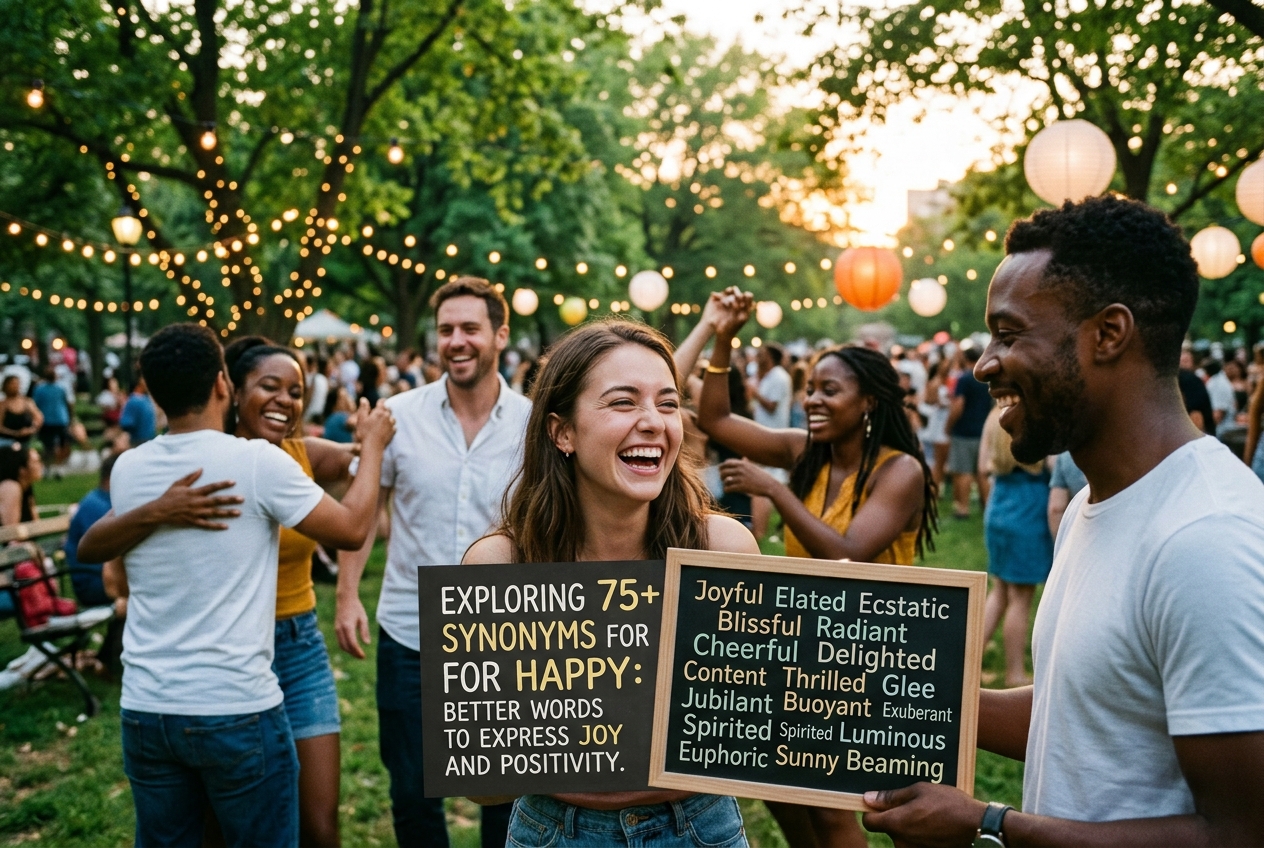
75+ Synonyms for Happy: Better Words to Express Joy and Positivity
You’ve written “happy” three times in one paragraph, and each time, it’s less happy. There’s nothing wrong with the word itself. It’s just that the context makes it sound flat; not wrong, just broad. It’s the same feeling of a completed to-do list and the thrill of good news at once, but you don’t know if you’re supposed to be reading both.
The problem is not finding the fanciest synonym possible, but rather figuring out what sort of gladness you’re attempting to convey, and picking a word appropriate for the feeling. Here is a guide to more than 75 synonyms for happy, organized by similar emotion (rather than alphabetical order), example sentences, a short guide to intensity, and some things to avoid.
Why “Happy” Needs Help
“Happy” is a very general word. It is used so often because it is good for almost any situation. It is easier to say than to write. When we say the word, the tone of voice gives us more information. On paper, there is no tone of voice.
- Let’s look at these two sentences.
- “She was happy with the results.”
- “She was relieved by the results.”
The first sentence tells us little about how she felt. The second sentence tells us that she was worried before she got the results. One word has provided us with extra information. That is the value of a good synonym for happy. It gives us more information rather than just decorating a sentence.
Quick Picks: Another Word for Happy by Situation
If you are in a hurry, start here.
| Situation | Try |
| A calm, steady good mood | content, at ease, serene |
| Friendly, upbeat personality | cheerful, sunny, genial |
| Great news | delighted, thrilled, elated |
| Overwhelming joy | overjoyed, ecstatic, euphoric |
| Good news after worry | relieved, grateful |
| A personal win | proud, triumphant |
| Casual speech or texting | over the moon, stoked, pumped |
| Formal writing | pleased, gratified, fulfilled |
Synonyms for Happy, Grouped by Feeling
Calm and Quiet Contentment
This is the gentle end of happiness. Nothing dramatic is happening, and that is the point.
- Content: settled and satisfied with what you have
- Satisfied: your needs or expectations have been met.
- At ease: free from worry or tension
- Peaceful: undisturbed and calm
- Serene: deeply calm, almost still
- Comfortable: physically or emotionally settled
- Relaxed: loose and unhurried
- Fulfilled: happy because something meaningful is complete
- Gratified: pleased that a wish or effort paid off
- Untroubled: free from concern
Example: After the move, he felt content, not thrilled, just quietly glad to be home.
Warm, Everyday Cheerfulness
These words describe a pleasant, friendly kind of happy that shows up in how someone treats other people.
- Cheerful: visibly and consistently in good spirits
- Pleasant: agreeable and easy to be around
- Sunny: bright and optimistic in manner
- Upbeat: positive and forward-looking
- Bright: lively and alert in mood
- Jolly: hearty and good-natured
- Merry: lighthearted and festive
- Genial: warm and friendly
- Good-humored: ready to laugh, hard to offend
- Chipper: brisk and energetic in a good mood
Example: The barista was chipper at six in the morning, which felt almost suspicious.
Big, Full-Hearted Joy
When the feeling is strong, “happy” is too small. These words carry weight.
- Joyful: full of joy, often lasting rather than brief.
- Delighted: strongly pleased, usually by something specific
- Thrilled: excited and very pleased
- Elated: lifted by success or good news
- Overjoyed: more than glad, close to overwhelmed
- Ecstatic: intensely, almost wildly happy
- Jubilant: openly celebrating a victory or good outcome
- Euphoric: a high, floating happiness
- Exultant: triumphant joy, often after struggle
- Blissful: perfectly, deeply happy
Example: The whole crew was jubilant when the last shot was wrapped.
Excited and Energetic
Some happiness has speed in it. These words fit anticipation and momentum.
- Exhilarated: energized by something intense or new
- Buoyant: light, hopeful, and resilient
- Giddy: happily dizzy, a bit silly
- Lively: full of energy
- Spirited: enthusiastic and animated
- Stoked: informal, very eager and pleased
- Pumped: informal, energized and ready
Example: She came off the zip line exhilarated and slightly speechless.
Relief, Luck, and Gratitude
Here happiness is tied to something that went well or turned out better than expected.
- Glad: simply pleased about something
- Pleased: mildly to moderately happy, often formal
- Relieved: happy because a worry has lifted.
- Grateful: happy and thankful toward someone or something
- Thankful: close to grateful, a little more general
- Fortunate: happy about good luck
Example: I was more relieved than happy when the test came back clear.
Pride and Achievement
Some happiness is really pride in disguise.
- Proud: pleased with your own or someone else’s accomplishment
- Triumphant: happy about winning or overcoming
- Chuffed: British informal, pleased and a bit proud
- Radiant: visibly glowing with happiness
Example: He looked radiant on graduation day, though he swore it was just the sun.
Informal and Idiomatic Ways to Say Happy
Idioms add personality, which makes them good for dialogue, social posts, and casual writing. Use them sparingly in professional settings.
- Over the moon: extremely pleased
- On cloud nine: floating with happiness
- Walking on air: light and elated.
- Tickled pink: amused and delighted.
- On top of the world: at a personal high point
- In high spirits: cheerful and lively
- Beaming: smiling broadly, visibly happy
- Grinning from ear to ear: unmistakably delighted.
Example: When the offer letter arrived, she was walking on air for a week.
Another Word for Happiness (Noun Synonyms)
Searching for a happiness synonym usually means you need a noun, not an adjective. Here are 22, again sorted loosely by intensity.
Quiet and steady
- Contentment
- Serenity
- Wellbeing
- Satisfaction
- Fulfillment
- Gladness
Warm and social
- Cheer
- Cheerfulness
- Merriment
- Gaiety
- Joviality
- Pleasure
Bright and intense
- Joy
- Delight
- Glee
- Exuberance
- Elation
- Jubilation
- Euphoria
- Rapture
- Bliss
Formal or literary
- Felicity
Example sentences:
- “Her contentment showed in small things: unhurried mornings, a clean kitchen.” (steady)
- “There was real glee in his voice when he opened the box.” (playful)
- “The jubilation in the stadium lasted well past midnight.” (collective, intense)
- “The novel treats felicity as something earned, not given.” (formal, literary)
A useful difference: joy and delight are usually feelings associated with a moment, while contentment and wellbeing are states that last longer. If your sentence refers to an extended period, it probably should use the second group of words.
A Simple Intensity Guide
Sometimes you know the strength of the feeling but not the word. This ladder helps.
| Level | Words |
| Mild | glad, pleased, content, comfortable |
| Moderate | cheerful, delighted, upbeat, grateful |
| Strong | thrilled, elated, joyful, exhilarated |
| Extreme | overjoyed, ecstatic, euphoric, blissful |
Two notes. First, intensity is not the only variable. “Serene” is strong in depth but low in energy. Second, these are general tendencies, and readers may rank a word a notch higher or lower depending on region and context.
Match the Word to the Setting
- _emails and business writing:_ pleased, glad, delighted, grateful. I’m delighted to join the team sounds good; I’m over the moon may sound too informal for a formal environment.
- _fiction:_ go for precise and uncommon synonyms and let actions speak for themselves. She was elated is a decent choice, but she laughed, then covered her mouth, then laughed again is a better choice.
- _greeting cards or messages:_ keep it simple and go for words that convey the intended emotion. Joyful, delighted, cheerful, thrilled.
- _academic or formal writing:_ satisfied, content, fulfilled, well-being. These are the words that will help you achieve a balanced and non-emotional tone that is perfect for scholarly, clinical, or formal writing.
- _social captions and texts:_ use idioms and uncommon synonyms. Stoked, pumped, over the moon.
Common Mistakes to Avoid
- Incorporating the most prominent word possible. Using ‘ecstatic’ to describe getting an extra cup of coffee sounds condescending. The size of the word should be proportional to the scale of the event that is taking place.
- Using a word that is not befitting of the intended context. Using ‘content’ to describe excitement would confuse readers because it is a word used to show calm satisfaction, but not excitement. Telling a friend that you are content with the gifts they got you for your birthday would not be a positive response.
- Not taking into account other dialects. ‘Chuffed’ is a word more widely recognised in Britain, so using it elsewhere could bewilder readers. ‘Stoked’ and ‘pumped’ are both slang and should be avoided, especially in a professional setting.
- Assuming that all similar words have the same meaning. ‘Glad’ and ‘relieved’ are interchangeable in responses to positive news, but the contexts in which the news is received are important. ‘Proud’ and ‘happy’ can’t always be switched for one another, especially with regard to the accomplishments of others.
- Using an excessive amount of synonyms. ‘She was joyful, delighted, thrilled, and elated’ is an unnecessary use of multiple synonyms. Words like ‘delighted’ and ‘elated’ are stronger than ‘glad’, so stating all three takes away from the impact of each word.
- Using outdated or unnecessarily complex words in casual conversation. ‘Felicity’ and ‘rapture’ are beautiful words, but not to be used lightly or in casual conversation, as they can sound pretentious when misused.
- Using ‘blessed’ carelessly or in an inapplicable context. ‘Blessed’ has a very religious undertone to it, and can be associated with spirituality by many people. It is best to save it for more serious occasions, or when writing in a devotional capacity.
Before and After: Small Rewrites That Work
Here are a few ways a more precise word changes the sentence.
- Before: “I’m happy you called.”
- After: “I’m relieved you called.” (adds worry)
- After: “I’m glad you called.” (simple, warm)
- Before: “The team was happy after the win.”
- After: “The team was jubilant after the win.” (public, celebratory)
- Before: “He’s a happy person.”
- After: “He’s an even-tempered, cheerful person.” (more specific)
- Before: “We had a happy weekend.”
- After: “We had a peaceful weekend.” (calm)
- After: “We had a joyful weekend.” (livelier)
Notice that none of the swaps are about sounding smarter. Each one tells the reader something the original did not.
Words That Mean Happy but Don’t Always Feel It
Some words sit near happiness without fully being it. They are useful when you want nuance.
- Relieved: the emotion is release, not joy.
- Proud: can include seriousness or emotion.
- Satisfied: may be neutral or flat.
- Amused: happiness tied to humor, not overall mood
- Hopeful: happiness aimed at the future
Use these when “happy” would be too neat.
Frequently Asked Questions(FAQs)
What is the best synonym for happy?
There is no best synonym for happy, since glad/pleased can be used for the majority of daily communication, cheerful – for the description of a character, delighted – for a specific good news, and content – for a calm, peaceful state.
What is another word for happy in formal writing?
Pleased, gratified, satisfied, fulfilled – these are the best synonyms for happy in the context of formal writing. Delighted is also pretty good for the majority of business correspondence.
What is a stronger word than happy?
Elated, overjoyed, ecstatic, euphoric, jubilant, glad, joyful. It all depends on the context, but generally speaking, you can use the first group of synonyms for something that made you feel good inside, and the second group – if you want to convey that you are in a good mood but do not want to show it too obviously.
What is another word for happiness?
Joy, contentment, delight, cheer, wellbeing, bliss. Again, it all depends on the context. The first group of synonyms is used more often when you refer to a particular object or event that caused you to feel happy. The second group is used when you want to describe your general state or a prolonged feeling of happiness.
Are “happy” and “joyful” the same?
They are pretty much the same, but joyful connotes a more intense emotion. Moreover, the word happy can also mean simply being in a good mood, while joyful cannot.