Synonyms for Like: 50+ Words to Use Instead of “Like”
Try changing the word “like” into one of its synonyms at a time, and you will soon reach a dead end. “I like pizza,” “It looks like rain,” and “She was, like, totally shocked” all use the same word, but it serves three different jobs. A word that will work in the first will seem foreign to the other two.
That is why most lists of synonyms for like feel useless. They give you a list of words with no indication of which meaning they fill. This guide organizes the synonyms based on what “like” is doing in your sentence, so you can find the word you need the first time.
What Does “Like” Mean? The Six Jobs It Does
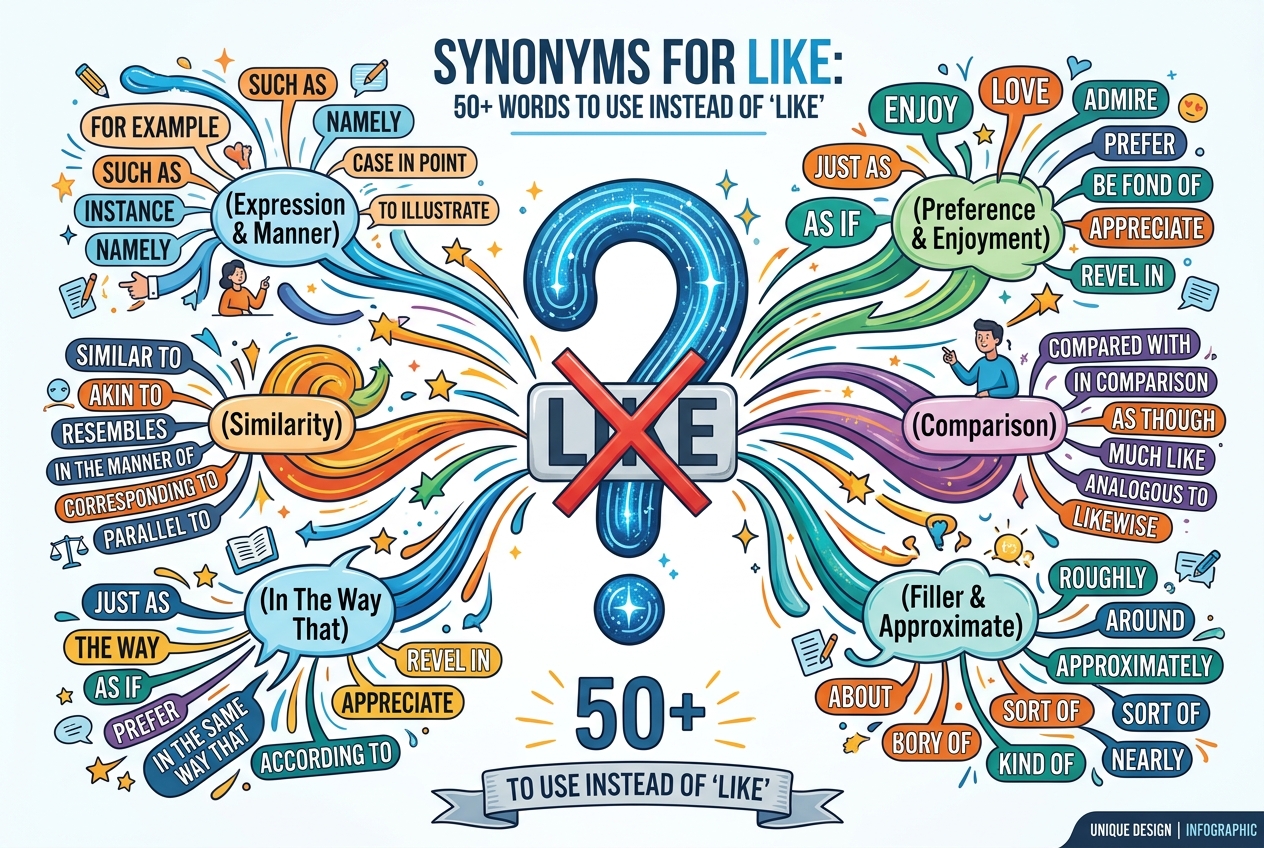
Before choosing a replacement, identify the role. Although Dictionaries list “like” as a verb, preposition, conjunction, noun, adjective, adverb, and suffix, in practice it is mainly used in the following ways in normal speech and writing:
- Verb of preference: “I like jazz.” (You have a preference for it.)
- Preposition of comparison: “She sings like her mother.” (In the same way as.)
- Introducer of examples: “Fruits like mango and papaya.”
- Conjunction: “It looks like it will rain.”
- Approximator or filler in speech: “It cost, like, fifty dollars.” (About.)
- Quotative in casual talk: “He was like, ‘no way.'”
Once you have identified which one you have, the correct synonym should be obvious, since the sections below are in this order.
Synonyms for Like When It Means “Enjoy”
This is the most common search behind “like meaning,” and it has the richest set of alternatives. The main difference between them is intensity, so a scale helps.
| Intensity | Words | Example |
| Mild | fancy, care for, be partial to, take to | “I’m partial to a quiet morning walk.” |
| Moderate | enjoy, appreciate, be fond of, be keen on, be into | “She’s keen on cycling.” |
| Strong | love, adore, relish, savor, delight in | “He relishes a good debate.” |
| Deep or lasting | cherish, treasure, admire | “They cherish their weekly dinners.” |
How to choose between them
Enjoy is the safest if not the most neutral replacement; it can be used in most registers of speech and writing and conveys the general feeling of pleasure derived from an experience: “I enjoy long train journeys.”
Love and adore are stronger and should be used if the feeling is very strong or the text will sound underwhelming without them.
Appreciate is a bit more reserved and is used to convey gratitude for something or a feeling of recognition of something’s value: “I appreciate a well-edited film.”
Fancy is more of a British word and can sometimes imply a passing or light interest: “I fancy a coffee.” It can also be used to show any degree of romantic interest depending on the context, so it might be worth googling before using it elsewhere.
Be into, be keen on, and dig are all quite informal. “Be into” is more modern slang, while “dig” is actually pretty old-fashioned.
Relish and savor are both best used in conjunction with experiences one takes time to partake in: often meals or any achievements, big or small: “She savored the quiet after the deadline.”
Prefer and favor are used to show which option one chooses or supports over another and are not used to express an all-in, enthusiastic approval: “I prefer tea to coffee.”
Admire is usually used concerning other people or their personal skills and is rarely used for objects or food: “I admire her patience.” “I admire this sandwich” would be a bit of an odd thing to say.
Liked Synonym: Past Tense Options
If you were searching for a liked synonym, chances are, you want the past-tense versions of the verbs that would sound good in a story, review, or report. Most of the verbs listed above can be converted to those forms easily:
- Enjoyed: “We enjoyed the museum more than we expected.”
- Loved: “The kids loved the ending.” The form here implies a stronger affection, so it may not always be a good fit.
- Appreciated: “Customers appreciated the quick reply.”
- Relished: “He relished the challenge.”
- Took to: “She took to the city right away.” (Began to like almost immediately, an idiom that’s worth knowing for a review, but should be used sparingly.)
- Was fond of: “My grandfather was fond of crosswords.”
- Warmed to: “I warmed to the book around chapter three.”
“Warmed to” is an underused phrase that can be a good alternative to “liked” in a case where something grows on you slowly, rather than liking it at first glance.
Another good alternative for reviews or feedback would be found it appealing/enjoyable/impressed by. These alternatives sound a bit more professional than “loved” and are probably better suited to formal writing.
Like It Synonym: Ways to Say “I Like It”
“I like it” is a short phrase that we replace with alternatives all the time in both conversation and messages. What is the best alternative will depend on the context of what you are giving feedback about.
In a reaction to an idea or a plan:
- “I’m on board with that.”
- “That works for me.”
- “I’m sold.”
- “That appeals to me.”
If it’s in reaction to something you can see or taste:
- “I’m a fan.”
- “It’s growing on me.”
- “It’s really nice.”
- “This is right up my street.” (More British)
As feedback in the workplace:
- “This is a strong draft.”
- “I think this direction works.”
- “I’m happy with this.”
One thing to note about giving feedback, particularly in the workplace, is that it’s always better to give an explanation as to why, rather than a synonym for “like it”. “I like the intro” gives no information for the writer to work with. “The intro gets to the point in two sentences” tells them exactly what they did well. If you find yourself second-guessing the word “like” when giving feedback, try changing the entire structure and giving a reason for your feedback.
Synonyms for Like as a Comparison
When “like” indicates “similar to”, the alternatives are more formal and are applicable to a wide range of degrees of similarity:
- Similar to: the plain vanilla. “Her approach is similar to mine.”
- Resembling: for physical or structural similarity. “A pastry resembling a croissant.”
- Akin to: somewhat literary, for a close relationship. “Feeling akin to homesickness.”
- Comparable to: useful when weighing two things against each other. “Comparable to a mid-range laptop.”
- Reminiscent of: when something reminds you of something else. “A melody reminiscent of an old lullaby.”
- Analogous to: technical or academic, for analogous structures. “The heart is analogous to a pump.”
- Along the lines of: looser, more conversational. “Something along the lines of a small workshop.”
- In the manner of: for style. “Written in the manner of a travel diary.”
A common mistake is to overreach; “analogous to” in a casual blog post will sound stiff, and “akin to” applied in excess will make writing sound precious. Use the fanciful ones sparingly, and save the plain vanilla for when you need it.
Synonym for Just Like
“Just as” or “just like” introduce a comparison to be made by the writer in his/her statement, and as such the writer should look for a replacement that has a similar or stronger degree of exactness.
Exact match:
- Exactly like: “It tastes exactly like my mother’s.”
- Identical to: “The two designs are identical to each other.”
- The same as: “Her answer was the same as his.”
- No different from: “In fact, it is no different from the last version.”
Strong, but not literal:
- Much like: “Much like a garden, a habit also requires some tending.”
- In the same way as: “He reacts in the same way as his brother.”
- Just as: “Just as the rules changed, the strategy changed.”
- The very image of: “She’s the very image of her grandmother.”
Echoing or mirroring:
- Mirroring: “The layout, mirroring the old site, would be instantly recognizable.”
- Echoing: “The ending echoes the opening scene.”
Note that “just as” requires a full clause to follow it and therefore “just as the rules changed” is correct but “just as a habit” would be wrong. “Just like” can take a noun as an object, which is why it is often easier to deploy and more common than “just as”.
Synonyms for Like When Giving Examples
Writers often use the word “like” to introduce examples, such as citrus fruits like lemons and limes. It is acceptable in many types of writing, but formal documents, academic essays, and style-conscious editors may prefer other options.
- Such as: the standard formal replacement. citrus fruits such as lemons and limes.
- For example / for instance: these introduce a full example sentence or clause.
- Including: signals that the list is not complete. Several fruits, including lemons
- Say: casual and hypothetical. Pick a number, say seven.
- e.g.: for parentheses and notes. Bring a snack (e.g., nuts or fruit).
Some usage guides treat “such as” as neater for examples and “like” as better for comparisons; however, this is a style preference and not a hard rule, and it is worth checking your publication’s style guide.
Synonyms for Like as a Conjunction
When “like” means “as if” or “in the way that,” it is common in speech and sometimes flagged in formal writing. Use these instead:
- As if/as though: “It looks as if the meeting will run late.”
- The way: “Do it the way I showed you.”
- As: “Do as I say.” (Traditional and more formal.)
“Like” in this role is widely used, but formal editors tend to change it. If you are writing for school, publication, or business, “as if” is the safer choice.
Replacing Filler “Like” in Speech and Dialogue
Spoken English uses “like” for pauses, emphasis, and rough numbers. Cutting it is a matter of clarity, not correctness.
When it means “approximately”:
- About: “It cost about fifty dollars.”
- Around: “We waited around an hour.”
- Roughly: “Roughly two hundred people came.”
- Approximately: for formal or written contexts.
- Or so: “Give it ten minutes or so.”
When it is a filler: simply delete it, or pause. Most fillers add nothing, and removing them often makes the sentence sound more confident.
When it introduces a quote or reaction: (“He was like, ‘wow.'”)
- Said/replied/responded: for reported speech.
- Reacted: “He reacted with disbelief.”
- Thought: for internal reactions. “I thought, this can’t be right.”
In fiction, keep the quotative “like” in dialogue if you are trying to capture how a character talks. Replacing it everywhere can make young or casual speakers sound unnatural.
Synonyms for “Would Like”
“Would like” is a way of saying that one wishes to do something, and there are a few ways to phrase such a request more politely. They are as follows:
Want: short, to the point, and best used between friends, or in situations where being rude is acceptable.
- Wish: “I wish to speak with a manager” and is more properly used in a formal setting.
- Prefer: “I would prefer the earlier flight”. Used when giving options.
Would appreciate: “I would appreciate a reply by Friday”. A formal way of asking someone to do something.
Note that “would like” is generally considered by far the most polite way of asking for something, as it is designed specifically to soften a request. It should not be replaced with “want”, as doing so will make your request sound much more demanding and less polite.
“Like” on Social Media and Apps
If you mean clicking a reaction button, the vocabulary is different:
- React to or heart a post.
- Favorite or star an item
- Upvote on forums
- Endorse on professional networks.
- Support or back a project or cause
Platform names for these actions change, so check the current wording in the app you are writing about before you publish instructions.
Common Mistakes When Replacing “Like”
- Substituting the first synonym that comes to mind. “Adore” in a business report or “resemble” in a text message sounds odd. It is necessary to match the level of the text to the audience.
- Neglecting grammar rules. “Enjoy” always requires an object or an -ing form. “I enjoy to swim” is wrong, but “I enjoy swimming” is correct. “Fond of” requires “of” and “keen on” requires “on”.
- Overcorrecting. Not every word “like” has to be replaced. “Like” is a perfectly fine word, so leave it alone if there is nothing wrong with the sentence.
- Overstatements. Changing all the likes to loves and adores dilutes the strength of both words and makes the reviews and recommendations less convincing.
- Neglecting the difference in meanings. “Alike”, “likely” and “likewise” are not synonyms. “Likewise” actually means “in the same way” or “also”.
Final Takeaway
There is no single synonyms for like because the word does several jobs. Identify the job first, then match intensity and tone. In many cases, the strongest edit is not a replacement word at all, but a more specific sentence.
Frequently Asked Questions(FAQs)
What is the best all-in-one synonym for like?
For the meanings enjoy and similar to, the best synonym would be enjoy, while for the meaning as a conjunction, similar to would be the best choice.
Is there anything wrong with using like to introduce examples?
Nothing at all; it is entirely correct and common usage. It is more common in casual writing than formal, so for formal pieces it is better to stick with such as, but it is not incorrect anywhere.
What is a good synonym for like in an essay?
Such as is the best synonym for like when introducing examples, while similar to or comparable to are good synonyms for when you mean something is like something else in comparison. As if is also a synonym for like when you are saying something is like something else, but only when you are stating what something is like, not introducing examples. When you mean enjoy, appreciate, and prefer, they are all good synonyms, while love is perhaps too strong a word for like in most cases.