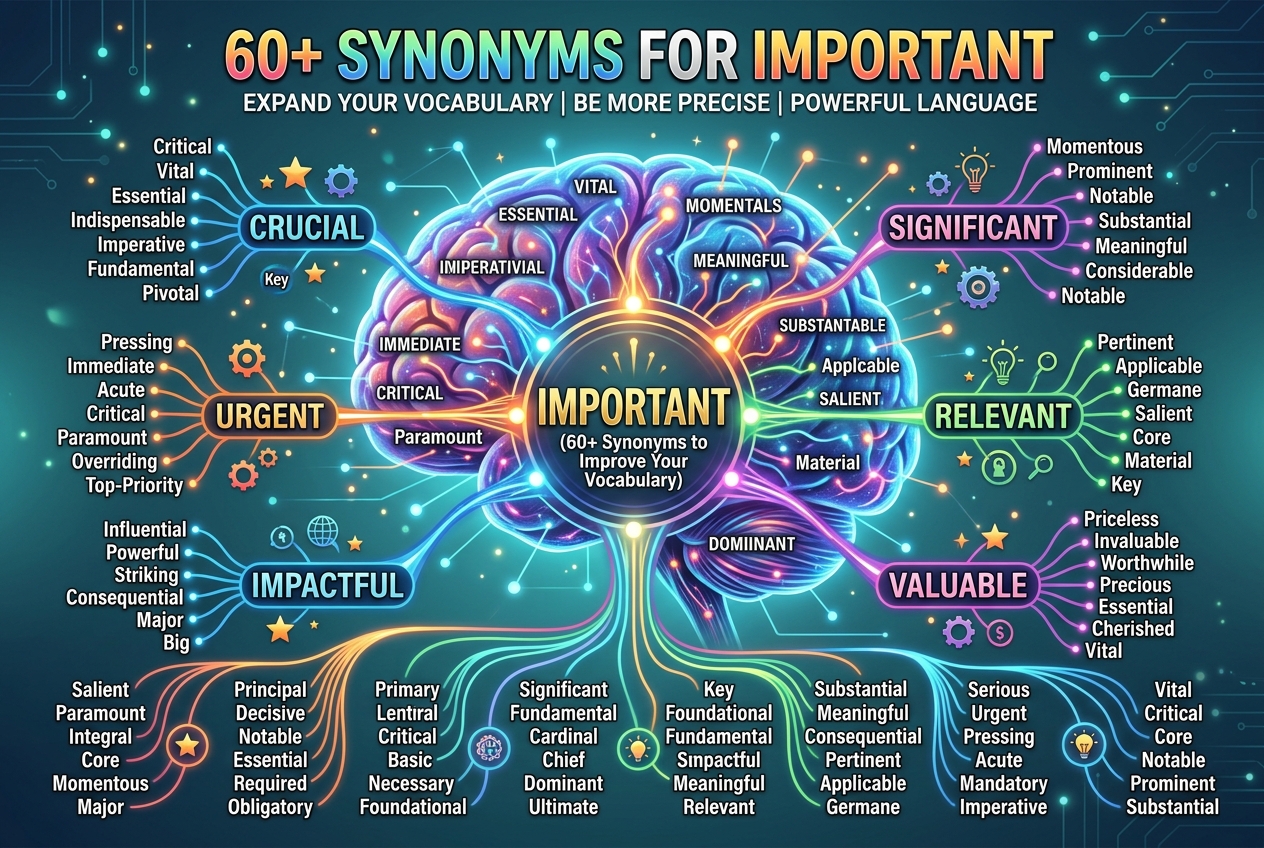
60+ Synonyms for Important to Improve Your Vocabulary
Using synonyms for an important word repeatedly in your writing can be boring, no matter if it’s an email, school project, or even when writing a novel. There’s a multitude of alternatives in the English language to spice things up and make your writing stand out while still keeping the same meaning. The trick is knowing when to use which word.
This guide will give you more than 60 synonyms for important and which scenarios they should be used in. There will also be examples for each word and how to use them properly. By the end of this guide, you will know which words to use for any scenario to sound as natural and professional as possible.
What Does “Important” Actually Mean?
Before you proceed to the alternatives in the table above, you must understand the actual importance of the word being analyzed. To begin with, an important thing refers to something that has meaning or relevance.
The word important can be used concerning:
- People: an important person
- Events: an important meeting
- Objects or documents: some important papers
- Ideas or decisions: an important argument
Due to the prevalence of the word in everyday speech, it is frequently used as a general term that is easily replaced by more specific synonyms for important. Besides, using this word in your paper is not only an indicator of skills in choosing the right words. It is worth remembering that this word is known to be overused, and therefore analyzing other alternatives can be beneficial for your writing.
Why Bother Learning Synonyms for Important?

Repetition is one of the quickest ways to make the writing look amateurish. Who among us has not gotten tired of reading a report where “important” has been used eight times in two paragraphs? Learning a variety of synonyms for important will enable you to:
- Convey the tone of writing (formal or informal)
- Vary the level of precision (urgent vs. merely valuable)
- Liven up your writing, i.e., avoid repetition in essays, articles, reports.
- Enhance your word power for exams, interviews, and general social interactions.
With these benefits in mind, let’s proceed to the list of more words for important, categorized by meaning, to help you pick the one that suits your writing the best.
Synonyms for Important: Formal and Professional Contexts
These words work well in business writing, academic papers, reports, and formal correspondence.
| Synonym | Best Used When |
| Significant | Describing data, results, or trends worth noting |
| Essential | Something is required, not optional |
| Crucial | The outcome depends heavily on this factor |
| Vital | Survival or core function depends on it |
| Fundamental | It forms the basic foundation of something |
| Critical | Failure is not an option; high stakes involved |
| Paramount | It ranks above all other considerations |
| Imperative | Immediate action or attention is required |
| Consequentia | It will lead to significant downstream effects |
| Pivotal | It marks a turning point |
| Indispensable | Nothing can function properly without it |
| Substantial | It carries real weight, often in terms of scale |
| Momentous | The event or decision is historically significant |
| Weighty | The matter deserves serious consideration |
| Salient | It stands out as the most notable point |
Example sentences:
- “The report highlights several significant trends in customer behavior.”
- “Meeting the deadline is crucial to keeping the project on schedule.”
- “Board members considered the merger a pivotal moment for the company.”
Synonyms for Important: Everyday and Conversational Use
For more casual writing, blog posts, or everyday conversation, some of the above formal-sounding words may be a bit much.
Here are some more everyday equivalents:
- Big (“This is a big deal for our team.”)
- Major (“That was a major decision for her career.”)
- Key (“Trust is a key part of any relationship.”)
- Main (“The main issue is communication.”)
- Serious (“This is a serious problem we need to solve.”)
- Prime (“Location was our prime concern when buying the house.”)
- Central (“Budget is central to how we plan the event.”)
- Meaningful (“We had a meaningful conversation last night.”)
- Notable (“It was a notable improvement over last quarter.”)
- Worthwhile (“It’s worthwhile to double-check the numbers.”)
These seem to be more words that “sound right” to the ear, and would be good for a blog, social media posts, or even emails.
Synonyms for Important That Emphasize Urgency
Sometimes one needs more than an important word. The following words will convey a feeling of a task needing attention soon.
- Urgent
- Pressing
- Time-Sensitive
- Critical
- Life-or-death (for serious situations, use it sparingly)
- Non-negotiable
- Mission-critical (often used in a business environment)
One should also take note that urgent doesn’t necessarily mean synonyms for important and vice versa. That is a common error. One might say that an important task is a task one should do eventually (not necessarily today), but an urgent task needs to be addressed immediately. Another example would be that a non-urgent, non-critical task might be to plan one’s finances, whereas an urgent task might be to reply to an email.
Synonyms for Important Related to Value and Worth
These words lean toward describing something precious rather than just significant.
- Valuable
- Precious
- Prized
- Treasured
- Priceless
- Worthy
- Cherished
Example: “Her advice turned out to be one of the most valuable things I learned that year.”
Synonyms for Important Related to Influence and Status
When it comes to describing persons, functions, or any kind of important positions – these synonyms might be more relevant than just using the general term of importance.
- Influential
- Prominent
- Distinguished
- Leading
- Notable
- High-ranking
- Renowned
- Eminent
- Powerful
- Authoritative
Example: She is an influential figure in the field of renewable energy.
As you can see, the word important describes a person or thing that is important in some way, while words such as prominent or eminent describe something that is notable or recognized. So when writing about a prominent expert, you would probably use a different set of words than just important – since the term prominent already suggests a level of importance.
Less Common but Useful Synonyms for Important
If you want to enhance your vocabulary, here are some lesser-used, but still accurate synonyms:
- Germane (about the subject at hand)
- Material (in law or business, having relevance to the matter at hand)
- Focal (serving as a focus)
- Cardinal (being of the greatest importance; often used with rule or principle)
- Momentous
- Far-reaching
- Overriding
- Preeminent
- Telling
- Decisive
Not everyday words, but helpful nonetheless. Just be careful not to overuse them, for words such as cardinal or germane can seem out of place if used too often in normal conversation.
Another Word for Importance (The Noun Form)
So far, we’ve focused on “important” as an adjective. But you’ll often need another word for importance, the noun itself.
Here are solid options:
- Significance
- Relevance
- Weight
- Value
- Consequence
- Prominence
- Magnitude
- Gravity (used for serious situations, e.g., “the gravity of the decision”)
- Priority
- Necessity
Example sentences:
- “The significance of this discovery can’t be overstated.”
- “Understanding the gravity of the situation changed how the team responded.”
- “Her contribution carried real weight in the final decision.”
How to Choose the Right Synonym: A Practical Framework
With so many options, it is also good to ask yourself a few questions before choosing a word.
- What is your tone of writing? Formal writing will use words like ‘paramount’ or ‘essential,’ whereas casual writing might use ‘big’ or ‘key.’
- Are you trying to show urgency, value, or influence? Not every synonym for important can be interchanged. For example, ‘urgent’ has a sense of something that needs to be done in a certain amount of time, while ‘valuable’ shows the usefulness of something. ‘Influential’ displays a certain amount of power.
- Will a person reading it know what it is? If you are using a more casual tone to describe something, words such as ‘germane’ will not be known by most, so it is best to avoid words that are very formal-sounding or are not commonly used if you are going to use a casual or formal tone of writing. As well, words should not be too complicated; clarity should be valued over flashiness.
Common Mistakes to Avoid
- Applying “critical” to anything that isn’t of actual importance. Critical means “capable of causing a crisis” -save it for things that deserve a crisis of their own.
- Confusing importance with urgency. As discussed above, these are not the same thing, although people often treat them as if they are. There is a big difference between something you should do eventually and something that requires your immediate attention.
- Using “important” as an intensifier in otherwise dry-sounding formal writing. “Cardinal” or “germane” aren’t always appropriate substitutes for “important,” so don’t use them just because something seems boring.
- Failing to consider context when discussing individuals. “Important person” is a vague phrase that usually fails to convey your intended meaning. Instead, you should probably use a more specific descriptor depending on what you mean by “important.”
- Using the same word over and over again whenever you want to replace “important.” You can’t use “significant” as a replacement word for every instance of “important” if you want your writing to continue sounding natural and fresh.
Quick Reference: Important Synonyms by Category
| Category | Examples |
| Formal/Professional | Essential, crucial, vital, significant, paramount |
| Everyday/Casual | Big, major, key, serious, main |
| Urgency | Urgent, pressing, time-sensitive, critical |
| Value/Worth | Valuable, precious, priceless, worthy |
| Influence/Status | Influential, prominent, renowned, eminent |
| Less Common | Germane, material, cardinal, focal |
| Noun form (importance) | Significance, relevance, weight, magnitude |
Final Thoughts
Use plain words to make things clear. Not to impress anyone. If you want to write better, do not chase fancy ways to replace “important.” The goal is meaning first. It also keeps the page from feeling dull.
If you write synonyms for important more than twice in one paragraph, pause. Read the lines back. Ask what you really mean. Then pick another word that fits. You might use urgency, value, influence, or significance.
To get better overall, do not lock onto just one trick. Try this word swap habit, but also review the topic more broadly. Choice of words matters. Still, it is only one piece of what makes writing work.
For a quick academic check, use a dictionary or thesaurus. Merriam-Webster is a well-known option. It helps you spot small shifts in meaning. That matters most when you try less common synonyms in formal writing.
Frequently Asked Questions(FAQs)
What is the most formal word for important?
“Paramount” and “imperative” are the most appropriate word synonyms in terms of the word’s formal and official tone.
What is the simplest word for important?
“Big,” “key,” and “major” are some of the least difficult alternatives and synonyms for the word “important.”
Is crucial a stronger word than important?
“Crucial” is a more powerful and intense word than “important.” In most cases, it is used to describe the importance of things requiring critical consideration.
Does urgent mean the same thing as important?
The word important means something entirely different from urgent. When used, “synonyms for important” refers to something that is considered significant. On the other hand, “urgent” signifies an event or task’s immediacy.