35+ Synonyms for Things to Improve Your Vocabulary
Read back through something you wrote last week and count how many times you used the word ‘thing’ or ‘stuff ‘; most people are surprised by the number. The problem is that these words are incredibly useful, as they can act as placeholders for almost anything, which means that they are also dangerously close to being meaningless. A reader who comes across a sentence such as ‘there are a few things to consider’ has to work out for themselves what it is that you are talking about.
The solution to this lies rarely in picking a single alternative word to your overused term, but rather in finding the word that best suits what it is you are trying to say. The type of word that you are looking for depends on what it is that you are talking about – an object, a possession, a topic, a task, or a situation. That is why I have put together this list of synonyms for things organised by type so that you can find the perfect word to replace that overused term.
What Does “Things” Mean?
Things meaning: words meaning things can be considered as “things”; this word could be defined as a general term for an object, fact, idea, action, or situation that cannot or does not want to be specified. Many dictionaries, including Merriam-Webster and Oxford, have listed numerous definitions that refer to the word’s multiple senses. Think of the following examples of using the word “things” in sentences:
- Pack your things. (belongings)
- 2. Several things went wrong. (event or problem)
- I have a lot of things to do.(tasks)
- Things are getting better.(the general situation)
The word has various meanings, and despite the convenience of using one word for multiple purposes in speech, in writing these senses may confuse the reader or misinterpret the intended meaning.
What Does “Stuff” Mean?
The meanings of the word stuff are connected to the word matter. This word may refer to some substances or materials in the plural form. Mostly, it is used as a mass noun in the singular form. For example, we say ‘some stuff’ but not ‘a stuff’. You can refer to physical objects (clear your stuff off the table), activities (I have some work stuff to do), or the quality of something (he is made of tough stuff). The difference between the words things and stuff is that things may have a plural form while stuff does not. Besides, stuff sounds a bit more colloquial than things. This word has a negative connotation and implies a number of unordered and insignificant items. That is why ‘another word for stuff’ is one of the most common queries on the web. It is the word that is usually highlighted by an editor.
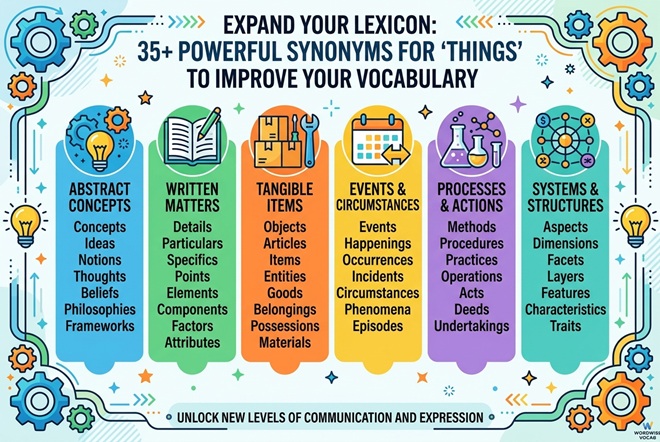
35+ Synonyms for Things, Grouped by Meaning
- Below are more than 35 alternatives, grouped according to the meaning they can stand for. For each group, an explanation is provided.
- Things That Stand for Physical Objects
- Items: neutral, functional objects, great as nouns for lists or things you buy or sell. “Please check all items before checkout.”
- Objects: a bit more formal than things for tangible objects you can see or touch. “The museum displays objects from everyday life.”
- Articles: articles are used formally, or in retail or fashion, for things you wear or tear. “Articles of clothing must be labeled.”
- Pieces: when referring to parts of a whole that have been created, or for crafty things, use pieces. “Each piece was made by hand.”
- Products: this is for items that are produced, particularly for retail. “The store carries organic products.”
- Goods: goods are items that are bought or sold, most often used in the plural form. “The shop sells household goods.”
- Devices: devices are tools or machines, often for electronics. “Make sure to turn off all devices.”
- Gadgets: gadgets are smaller devices or interesting inventions, always in an informal tone. “He loves kitchen gadgets.”
- When “Things” Means Belongings
- Belongings : the most natural substitute for “your things.” “Please keep your belongings with you.”
- Possessions : a slightly more formal and valuable connotation. “She sold most of her possessions before moving.”
- Personal effects: formal, used in hospitals, hotels, or legal contexts.
- Property: legal or official tone. “Lost property can be collected at the desk.”
- Luggage or baggage: when referring to travel. “Baggage” can also be used metaphorically, so make sure to consider context.
- Gear : casual, but very useful for the specific category of belongings related to an activity. “Bring your hiking gear.”
- When “Things” Means Equipment or Materials
- Equipment: for tools and machinery used for a particular purpose. Like “stuff,” it is uncountable: “some equipment,” not “an equipment.”
- Supplies: for consumables used for a particular purpose. “Art supplies,” “office supplies.”
- Materials: for raw materials or working elements. “Bring writing materials.”
- Tools: very similar to equipment, but more specifically for objects used to perform work. “You will need a few basic tools.”
- Kit: for a defined set of tools or supplies. “A first aid kit.”
- Apparatus: more formal and typically used in scientific or technical contexts.
- When “Things” Means Topics, Points, or Ideas
- This is the category in which substitution has the most impact on clarity.
- Matters : formal, often used in business contexts. “We need to discuss a few urgent matters.”
- Issues: implies some level of controversy or unresolved debate. “Several issues remain unresolved.”
- Topics: general word for subjects of discussion. “The meeting covered three topics.”
- Points: individual items or arguments in a list. “She made two strong points.”
- Aspects: elements of a greater whole. “Consider the financial aspects.”
- Factors: elements that have an impact on the outcome. “Several factors affect the price.”
- Elements: parts of a system or composition. “Trust is a key element of teamwork.”
- Details: specific pieces of information. “Check the details before signing.”
- Considerations: items that need to be taken into account.
- When “Things” Means Tasks or Responsibilities
- Tasks: the most neutral and general word. “I have five tasks to finish today.”
- Chores: typically used for recurring or occasional tasks, especially around the home. “Weekend chores.”
- Errands: for short trips to accomplish a task. “Running errands.”
- Duties: obligations that come with a position. “Her duties include scheduling.”
- Responsibilities: things for which one is held accountable.
- Assignments : tasks given by a superior or an authority figure, such as a teacher or manager.
- Jobs: similar to tasks, but often implying a certain degree of informality. “There are a few jobs left around the house.”
- When “Things” Means Circumstances or Situations
- Circumstances : formal word for the context or environment in which something happens. “Under the circumstances, we changed plans.”
- Conditions: the state of something. “Working conditions have improved.”
- Events: occurrences. “Recent events changed the schedule.”
- Developments: changes in a situation. “Here are the latest developments.”
- Affairs: matters, especially those concerning business or politics. “Current affairs.”
- Matters and issues can also be used in this sense.
- Casual and Informal Alternatives
- Odds and ends: small and various items. “I cleaned out odds and ends from the drawer.”
- Bits and pieces: similar to the above, but with a friendlier tone.
- Whatnot: an informal end to a list. “Books, papers, and whatnot.”
- Belongings and gear also have casual usages.
- Clutter or junk: used when referring to things that are not wanted or needed; carry a negative connotation, so use them judiciously.
Gizmo, doodad, thingamajig: whimsical terms for objects without a specific name. That is well over 35 options, and most of them are more precise than the word they are meant to replace.
Other Words for Things: Quick Comparison by Context
A table helps here because the right word depends on the setting.
| What you mean | Formal writing | Everyday speech |
| Objects | items, articles | stuff, things |
| Belongings | possessions, personal effects | stuff, gear |
| Topics | matters, issues | things, points |
| Tasks | responsibilities, duties | jobs, chores |
| Situation | circumstances, conditions | how things are |
| Small mixed items | miscellaneous items | odds and ends, bits and pieces |
Another Word for Stuff: Choosing the Right Replacement
Due to the fact that “stuff” is informal and non-countable, the best substitute depends on the type of stuff you are talking about.
- The belongings/possessions, etc you own: gear, items, equipment, etc.
- The equipment, materials, etc. used for one’s work: supplies, materials, equipment, etc.
- The goods, products, merchandise that are sold: goods, merchandise, products, etc.
- The rubbish, clutter, etc. thrown away: rubbish, clutter, etc. (US and UK English may differ; make sure to specify your audience)
- A mix of things: miscellany, odds and ends
- Substance: material, matter, substance
- Could a reader picture what you mean? If not, specify the objects you mean.
How to Replace “Things” in Real Sentences
Here’s a process that works well when editing one’s own writing: find the vague word, ask what it stands for, and then replace it with that noun. Sometimes the fix is a synonym, but sometimes it is a more specific word entirely.
- Before: “There are a lot of things to consider before buying a laptop.
- After: “There are several factors to consider before buying a laptop: battery life, weight, and price.”
- Before: “I need to get some things done today.”
- After: “I need to finish three tasks today: the report, the invoice, and the grocery run.”
- Before: “Pack your things before we leave.”
- After: “Pack your belongings before we leave.”
- Before: “Things at work have been stressful.”
- After: “Working conditions have been stressful lately.”
Note that the fixes aren’t always a matter of swapping one word for another. In particular, the improved versions often provide the reader with more information than the original. That’s really the point of getting away from “things” in the first place: it forces you to make a decision about what you really mean.
When “Things” Is Actually the Right Word
Not every use of “things” has to be changed. In fact, if you change everything, it will sound stiff and unnatural. Here are some reasons to keep “things”:
It’s often a preposition, as in how are things? That’s not often used in writing, as in ” How are the circumstances?
The speaker may want to be vague. Some things are best left unsaid. That’s even a good thing.
If a specific word would sound goofy. Things went smoothly. is better than the developments proceeded smoothly.
The situation makes it clear, like put your things by the door. It’s a good idea to use “things” when the noun isn’t important, but change it when you think the noun is important.
Common Mistakes to Avoid
- Using too pretentious a word that changes the context. Although ‘paraphernalia’ and ‘effects’ may sound more intelligent, ‘paraphernalia’ often refers to equipment needed for a particular activity, and ‘effects’ can sometimes mean results. Make sure to look up a word’s definition before deciding that it is a good replacement.
- Using a formal synonym in an informal context or vice versa. If you ask a friend to “get your effects”, he or she may look at you funny. Make sure to keep the style consistent when substituting words.
- Making uncountable nouns countable. Words such as ‘equipment’, ‘stuff’, or ‘gear’ usually do not pair well with ‘a’ and often do not have a plural form. Instead of saying ‘an equipment’, say ‘a piece of equipment’
- Using the same synonym multiple times as the original word. If there are 8 instances of the word ‘items’ in the paragraph you are substituting, you have basically done the same thing the original author did. Simply use a different word or specify the things you are referring to
- Overlooking regional variations. Some words are not commonly used in certain places. ‘Rubbish’ and ‘effects’, for example, are not often used in America. Avoid using words that are not familiar to most people.
- Accidentally using negative words. ‘Junk’, ‘clutter’, and ‘baggage’ all have negative connotations. Unless you are trying to evoke a feeling, it is better not to use these words.
Key Takeaways
- “Things” and “stuff” are lazy words. Use them only when your audience should understand what you mean by either of these terms.
- Depending on the category (objects, belongings, equipment, etc.), choose a more specific synonym.
- Make your choice based on the formality of your document and the expectations of your audience. For example, use “possessions” in a formal letter and “gear” in an informal how-to guide.
- Stick to “things” and “stuff” when the meaning of these terms is clear to your audience.
- Before using a word as a synonym for “things,” double-check its meaning in a dictionary.
Frequently Asked Questions(FAQs)
What is a synonym for things in a formal essay?
Depending on the context, you can use items, articles, matters, issues, responsibilities, and circumstances instead of things.
What is another word for stuff?
The word stuff can be replaced by belongings, possessions, gear, equipment, supplies, materials, and goods. In the singular form, stuff can also be odds and ends.
Is the word stuff rude?
The word stuff is not considered rude or offensive. However, it is generic and better to avoid in formal writing and speaking in favor of more specific terms.
Are stuff and things the same?
The two words are generally used interchangeably; however, stuff is usually uncountable and often implies objects made of different materials. Meanwhile, things can be both countable and uncountable and can also mean abstract ideas, such as in the phrase things went wrong.
How many synonyms for things should I know?
You do not have to learn all the listed words to replace the word “things.” However, it is advisable to learn five or six of the most common and useful synonyms, such as items, belongings, matters, tasks, and circumstances, among others.