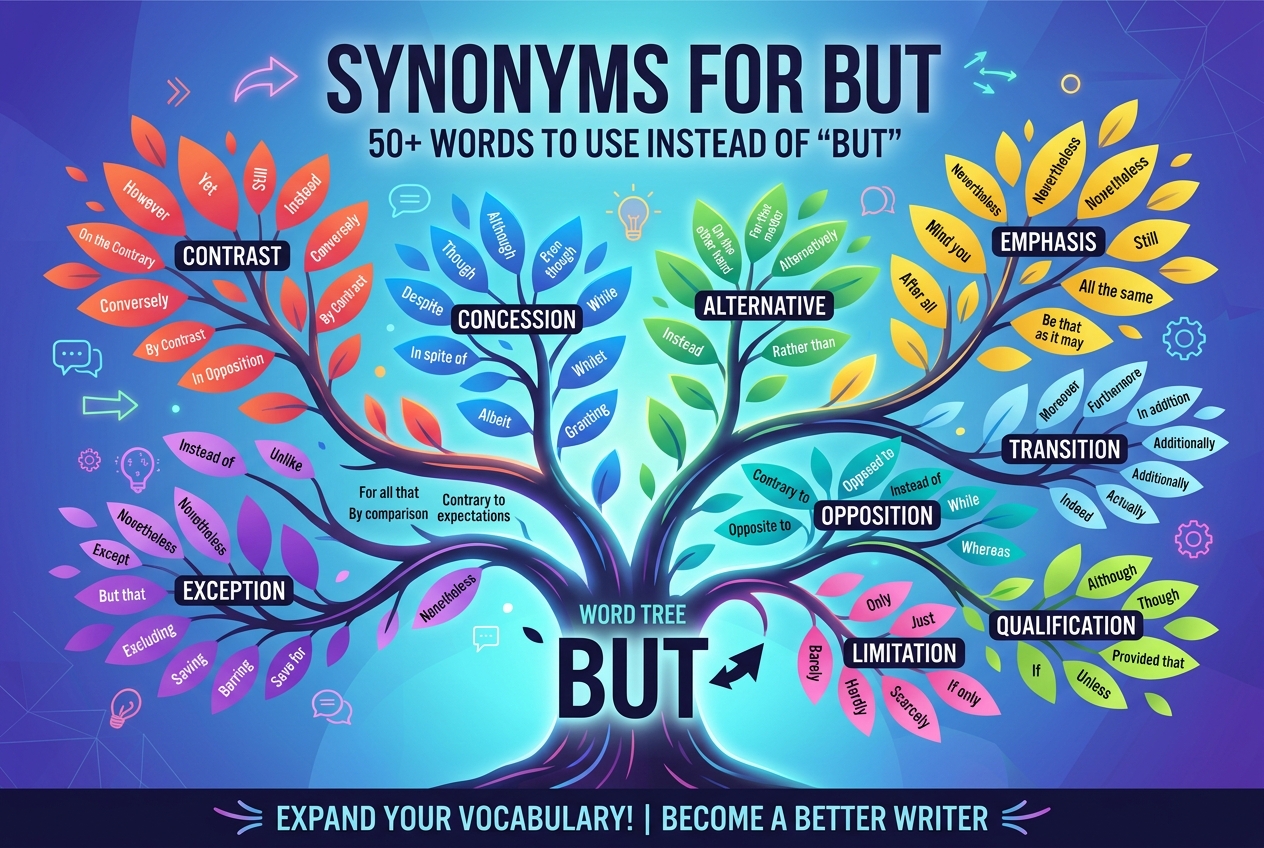
Synonyms for But: 50+ Words to Use Instead of “But”
The issue with replacing “but” lies in its lack of a single, specific meaning. The word serves several related purposes. One synonym might fit a given context perfectly while mangling another -“however” does not always work in place of “but,” for instance, any more than “except” always works in place of “yet.” This guide categorizes expressions that serve the same purpose as synonyms for but so that you can identify which conjunctions and phrases best suit your needs. In addition to the list, this guide includes rules about punctuation, a quick-reference table, and notes on common pitfalls to avoid.
What Type of Word Is “But”?
Before looking at other options, let’s look at what we are swapping out. But is typically a coordinating conjunction, linking two conflicting ideas together
- I wanted to go, but I was too tired.
- However, but can also function as
- a preposition (meaning “except”),
- an adverb (usually “only”)
- or even as a noun.
- Everyone but Sara got here on time.
- She is but a beginner (very formal and old-sounding)
- No ifs, ands, or buts
This is important since each alternative requires a different approach depending on the part of speech. The key to finding the most suitable replacement for but is knowing what job it has to do in the sentence.
The Three Main Jobs “But” Does
Almost all uses of the word “but” fall into one of the following categories:
- Contrast: Two ideas are at odds with each other. (It was cheap, but it broke in a week.)
- Exception: One thing is left out of a group of something. (Everyone but me.)
- Limit or “only”: The word is used to limit something, or specify that it is only something. (We had but one chance.)
That’s the pattern described in the rest of the article. Contrast is a much bigger category than the others, and so it is elaborated on more.
Synonyms for “But” That Show Contrast
Simple replacements for “but” with similar grammatical function usually take a comma as well.
- Yet. Sounds a bit more literary than “but”; often implies a twist.
- The trail was steep, yet the view was worth it.
- Still. Points out that the second thought is even more true.
- He lost the match; still, he shook every hand. (In more casual writing, you might want to open a new sentence: He lost the match. Still, he shook every hand.)
- And yet. More dramatic than just “yet”.
- She had never studied music, and yet she played beautifully.
Words that begin a clause: “although” and friends
The following conjunctions are subordinating conjunctions because they make one component of the sentence subordinate to the other and stress the second component.
- Although: This conjunction is neutral and is used frequently in formal and academic writing.
Although the report was short, it covered all the key points.
- Though: This word is mostly used in casual conversation and writing. It can also be placed at the end of the sentence, unlike although.
The food was fine; the service was slow, though.
- Even though: This conjunction is used to emphasize the contrast between the two clauses.
Even though he trained hard, he missed the qualifying time.
- While: It is used to indicate a balanced comparison between two things or ideas rather than contrast.
While I love cooking, I hardly ever have time for it.
- Whereas: It is used to compare two things or ideas in formal or academic writing.
Version one was loads faster than version two, whereas version one loads instantly and the other takes a few seconds to load.
- Albeit: This conjunction is also used in formal writing. It makes the sentence a little long and is used to add information that qualifies or modifies the main clause.
It was a helpful answer, albeit brief.
Transitional words that start a new sentence or follow a semicolon
These are known as conjunctive adverbs or transitional phrases. These expressions cannot join two clauses; therefore, they must be preceded by a period or semicolon.
| Conjunction/Phrase | Description/Usage | Example |
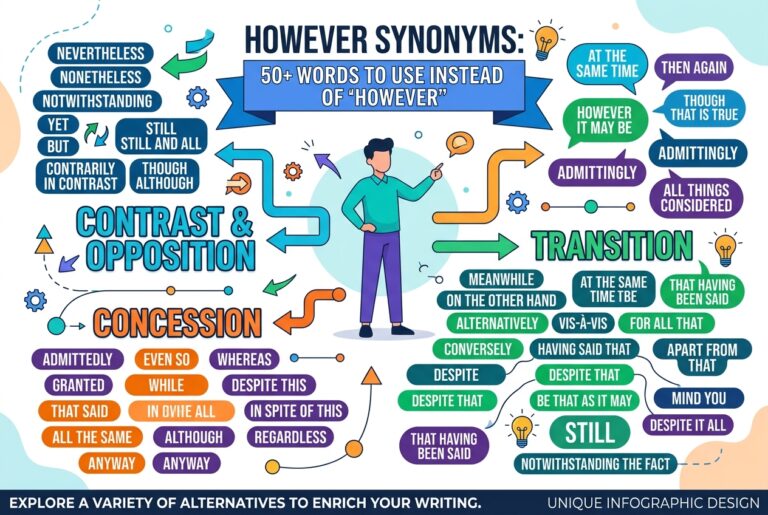
| However | Most common formal substitute. | The plan looked good. However, the budget has yet to be approved. |
| Nevertheless | A bit more formal and heavier than however. Generally speaking, used in reports, legal and academic writing. | The results were preliminary, nevertheless encouraging. |
| Nonetheless | Similar to nevertheless but less stiff to some ears. | The room was small; nonetheless, its atmosphere was welcoming. |
| Even so | Colloquial but clear. A happy medium. | The forecast looked grim. Even so, the event went on. |
| That said | Very common in modern, conversational writing and blog posts. | The software is powerful. That said, it takes time to learn. |
| Having said that | A more drawn-out version of that said. | Having said that, I adore this design; I wouldn’t pay full price for it. |
| All the same | Informal and friendly. | I know it’s highly unlikely; all the same, I want to try. |
| Then again | Used mostly in informal writing to show doubt on the part of the author. | We could take the train; then again, driving might be cheaper. |
| Be that as it may | Formal and a bit emphatic. Use rarely. | You might be right about spending; be that as it may, we still need to make a decision today. |
| Admittedly | Used to concede a point before advancing an argument. | Admittedly, the first draft was poor; the final version is brilliant. |
| Granted | Similar to admittedly but more casual. | Granted, it isn’t cheap; it is well made. |
| Conversely | Shows a contrast in comparisons. | Some people thrive on deadlines; conversely, some people are paralyzed by them. |
| In contrast / By contrast | Clear and direct comparison of two ideas or arguments. | Sales increased in the north; by contrast, the southern region’s sales remained steady. |
On the other hand. Presents the opposite of an argument, mainly used in formal and academic writing. The phrase on the one hand is generally used to introduce the first part of a comparison, but it is increasingly used on its own.
| Transition Phrase | Usage/Definition | Example |
| On the other hand | Used to contrast two points | Working from home saves commuting time; on the other hand, it can cause blurring of the lines between work and personal life. |
| On the contrary | Used to deny what is stated directly before it | The meeting wasn’t a waste of time; on the contrary, it solved three issues. |
| Instead | Used to indicate an alternative to something previously mentioned | He didn’t call; instead, he sent a brief message. |
| Rather | Similar to instead, but often used in a construction that includes than or but rather | It wasn’t a failure, rather, a valuable experiment. |
| Otherwise | Used to show what would happen if something weren’t the case, or to indicate something else true | The program crashed twice; otherwise, the program performed well. |
| At the same time | Used to show that two things are true and happen concurrently | She wanted more responsibilities at work; at the same time, she feared becoming overwhelmed. |
| Regardless | Indicates that something is true or happened despite other factors | The reviews were mixed; regardless, sales of tickets to the event were robust. |
| Anyway | Very informal, often used to present a conclusion or a separate point after a digression | Driving there would have been long; anyway, we arrived safely. |
| In spite of that / Despite that | Simple and clear | The road was icy; despite that, most made it safely. |
| Mind you | Slightly old-fashioned British expression used to make a minor concession | The hotel was noisy; mind you, it was reasonably priced. |
| Notwithstanding | Used chiefly in legal or formal contexts, can precede or follow its object | Notwithstanding the delay, the project was completed on budget. |
| Still and all | Used to present a view or attitude similar to the one expressed before, with some reservation | Still and all, it was a good year. |
Quick Reference Table
This table is worth saving. The “punctuation” column is where most errors happen.
| Word or phrase | Best used for | Punctuation pattern | Tone |
| yet | Surprising contrast | Comma before | Neutral to literary |
| although / though | Softening one idea | Comma after the first clause | Neutral |
| while / whereas | Direct comparison | Comma between clauses | Neutral to formal |
| however | Formal contrast | Period or semicolon before, comma after | Formal |
| nevertheless / nonetheless | Strong formal contrast | Same as “however” | Formal |
| that said / even so | Conversational contrast | Period before, comma after | Casual to neutral |
| except / apart from | Exception | No comma needed in most cases | Neutral |
| only / just | Limit | No comma | Neutral to casual |
How to Choose the Right Word
You do not have to memorize this entire list. A few questions will allow us to narrow it down to the word appropriate for your specific needs.
- What is the relationship between these two ideas?
If the second idea cancels the first one out, or creates a juxtaposition with it, your best options are “but” or “however.” If the second idea just happens to balance the first one, you should go with “while” or “whereas” as a match. If the second idea just surprised you, you should use “yet.”
- Who are you writing this for?
“However” is probably unsuitable if you are texting a friend, but it is a must if you are writing a legal document. A business e-mail might call for “that said” or “even so,” but informal messages will probably need just “but.”
- Is one idea more important than the other?
Your phrase will have different implications depending on which idea is held as the more important one. You will be drawing more attention to whatever comes after “but” in the sentence, and less attention to whatever comes after “although.” Compare the following two sentences.
The plan was risky, but it worked. Although the plan was risky, it worked. The plan worked, but it was risky.
Now compare the implications of the two sentences. In the first one, the fact that the plan worked seems to be stressed more than the fact that it was dangerous. In the second example, the main point is the fact that the plan worked, but the fact that it was dangerous still seems to be stressed. In the third example, the fact that the plan was dangerous takes precedence.
Common Mistakes When Replacing “But”
- Comma splices with “however.” This is the most common error.
Incorrect: The team worked hard, however the deadline passed.
Correct: The team worked hard; however, the deadline passed.
Also correct: The team worked hard. However, the deadline passed.
- The word “however” can’t join two full clauses with only a comma. “But” and “yet” would be fine, though.
- Using “on the contrary” as a general contrast word. It means “the opposite is true,” so if you only mean “in contrast,” you should use “by contrast” instead.
- Stacking contrast words. “But however” and “although…but…” in the same sentence are both redundant and should be cut down to one.
- Swapping every “but” for a fancier word. A page full of “nevertheless” and “notwithstanding” would sound very stiff. We want to use alternatives where it makes the writing more interesting, not on every line.
- Remember that “though” can go at the end; “although” can’t. “It was fine, though.” is correct, but “although” can’t go there.
Is It Wrong to Start a Sentence With “But”?
No. Many were taught that it’s wrong, but most major style guides consider it perfectly acceptable in general writing. It’s a matter of style, not grammar. Using ‘But’ at the beginning of a sentence is a more abrupt way to start, and may be preferable for that reason.
We expected a quiet weekend. But the phone rang at six.
If you’re writing for a very formal audience, or if you’re writing a legal brief or something similar, you may need to use ‘However’ or ‘Nevertheless’ at the beginning of a sentence. Check your preferred style guide to be sure.
When “But” Is the Best Choice
Sometimes the best synonym for but is but. The word is simple, straightforward, and easy to understand. Readers don’t have to read it three times to figure out what it is. But is almost always the best choice when it comes to instructions, titles, or speech.
A good rule of thumb while editing is to change a word to another if the sentence is now clearer, more precise, or fits the reader better. If it only makes the sentence sound more fancy, then it is best to avoid changing it.
A bad habit many writers develop is using too many buts in one paragraph, especially if they are consecutive. A better way to avoid having to use too many buts is to make sure you are getting all your points across before you begin qualifying or stating an exception to your previously written statements.
Key Takeaways
- “But” is mostly a coordinating conjunction; however, it can also be a preposition, an adverb, and a noun.
- First off, you need to identify if the word “but” is showing contrast, exception, or limitation before thinking about a possible word to replace it. The following advice will apply to “exceptions”, “limitations”, and “contrasts”.
- For contrast, you have several options. You can use “yet,” “although,” “while,” “however,” or “that said,” for example, depending on how formal or informal, and depending on sentence structure you are going for.
- For exceptions, you can use “except,” “apart from,” and “aside from.”
- For “only,” you can use “only,” “merely,” or “just.”
- Also, be careful with punctuation. If you are using a conjunction such as “however”, you need to put a period or semicolon before it, and a comma after it (you cannot just put a comma). And finally, you should not replace “but” with another word to avoid repetition, unless there is a need to do so.
Frequently Asked Questions(FAQs)
What is a different word for but?
It depends on what you want to replace. If it’s a conjunction to show contrast, you could use yet, although, or however. To show an exception, you can use except. To replace only, you can use merely or just.
What are other ways to say but in a formal email?
However, nevertheless, that said, and even so are all good substitutions for but in a formal email. Unfortunately can also be used to indicate a refusal, but it’s not an exact substitute.
Can I use however in the middle of a sentence?
Yes, but you have to punctuate it correctly. You can either put a semicolon or a period before it and a comma after it.
Is yet a synonym for but?
It can be, depending on the context, but it shows surprise at the contrast more often than not.
What type of word is but?
It’s mainly a coordinating conjunction, but it can also act as a preposition, adverb, or noun.