40+ Synonyms for Strong to Improve Your Vocabulary
“Strong” is one of the most versatile adjectives in the English language. Your friend can be strong, and so can your coffee. A password, an opinion, a marriage, and a brand can also be strong. A good grip is strong, but so is a poor grip. And the flexibility of the adjective is both a blessing and a curse. While the word is great for everyday conversation, in writing it can make a sentence sound imprecise. A “strong leader” can be an effective decision-maker, have a muscular build, have a principled personality, or have a high public profile.
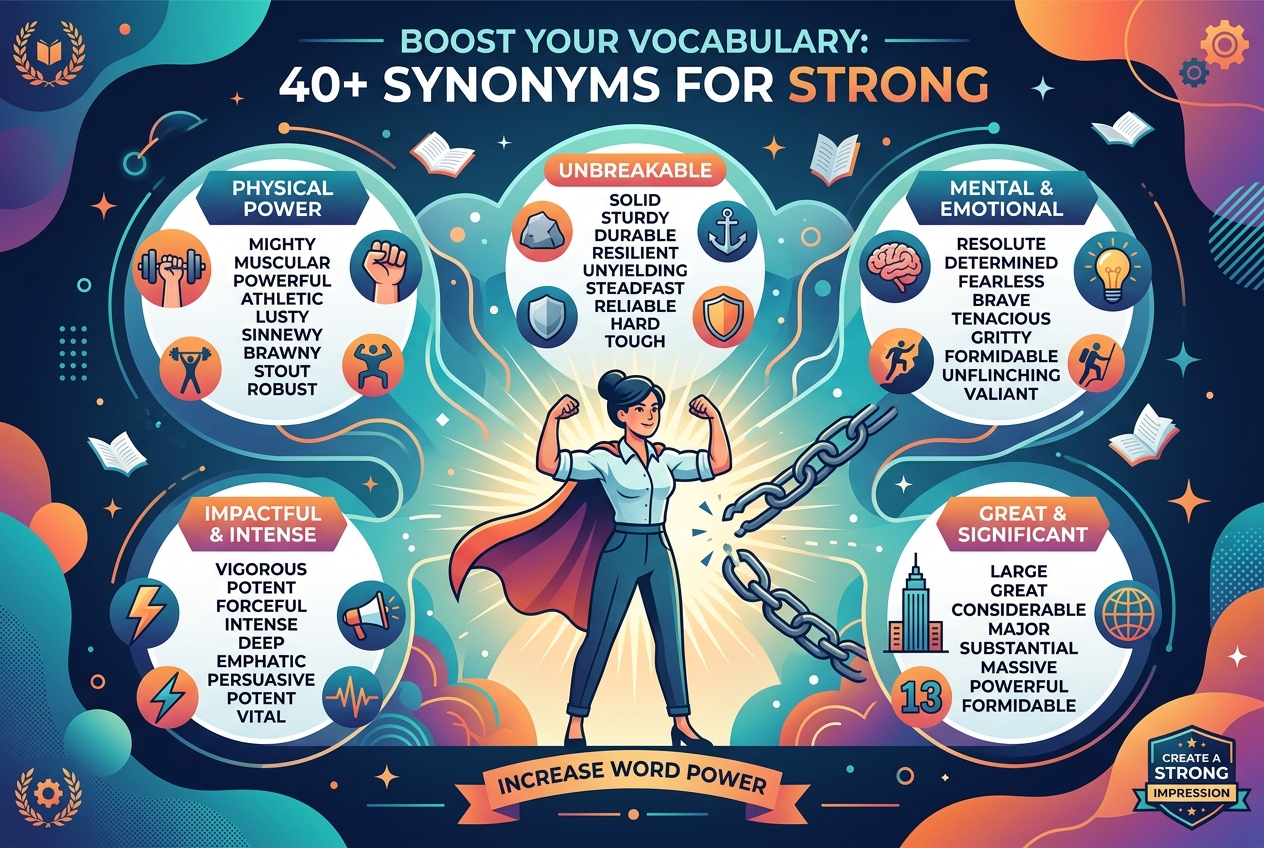
This guide will list a variety of synonyms for strong, grouping them according to the type of strength they’re meant to describe. It will also give definitions, explain the differences between similar terms, and note any possible pitfalls. There is a short reference table, synonyms for strong, a list of common errors, and answers to a few frequently asked questions.
What Does “Strong” Mean? (Strong Def)
If you were doing a quick search for another word for strong, there you go. Strong is an adjective and has many different ‘senses’ (meanings):
- Physically strong/powerful: able to lift, push, or withstand great amounts of force. She is strong enough to carry the pack for an entire day.
- Hard to break/damage: made well, sturdy. The shelf is strong enough to hold the heavy books.
- Mentally/emotionally strong: able to withstand hardships. He was strong throughout a difficult year.
- Strong (in terms of flavor/smell/taste): intense, overpowers your senses. There was a strong smell of smoke wafting out of the hallway.
- Strong (as in a position/viewpoint): strongly supported by facts or reasons, compelling. They made a strong argument.
- Strong (in terms of feeling): deeply held or powerful. She has strong feelings about this subject.
Dictionaries may organize them in different ways, so for a more proper list, refer to a dictionary such as Merriam-Webster or the Oxford Learner’s Dictionary.
What this means is, when you’re looking for a synonym, any given word is only going to touch on one or two of these senses. Which is why there really isn’t only one ‘answer’ to “another word for strong”, and why they’re organized how they are here.
Synonyms for Strong at a Glance
| Type of strength | Good options |
| A strong body | muscular, powerful, robust, sturdy, athletic, strapping |
| A strong object | durable, sturdy, solid, heavy-duty, well-built, hardwearing |
| A strong mind or spirit | resilient, resolute, steadfast, determined, courageous, tenacious |
| A strong flavor or smell | intense, potent, pungent, bold, concentrated |
| A strong argument | compelling, convincing, persuasive, cogent, well-founded |
| A strong opinion | firm, staunch, ardent, adamant, fervent |
| A strong system or organization | robust, healthy, thriving, solid, formidable |
Other Words for Strong When Describing People and Bodies
When you describe the physical strength of someone, the right word depends on what you want the reader to visualize. Each of these words conveys slightly different implications and should not be used interchangeably.
- Powerful. This word implies the presence of considerable physical strength or power. Use this term for athletes, machines, and strong-smiling people. A powerful swimmer won the race by a mile.
- Muscular. The word muscular usually describes someone’s physical appearance. You can use it for a person or an animal with well-developed muscles. However, note that you can look muscular and not be strong at all.
- Robust. The word robust implies a strong, healthy, and sturdy body. You can use it to describe a person who seldom gets sick. He looked robust even in his eighties.
- Sturdy. Another term that usually applies to the body structure of an individual, sturdy means dense and strong. It might be helpful to use this term for children, animals, and things that appear durable at first glance.
- Brawny. This word implies that someone is muscular and strong, and it gravitates towards a more old-fashioned and informal way of speaking. Brawny men are usually fit and have a solid build.
- Burly. Burly is another word that describes someone’s strong physique, and it also has a somewhat informal and old-fashioned connotation. Unlike muscular, burly refers to someone hefty and large in stature.
- Strapping. A strapping young man is typically tall, strong, and healthy. Strapping is an informal and dated word to describe a person of good build.
- Athletic. Unlike other words in this list, athletic does not imply any specific body type. This term refers to a person’s ability to perform sports activities and physical exercises. Athletic men are usually stronger and more flexible than the average person.
- Mighty. The word mighty implies tremendous strength and power. It usually applies to gods, monsters, and athletes in fairy tales and epic poems.
- Sinewy. A sinewy body means a lean and strong body with prominent muscles. This word is suitable mainly for men as it implies a somewhat wiry and agile body type.
- Hardy. Hardy usually describes a person, animal, or plant that can resist hardships and stay healthy. Hardy also applies to clothes and other things that are durable. This word rarely describes someone’s strong physique, although it is sometimes used in this context.
- Rugged. Rugged men are usually athletic and muscular. This term refers to a person’s ability to work outdoors and resist weather conditions. Rugged also applies to landscapes and other things that appear tough.
Another Word for Strong When Describing Objects and Materials
For things, the word strong usually means resistant to breaking, wearing, or pressure. All of these are more precise than simply ‘strong’ and more likely to improve instructions or descriptions.
- Durable. It lasts a long time under use. A durable backpack will see a lot of journeys over its life.
- Sturdy. Solid and stable, not easily upset or broken. It’s the default word for furniture, ladders, and tables.
- Solid. Thoroughly put together with no weak elements. It can also mean made of one material throughout, as with ‘solid oak’, so watch out for ambiguities.
- Heavy-duty. Made for especially tough use. Used for tools, equipment and packaging.
- Well-built. Plain and simple, it’s about quality of construction.
- Hard-wearing. Resists wear and tear. Often used for fabric, flooring and shoes.
- Tough. Resists damage and abuse. Can be applied to people as well, using the same meaning but a slightly different weight.
- Reinforced. Built with additional strengthening. More specific than ‘strong’, as it says how it’s been made stronger.
- Stout. Strong and thick, often used in things like walls, sticks, or boots, or to describe someone as strong and broad. Can also be used to describe a person as heavyset, so be careful with the nuance.
- Indestructible. Cannot be harmed, destroyed, or damaged in any way. It makes a bold claim, so it should be used sparingly, if at all, as most things described this way will not truly be indestructible.
A note on accuracy. In writing product descriptions or reviews, ‘durable’ is a statement about time, and ‘sturdy’ is a statement about stability. Pick one word that covers what you saw, not what you imagine. If you haven’t seen it tested, describe the material rather than stating how long it might hold up.
Synonyms for Strong Character, Mind and Spirit
Mental and emotional strength is where “strong” is most generic. More specific words add personality.
- Resilient. Bounces back. Suggests the ability to recover from setback, not necessarily that it was not harmed. The town proved resilient after the flood.
- Resolute. Unswerving. Shows determination, an unwillingness to be convinced
- Steadfast. Loyal. Used frequently in reference to commitment or friendship. Shows duration.
- Determined. Plain and simple. Shows a drive towards something. Common, easily understood.
- Tenacious. Not easily loosened. Could describe something or someone that is willfully holding on, in a good or bad sense. Can be used as either a positive or negative descriptor.
- Courageous. Bravely. Describes willingness to act in the face of danger or fear.
- Unwavering. Unshakable. Used in reference to commitment, support, or sometimes just focus.
- Stalwart. Reliable. Hard-working. Often used when describing loyalty to a cause or group.
- Indomitable. Inexorable. Very strong and literary-sounding word. Something that cannot be overcome.
- Gritty. Not easy. Shows determination and courage in the face of adversity. Sounds almost trendy. Can describe a person.
- Composed. Calm. Shows control in the face of adversity. Good alternative to “strong” if you mean someone is cool under pressure.
To see the difference, try thinking of two different sentences. “She is a strong woman.” says very little. “She is resolute” shows that she has inner strength, but it doesn’t say what it is. “She stayed composed through the entire hearing” tells you specifically what she did.
Every time you feel you want to use the word “strong” in reference to a person’s character, ask yourself what it is that you saw them do.
Words for Strong Flavors, Smells, Colors and Feelings
Here “strong” means intense. The right word often shows whether the intensity is nice or nasty.
- Intense. Neutral term for high degree of strength or depth. An intense flavor of dark chocolate.
- Potent. Has power. Common for drinks, drugs, arguments, and memories.
- Pungent. A sharply penetrating smell or taste. Usually negative or at least sharp, so avoid it for something you want to sound nice.
- Bold. Strong and confident in flavor, color, or style. Generally nice.
- Concentrated. Contains a high amount of the active ingredient, as with juice or cleaning products.
- Vivid. Bright and striking, for colors and images.
- Overpowering. So strong that it dominates everything. It says it is a problem.
- Sharp. Strong and cutting, for tastes, smells and pain.
- Heady. Strongly affecting the senses, sometimes with an intoxicating effect. It appears often in descriptions of perfume and wine.
- Fierce. Violent or intense, often for emotions, competition and weather.
Because these words have different emotional tones, they are important in reviews, food writing and product descriptions. Calling a perfume “bold, overpowering” warns people off.
Synonyms for Strong Arguments, Evidence and Opinions
Strength in reasoning means persuasion, not force.
- Compelling, hard to ignore or resist, suggests that the reader feels pulled towards the conclusion.
- Convincing, making people believe it is true.
- Persuasive, effective at changing minds, applies to people and their speaking as well as arguments.
- Cogent, clear, logical, and well organized; suggests tight reasoning more than emotional appeal.
- Well–founded, based on good evidence or reasons.
- Airtight, so watertight that it has no visible gaps; use it sparingly, as few arguments are that good.
- Forceful, presented with energy and conviction; this describes delivery more than logic.
For strongly held opinions:
- Firm, not easily changed. She remained firm about the deadline.
- Staunch, loyal and committed, typically used for supporters. A staunch defender of public libraries.
- Ardent, passionate and enthusiastic.
- Adamant, refusing to be persuaded, has a slight edge of stubbornness.
- Fervent, showing intense feeling, often about beliefs or hopes.
Other Words for Strong in Business, Systems and Performance
For economies, teams, brands and results, “strong” tends to be a generic and sometimes boring choice. Other terms may be better alternatives.
- Robust: performs well under stress. A robust supply chain.
- Healthy: in good condition and functioning well.
- Thriving: growing and successful.
- Solid: dependable, without extremes.
- Formidable: strong enough to be intimidating to competitors.
- Dominant: in a leading position.
If you’re writing reports or professional copy, be careful about using “robust”, as it’s become common enough that many readers are likely to be put off by its ubiquity. Try to use it only when you can specify what a system is being robust against.
Common Mistakes When Using Synonyms for Strong
Swapping words mechanically is the most dangerous way to make your writing sound strange. A few common pitfalls should be avoided when you’re looking to make your writing more interesting.
- Not thinking about connotation. “Pungent” and “overpowering” rarely express something positive. “Stubborn” and “tenacious” describe the same set of actions, but imply vastly different levels of positivity.
- Using a word because it sounds impressive. “Indomitable” may be right for a novel, but it’s out of place in a work email. Read the context, and choose the tool that fits the task.
- Confusing an appearance with ability. “Muscular” and “burly” describe a person’s physical appearance, not their abilities.
- Claiming something is absolute. “Indestructible” and “airtight” are almost always verboten. They’re divisive and frequently inaccurate.
- Replacing “strong” with another word where it doesn’t belong. Don’t jump at the first synonym. Sometimes, “strong” is exactly the right word. Short words are often more powerful. Your thesaurus is your friend, but not your only tool. Test the sentence with different options, and pick the best one instead of using a word because it sounds impressive.
- Copying a thesaurus entry without reading the sentence. Not all synonyms fit all sentences. Read the whole sentence again with your new word choice. If it doesn’t fit, try another option.
How to Choose the Right Word for Strength
A short process will make the choice easier.
- Decide what kind of strength you mean: physical, structural, mental, sensory, logical, or organizational.
- What should the reader feel? Admiration, caution, comfort, or unease?
- What register? Casual, professional, academic, or literary?
- Can you think of a better synonym? A more specific description, perhaps? Instead of ‘a strong bridge’, perhaps ‘a bridge that is made to carry heavy trucks’. Sometimes a short explanation is the best synonym.
- Read it aloud. Does it sound forced? If so, pick another synonym.
Key Takeaways
- The word “strong” has several alternate meanings, which is why the best synonym varies depending on the context.
- Consider using different variations of the word to indicate physical, structural, mental, sensory, logical, or organisational strength.
- Also note connotations – some synonyms are positive compliments while others are negative warnings.
- A word that is common but specific is likely to have more impact than a rare and clumsy word.
- Remember that “strong” might simply be the best word to use.
Frequently Asked Questions
What is another word for strong?
It depends on the context. Powerful, sturdy, durable, resilient, and intense are all common choices, but each fits a different situation.
What is a good word for strong that is more formal?
Robust, formidable, resolute, and cogent work well in professional or academic writing, depending on what you are describing.
What is a positive word for strong?
Resilient, steadfast, courageous, and compelling all carry favorable meanings. Words such as “pungent” and “overpowering” lean negative.
Is “strong” a formal or informal word?
It is neutral and works in nearly any setting. Many synonyms are more specific rather than more formal.