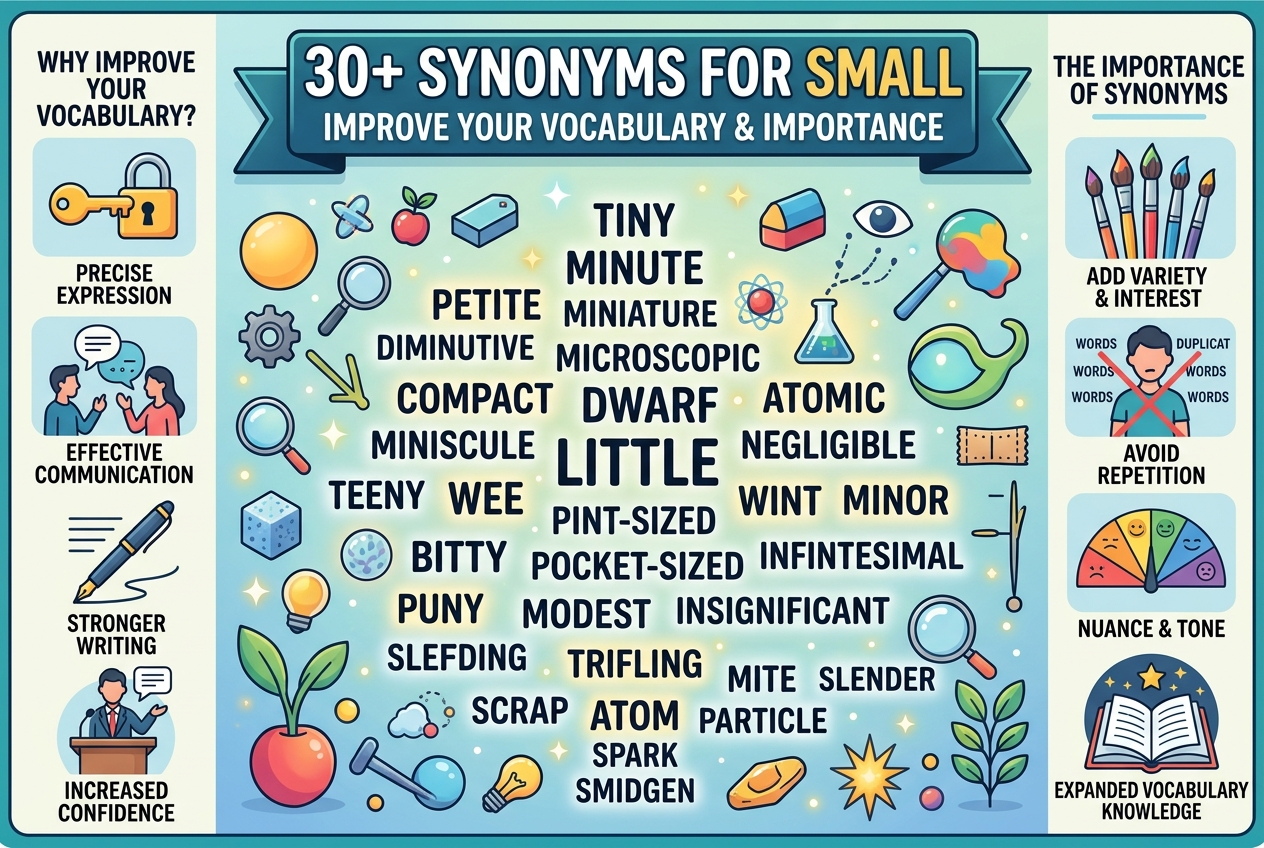
30+ Synonyms for Small to Improve Your Vocabulary
Read back through something you’ve written recently and count how many times you used the word ‘small’, and where you used it. A small room, a small budget, a small mistake, a small town. The word is doing several different jobs, but none of them very well.
The good news is that English has a range of alternatives. The bad news is that they’re not entirely interchangeable. ‘Tiny’ and ‘minor’ are both synonyms for ‘small’, but you wouldn’t say that a serious problem was a ‘tiny problem’. Synonyms for small‘ are grouped in this guide according to the nuances of meaning, to help you choose the most appropriate word for your intended context and meaning.
What Does Small Mean?
The definition of small found in any dictionary is “of less than average size, amount, or importance.” But that brief explanation overlooks the fact that small can refer to at least four different things.
- Physical size: small apartment, small dog
- Quantity: small amount of sugar, small number of votes
- Importance or seriousness: small issue, small detail
- Age or character: small child, small-minded remark
Each of these can belong to a good synonym, for they all belong mainly to one of these territories. If you know which one you are in, it will be much easier to choose the right one.
Quick Reference: Other Words for Small at a Glance
| If you mean… | Try these words |
| Physically little | tiny, little, compact, petite, miniature |
| Extremely little | minuscule, minute, microscopic, teeny |
| Cute or endearing | wee, mini, pint-sized, bite-sized |
| A limited quantity | slight, modest, limited, minimal, scant |
| Too little (negative) | meager, sparse, paltry |
| Not important | minor, trivial, insignificant, inconsequential |
| Narrow in attitude | petty, small-minded |
Synonyms for Small Size
This is the most common use, and there are the most options. The distinctions tend to be matters of degree and attitude.
Neutral, everyday uses
- Little is the friendliest and most flexible substitute. It often takes on a warm cast: “a little cottage by the river.” It is also used for children and animals.
- Compact describes something small by design, usually with a positive twist. A compact car or compact kitchen is small but efficient. It is used when small is a virtue.
- Petite is used mostly for people, in the context of clothes and fashion, and for delicate little things. “A petite woman” is standard in that context. Beware that describing someone’s body is a delicate matter, so use it only when it is appropriate.
- Miniature means a smaller version of something customary. A miniature horse or miniature railway is a reduced copy, rather than something that is small by design.
- Undersized points out that something is smaller than it is supposed to be. “The team fielded an undersized squad.” Usually, it has a critical edge.
Very small
- Tiny is the go-to word for very small. It is stronger than small and slightly more emotional: “a tiny kitten,” “a tiny crack in the wall.”
- Minute (pronounced my-NYOOT) means extremely small, in a scientific or detailed sort of way. “The lab detected minute traces of the chemical.” Beware the other minute, the unit of time, which is pronounced differently.
- Minuscule takes it further, meaning extraordinarily small. Many writers misspell it as “miniscule,” and that is common enough that some dictionaries list it, but “minuscule” is the traditional form and the one you should stick with in formal writing.
- Microscopic literally means too small to see without a microscope. In the real world, it is used as an exaggeration: “The print on the contract was microscopic.”
- Diminutive is a more formal word for unusually small, often for people or creatures. “A diminutive figure appeared in the doorway.” It can be seen as literary, so it is good if you are looking for a descriptive word or if you are writing fiction, rather than having a conversation.
Playful or informal
- Teeny and wee are informal and affectionate. “Wee” has a Scottish and Irish cast, and is often used for charm. “Just a wee bit.”
- Mini is the modern, casual option, common in product names and everyday speech: a mini fridge, a mini break.
- Pint-sized describes small people or things with a humorous edge. “A pint-sized striker who scored twice.”
- Bite-sized means small enough to consume or understand, which makes it ideal for food and for content. “Bite-sized lessons” is a natural use.
Small Amount Synonyms
When you are referring to quantity, size words usually seem incorrect. Nobody has a “tiny” opinion on a budget, as they may have a “modest” one. A positive small-amount synonym also carries a judgment of whether the amount was good or not.
Neutral or positive
Slight suggests a small degree or amount. “A slight delay,” “a slight increase.” It is mild and rarely alarming.
Modest is a polite way to describe something small but respectable. “A modest income,” “a modest improvement.” It often signals that the amount was acceptable, even commendable.
Limited simply states that there is a ceiling, a maximum. “Limited seating,” “limited time offer.” It is neutral and factual.
Minimal means the smallest possible, or an amount that is kept to a minimum. “Minimal risk,” “minimal effort.” Use it when you want to state small as the goal.
Marginal describes a tiny difference or effect, usually in the area of business and statistics. “A marginal gain” means it barely moved.
Negligible means so small it can be ignored. “The cost difference is negligible.” Use it when you want to reassure the reader that there is no amount to speak of.
Negative or critical
Scant means barely enough or less than enough. “There was scant evidence to support the claim.” It suggests a shortage.
Sparse describes things that are thinly scattered or spread out. “Sparse vegetation,” “sparse attendance.” It is about distribution as much as amount.
Meager (also spelled meagre) means unsatisfactorily small. “A meager salary” clearly suggests that there is disappointment.
Paltry is harsher still, meaning that the amount was so small that it is almost insulting. “A paltry sum for a week of work.”
A good test would be: if you want the reader to feel reassured, choose between slight or negligible. If you want them to feel the shortage, choose between scant or meager.
Synonyms for Small in Importance
When “small” means unimportant, choose from this group. These words range from neutral to dismissive.
Minor is the most neutral. “A minor injury,” “minor changes.” It states that something is less serious without judging it.
Trivial suggests something too unimportant to deserve attention. “Trivial details.” It may be dismissive if you are talking about someone else’s concern.
Insignificant means that it has no meaningful effect. It is a common word in formal and analytical writing: “The difference was statistically insignificant.”
Inconsequential is similar, but refers to results. Something inconsequential leads to nothing important.
Petty describes something trivial in a way that makes it seem unworthy or annoying. “A petty argument about who left the dishes.” It usually carries a judgmental edge.
How to Choose the Right Synonym
Ask yourself these three questions:
- What am I measuring? Size, amount, importance, or age? Choose the appropriate set from the list above.
- How big is it? A little (small, compact, slight)? Or very small (minuscule, negligible)?
- How do you want your reader to feel? Charmed by wee, mini, or diminutive? Reassured by minor, negligible? Or horrified by meager, paltry?
Here’s how that can change the tone of a sentence using the same word:
- “The company made a small profit.” (neutral)
- “The company made a modest profit.” (positive)
- “The company made a marginal profit.” (negative)
- “The company made a paltry profit.” (negative)
Same facts, different connotations. Now that’s the value of a larger vocabulary!
Common Mistakes to Avoid
Synonym replacement while ignoring connotation. You wouldn’t say that someone’s salary in a job offer is meager, would you? Modest is much more fitting when it comes to money.
- Using overly fancy words in the wrong contexts. Your reader won’t be impressed if you attempt to use diminutive or inconsequential in a casual conversation or text. Go with tiny and minor instead.
- Using excessively small words for every other word. If you’re going to write everything in microscopic terms, there’s no point in using minuscule at all.
- Mixing up the meanings of minute the adjective and minute the time measurement. They might be spelled the same, but they aren’t synonyms.
Overcorrecting. Sometimes you do want to say small. There’s nothing wrong with simple diction so long as it accurately reflects what you want to say.
Key Takeaways
- The word “small” may refer to size, quantity, significance, or age, so pick its synonyms according to the context.
- Consider the connotations carried by the word: modest and paltry have the same meaning, but sound quite different.
- Write casually with words like teeny and wee, or go for the more formal diminutive and negligible.
- A well-chosen synonym will often make a sentence more understandable and even more convincing than an additional adjective.
Frequently Asked Questions(FAQs)
What is another word for small?
The best choice depends on context. “Little” and “tiny” are the most common for size, “slight” and “modest” for amounts, and “minor” for importance.
What is a stronger word than small?
For size, use tiny, minuscule, or microscopic. For amounts, use negligible or minimal.
What is a formal synonym for small?
Diminutive, minute, negligible, and insignificant all suit formal or academic writing.
What is a positive synonym for small?
Compact, petite, modest, and bite-sized generally have positive or neutral associations.
What is a small amount synonym for formal writing?
Minimal, limited, marginal, and negligible all work well in reports and essays.