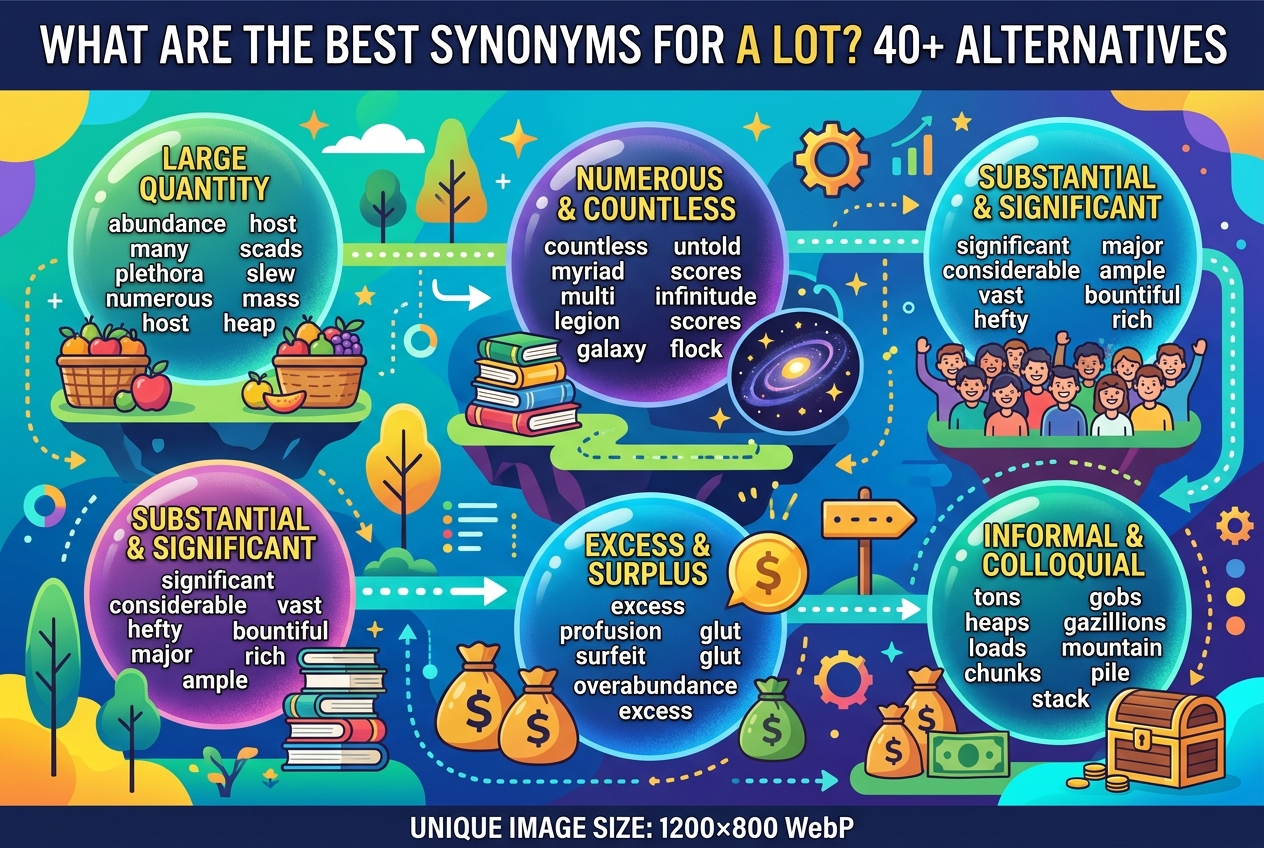
What Are the Best Synonyms for A Lot? 40+ Alternatives
“A lot” is a useful word. It’s convenient to use, informal yet understandable, and concise. However, it is vague and tends to crop up three times in one paragraph without you even realizing it.
The issue is that there is no single word that serves the same function in all contexts. “Plenty of” is appropriate in an informal email, but would that be considered correct in a legal document? “Numerous” may work well in a formal essay, but would it be right to say “numerous” in a message to your best friend? Also, various options work with specific types of nouns, confusing even the most seasoned writer.
This guide will help you browse through more than 40 possible alternatives categorized by tone and grammatical function, so that you can select the most appropriate variant. This article also explains what “alot” really means and whether that is even a word. Finally, there are some synonyms for a lot and concluding remarks.
What Does “A Lot” Mean?
The phrase “a lot” is used to describe a large amount, number, or extent of something. Two grammatical structures can be formed with “a lot.” These are
- “A lot” + of + a noun (“She has a lot of experience” – note the space between “a lot” and “of”)
- 2. “A lot” as an adverb (“He travels a lot.” or “It hurts a lot”).
Therefore, if “a lot” is to be replaced by another word or phrase, it needs to be determined whether the former (“a lot” + of + a noun) or the latter (“a lot” as an adverb) structure is being used. “Numerous” could be an option to replace “a lot of” before a plural noun, but it cannot be used instead of “a lot” when it comes to an adverbial phrase.
Is “Alot” a Real Word?
No. “Alot” is not a word. “A lot” is two words, and, commonly, so many people spell it incorrectly; however, it is a commonly misspelled word by most people and it should be spelled “a lot”
- Some people get allot mixed up with the word allot, which means to give or assign something. “The manager will allot each team a budget.”
- A lot is also used to refer to a plot of land or something that has been auctioned off. “The auction house sold the lot for a high price.” Again, it’s a different use of the word, but allot is an entirely different word that is commonly mistaken for a lot. A simple trick to remember how to spell a lot is to remember that you wouldn’t say abit instead of a bit.
How to Choose the Right Synonym
Before making any synonym substitutions, there are three rules to consider.
The first rule is to determine if the noun is countable or uncountable.
Some synonyms are only countable, and some are only uncountable. Second, you need to evaluate the level of formality. The word choice for a casual conversation with a friend and a formal academic paper will be greatly different.
The third rule is to make sure the precision of meaning is correct.
Using “a lot” may indicate quantity or frequency. However, it is better to use a synonym that will convey more precise information.
Quick Reference Table
| Synonym | Tone | Works with | Example |
| lots of | Casual | Both | “We have lots of time.” |
| plenty of | Neutral | Both | “There is plenty of food.” |
| a great deal of | Neutral to formal | Uncountable | “It took a great deal of effort.” |
| numerous | Formal | Countable | “Numerous studies agree.” |
| a wealth of | Formal | Mostly uncountable | “She offers a wealth of knowledge.” |
| countless | Neutral to literary | Countable | “Countless people volunteered.” |
| loads of | Very casual | Both | “I have loads of homework.” |
| often | Neutral | Adverb | “She visits often.” |
| considerably | Formal | Adverb | “Prices rose considerably.” |
Casual Synonyms for A Lot
These are suitable for use in texts that are more casual, such as chats, social posts, and lax blog posts. Avoid in formal reports, cover letters, and academic writing.
| Lots of | The closest everyday equivalent to the phrase. “There are lots of good cafes nearby.” |
| Loads of | Common in British English and increasingly in other varieties of English. “I have loads of photos to organise.” |
| Tons of | Used in American English. “We got tons of positive feedback.” |
| Heaps of | Common in Australian, New Zealand and British English. “There’s heaps of room.” |
| Oodles of | Used rather playfully, and perhaps a touch old-fashioned. “She has oodles of charm.” |
| Piles of | Suggests stacking of items. “I have piles of laundry to wash.” |
| Stacks of | Stacks of emails are waiting for me. Similar to piles, although often used for paper or paperwork. “Stacks of emails are waiting.” |
| Masses of | Sounds slightly more British than lots of. “There were masses of people at the station.” |
| A bunch of | This works best with quantity expressions that are normally countable nouns. “A bunch of friends came over to visit.” |
| A whole lot of | Adds emphasis. “It takes a whole lot of patience.” |
| A slew of | More informal way of expressing an arrival of things. “A slew of new apps have launched this month.” |
| Plenty of | Can be used in both casual and more formal writing. “There’s plenty of time.” |
Tip: Casual quantity expressions are entirely acceptable in dialogue. The issue is not that they are wrong, but that they can sound out of place in a serious context.
Neutral and Everyday Synonyms
These work in most emails, articles, and workplace writing without sounding stiff.
| A great deal of | best with uncountable nouns. For instance, she spent a great deal of time researching. |
| A good deal of | a milder version of a great deal. He has a good deal of experience. |
| A large amount of | straightforward, also used with uncountable nouns. A large amount of data was lost. |
| A large number of | the synonymous countable noun version. A large number of applicants were qualified. |
| A large quantity of | often used in reference to goods or material. The shop ordered a large quantity of paper. |
| Many | used with plural countable nouns; many people prefer email. |
| Much | used with uncountable nouns; much time is wasted. |
| A considerable amount of | neutral to more formal than much or many. It requires a considerable amount of planning. |
| A substantial amount of | implies weight or importance. They raised a substantial amount of money. |
| A fair amount of | use with caution; often suggests a moderate amount rather than a huge amount. I have a fair amount of work to finish. |
| Abundant | as an adjective for resources. The region has abundant rainfall. |
| Ample | more than enough of something rather than a huge amount. There is ample parking. |
Formal and Literary Synonyms
These suit essays, reports, speeches, and polished writing.
| Numerous | For use with countable nouns. “Numerous factors affect the result.” |
| A multitude of | Implies a large and varied number. “A multitude of options are available.” |
| A myriad of | This describes a huge number of something. Both “a myriad of” and “myriad options” are correct. |
| A wealth of | Upbeat. “The archive offers a wealth of information.” |
| An abundance of | Implies more than you know what to do with. “An abundance of caution slowed the project.” |
| A host of | Slightly literary. “A host of problems emerged.” |
| A plethora of | Perfectly valid, but overused and pretentious. Use it sparingly. |
| A profusion of | Used to describe things that grow or fall in abundance. “A profusion of flowers lined the path.” |
| Scores of | Scores means many dozens. “Scores of residents attended the meeting.” |
| Dozens of | Specific and implies a number, although not an exact one. Especially useful if it is actually true. “Dozens of volunteers helped.” |
| Hundreds of / thousands of | Also specific, and more vivid if you know the exact number. “Thousands of people signed the petition.” |
| Countless | Implies too many to count, although it really only should be used if it’s true. “Countless hours went into the project.” |
| Innumerable | A more upmarket word than countless. “Innumerable stars filled the sky.” |
| Copious | Used with uncountable nouns, often notes or detail. “She took copious notes.” |
| Extensive | Another word for wide-ranging or broad. “The team has extensive experience.” |
Synonyms for “A Lot” as an Adverb
When “a lot” comes at the end of a sentence or modifies a verb, you need different words. This is where many “another word for a lot” searches actually land.
For frequency:
- often = “She reads often.”
- frequently = more formal: “He frequently travels abroad.”
- regularly = suggests a pattern: “They meet regularly.”
- repeatedly = suggests repetition: “She asked repeatedly.”
- constantly = suggests nonstop: with caution, since it is often an exaggeration: “He constantly checks his phone.”
For degree:
- greatly = “I greatly appreciate your help.”
- considerably = “Sales improved considerably.”
- significantly = best if there has been a significant difference: “Costs dropped significantly.”
- substantially = “The plan changed substantially.”
- extensively = in terms of scope or depth: “She has written extensively on the topic.”
much = “I don’t like it much.”
- With comparisons (“a lot better”, “a lot more”):
- much better / far better = “The new version is far better.”
- considerably more = “It costs considerably more.”
- way better = only in casual usage.
Before and After: Real Rewrites
Being able to see changes in context is more valuable than a list. Here are a few rewrites.
Casual message
Before: “I learned a lot at the workshop.”
After: “I picked up plenty at the workshop.” or “I learned loads at the workshop.”
Professional email
Before: “We received a lot of applications.”
After: “We received a large number of applications.”
Academic writing
Before: “A lot of researchers disagree with this view.”
After: “Numerous researchers disagree with this view.”
Product description
Before: “This backpack holds a lot.”
After: “This backpack holds a generous amount of gear.” (Or, better still, give the actual capacity.)
Blog writing
Before: “There are a lot of ways to save money.”
After: “There are plenty of ways to save money.”
Notice that the last example with a product is improved most by replacing the vague phrase with an actual fact. That leads to the biggest tip in this article.
When a Number Beats a Synonym
Sometimes the best substitute for “a lot of” is not a synonym at all. It’s specifics!
- A lot of users becomes “about 300 users” (if that’s what you know!)
- It takes a lot of time becomes “it takes about 2 hours.”
- She exercises a lot becomes “she exercises five days a week.”
Specifics are more convincing than generalities, more likely to convince the reader, and more informative. If you don’t have specific numbers, use approximations like “dozens,” “hundreds,” or “roughly half.” Don’t make up numbers; you should give accurate figures if you know them.
Common Mistakes to Avoid
- Writing “alot.” It is always two words.
- Overusing any one synonym. Swapping every “a lot” for “numerous” makes writing feel repetitive in a different way. Vary the structure of the sentence, not just the word.
- Picking a fancy word to sound smart. “A plethora of” adds nothing that “many” does not. Clear writing usually beats impressive writing.
- Exaggerating. “Countless” and “tons of” can weaken credibility when the real amount is modest.
- Ignoring tone. “Oodles of” in a formal report will stand out for the wrong reasons.
Which Synonym Should You Pick? A Simple Guide
- Texting or chatting: lots of, loads of, tons of
- Emails to colleagues: plenty of, a large number of, a good deal of
- Essays and reports: numerous, a considerable amount of, a wealth of
- Persuasive or descriptive writing: an abundance of, a myriad of, countless
- Talking about frequency: often, regularly, frequently.
- Talking about degree: considerably, greatly, significantly
- When you can be exact: use the number.
Key Takeaways
- “A lot” is always two words. “Alot” is incorrect.
- Choosing the right synonym depends on style, whether the noun is countable, and whether you mean amount, number, or frequency.
- For an adverbial use (I like it a lot), use a synonym such as greatly, often, or considerably.
- A specific number or detail is often better than using a synonym.
- . Vary your sentence structure and don’t overuse a particular synonym.
Frequently Asked Questions
What is another word for a lot of?
The alternative words for ‘a lot of’ include ‘plenty of’, ‘lots of’, ‘many’, ‘numerous’, “a great deal of,” and ‘a large number of’. However, the phrase depends on whether the object is plural or singular and how formal the tone of the writing is.
What does alot mean?
The term ‘alot’ does not have a meaning. It is a wrongly spelled word that is supposed to be ‘a lot’.
Is lots of a good synonym?
Using the phrase ‘lots of’ is appropriate while writing informally. However, it is not advisable to use the expression while writing formally. Instead, use ‘numerous’, ‘a large number of’, and ‘a considerable amount of’.
Can I use a lot in formal writing?
Most writing guidelines discourage the use of ‘a lot’ since it is an informal word. Therefore, when writing formally, use another word that can replace it. When in doubt about whether to use the phrase or not, it is advisable to check the style guide provided by the institution or publisher.
What is a better word than a lot?
The words ‘countless’, ‘innumerable’, ‘a multitude of’, ‘an abundance of’, and ‘numerous’ are better alternatives. However, it is advisable to use them only when referring to a larger number.