45+ Synonyms for Also to Improve Your Writing
Read back through something you’ve written recently and count the number of times you’ve used ‘also’. In most cases, it’ll be significantly higher than you’re probably aware of. It’s a useful little word, but it tends to build up and, once it does, your writing begins to sound repetitive. The solution isn’t necessarily to find an alternative word that’s synonymous, per se. Different synonyms for also have different weightings in terms of formality, sentence placement, and can sometimes convey slightly different meanings. ‘Moreover’ is better suited to a research paper, whereas ‘plus’ would be better in a text to a friend, and ‘likewise’ does something completely different from all of them.
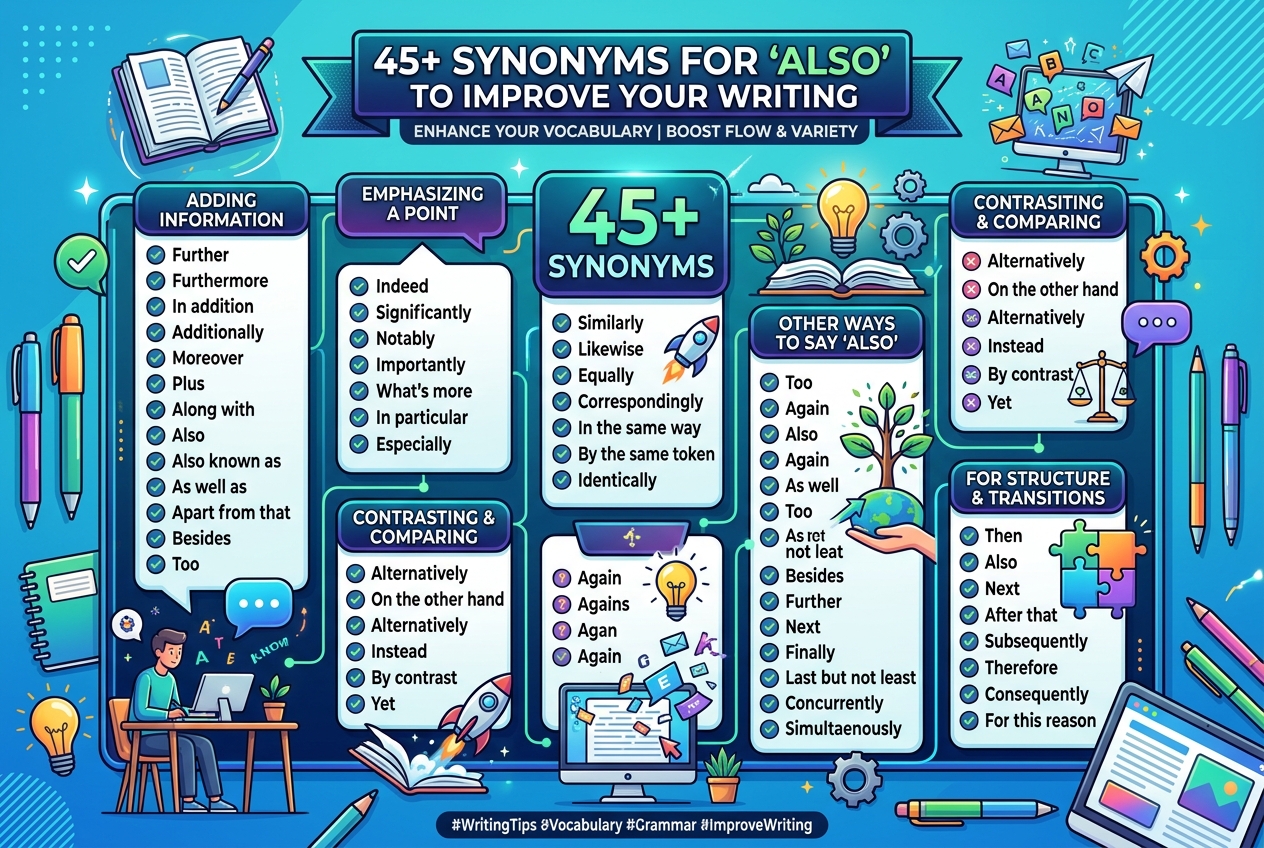
This guide covers exactly what ‘also’ means, followed by over 50 alternatives, split into sections based on what they mean, along with examples you can use in your own writing. You’ll also find a comparison table, punctuation advice, and common mistakes people make with the word.
What Does “Also” Mean?
“Also” is an adverb that means “in addition” or “too.” The adverb “also” adds information to the sentence.
- She speaks French. She also speaks Portuguese.
- The hotel has a pool. It also has a small gym.
That is the whole job. The word adds an item, fact, or idea to the previous statement. Most of the synonyms below work the same way, although a few of them (such as “likewise” and “similarly”) perform a narrower function, which we will get to shortly.
Why It Helps to Have Another Word for “Also”
There are three reasons to vary it:
- Rhythm. Using the same connector in successive sentences makes the text sound robotic.
- Tone. “Also” is bland. Sometimes you need a warmer, more formal, or emphatic word.
- Precision. Sometimes the sentence is not simply adding a fact. It’s giving a reason, drawing a parallel, or piling up evidence, and a more precise connector makes that clear.
That said, don’t replace every “also” on principle. It is short, clear, and perfectly good. Variety is a means to an end, not an end in itself.
Everyday Synonyms for Also
These all tend to work in most conversational and general writing. They are the safest options to choose, generally speaking.
| Too | She likes hiking. I do too. |
| As well | He teaches maths and coaches football as well. |
| And | Often the most straightforward solution. “We sell books and also stationery” doesn’t sound as good as “We sell books and stationery.” |
| Plus | The plan covers repairs, plus a yearly inspection. |
| Along with | Bring your ID along with a recent bill. |
| Together with | The report, together with the appendix, runs to forty pages. |
| As well as | She manages the team as well as the budget. |
| On top of that | The flight was delayed. On top of that, our luggage went missing. |
| Besides | The route is too long. Besides, the weather looks bad. |
| In addition to | In addition to a salary, the job includes health cover. |
A note on “besides”: it has a meaning which is often closer to ‘as a further argument’ than a neutral addition, so it tends to work best in arguments and justifications.
Formal and Academic Synonyms for Also
In essays, reports, and professional documents, connectors are words that signal a step in your reasoning.
| Transition Phrase | Example Sentence 1 | Example Sentence 2 | Notes |
| Additionally | The study measured sleep length. | Additionally, it tracked sleep quality. | – |
| Furthermore | The proposal is affordable. | Furthermore, it can be delivered within a quarter. | – |
| Moreover | The data is incomplete. | Moreover, the sample is small. | – |
| In addition | – | In addition, staff will receive refresher training. | Most common, neutral, flexible. |
| Further | – | Further, the committee recommended a review. | Less common, quite formal. |
| What is more | – | What is more, the results were repeated in a second trial. | – |
| Beyond that | – | Beyond that, there are legal considerations. | – |
| Apart from this | – | Apart from this, the design has no known flaws. | – |
| Above all | – | Above all, the meeting went well. | – |
| Over and above | – | Over and above the base fee, clients pay for travel. | – |
“Furthermore” and “moreover” are close cousins. Both add weight and both work best when the new point reinforces the previous one. If the new point is simply unrelated, “additionally” is often the most straightforward choice.
Casual and Conversational Synonyms for Also
These add a friendlier tone to your writing. Perfect for blogs, e-mails to colleagues you know, and social media posts, but avoid using them in formal documents.
| What’s more | It is cheap. What’s more, it lasts for years. |
| Not to mention | The hotel is beautiful, not to mention affordable. |
| To boot | He got a promotion and a pay rise to boot. |
| And then some | The course covers the basics and then some. |
| Ditto | “I need a coffee.” “Ditto.” |
| As a bonus | The app tracks spending, and as a bonus, it sends bill reminders. |
| Another thing | Another thing to consider is the commute. |
“Ditto” is extremely informal and should be reserved for dialogue or light-hearted writing; “to boot” can be old-fashioned, which may be a good thing, depending on the context.
Synonyms That Show Similarity
This group also deserves separate mention, as these words perform the additional function of making a comparison – they mean “the same is true of this, too”.
| Likewise | She donated her time. Likewise, her brother volunteered. |
| Similarly | The first draft needed cuts. Similarly, the second draft was too long. |
| In the same way | In the same way that a chef tastes as they cook, a writer should reread as they draft. |
| By the same token | He expects honesty, and by the same token he offers it. |
| Equally | Equally, the risks of waiting should be considered. |
| In like manner | In like manner, the second clause followed. (Formal and rare.) |
| Correspondingly | Demand grew, and prices rose correspondingly. |
| Same goes for | The kitchen needs updating. Same goes for the bathroom. |
Watch out: “Likewise” and “similarly” are not always interchangeable with “also”, and using “The car is red. Likewise, it has four doors” would be wrong, because there is no parallel between colour and doors. Use them only when the two ideas actually echo each other.
Synonyms for Listing and Sequencing Points
When “also” is doing the job of introducing another item in a list of reasons or steps, these help the reader follow your structure.
| Transition Phrase | Example Sentence |
| For one thing / for another | For one thing, the location is ideal. For another, the rent is fair. |
| In the first place | In the first place, we lack the budget. |
| For starters | For starters, the software is free. |
| Next | Next, check the settings. |
| Then | Then add the eggs slowly. |
These are less about “also” as a pure addition and more about guiding the reader through a sequence. They often make a paragraph clearer than a string of “also” sentences would.
Synonyms for “Also Known As”
There are many ways to introduce an alternative name to one’s name, and many people are looking for an “also known as synonym that fits their needs. Here are the most popular options.
| Term | Usage/Definition | Example |
| Also called | The common cold, also called an upper respiratory infection. | The common cold, also called an upper respiratory infection. |
| Otherwise known as / otherwise called | Use for any alternate name. | Lionel Richie, otherwise known as … |
| Sometimes called | The stone fruit is sometimes called a Chinese date. | The stone fruit is sometimes called a Chinese date. |
| A.k.a. or aka | Informal. Common in casual writing and headlines. | A.k.a. or aka |
| Alias | Usually suggests a false or assumed name, often in legal or crime contexts. Has a slightly negative flavour, so avoid it for neutral name variants. | Alias |
| Formerly | Use when a name has changed. | The company, formerly known as ABC Corp, now trades as XYZ. |
| Née | For a woman’s birth surname. | Maria Chen, née Lopez. |
| Or | In many contexts, a simple “or” works. | The Tasmanian devil, or Sarcophilus harrisii. |
Select your option based on the tone and accuracy; “Alias” and “aka” are not always neutral terms, and “formerly” is only correct when the old name is no longer in use.
What About “A.L.S.O.”?
Some people search for “a.l.s.o.” with periods. In ordinary English, “also” is written without them, so “a.l.s.o.” is not a standard spelling. When the letters appear with periods, they usually stand for an abbreviation or acronym in a specific field or organisation. If you have come across “A.L.S.O.” in a document, check the surrounding text or the source’s glossary to see what it stands for, because the meaning depends entirely on context. If you simply meant the adverb, write “also.”
Quick Comparison Table
| Word or phrase | Tone | Best for | Example |
| too | Casual to neutral | End of sentence | We liked it too. |
| as well | Neutral | End of sentence | We liked it as well. |
| plus | Casual | Informal lists | Free shipping, plus a gift. |
| besides | Neutral | Adding a reason | Besides, it is cheaper. |
| additionally | Formal | Reports, emails | Additionally, we tested speed. |
| furthermore | Formal | Building an argument | Furthermore, it saves time. |
| moreover | Formal | Strengthening a point | Moreover, it is safer. |
| what’s more | Conversational | Blogs, speech | What’s more, it is free. |
| likewise | Neutral to formal | Parallel ideas | She agreed. Likewise, he did. |
| for one thing | Conversational | Listing reasons | For one thing, it is fast. |
Where to Put the Word in a Sentence
Position matters as much as word choice, and it is where many writers slip.
- “Also” sits before the main verb (or after “be”): “She also plays piano.” “He is also a teacher.”
- “Too” and “as well” go at the end: “She plays piano too.” Placing “too” mid-sentence can work (“I, too, disagree”), but it sounds formal.
- Transitions like “furthermore” and “moreover” start a sentence or clause and are followed by a comma.
Some traditional style guides discourage starting a sentence with “also.” It is common in modern writing, but if you are writing for a strict style guide, check its rules or use “additionally” instead.
Punctuation Tips That Save You From Errors
- After sentence-opening transitions, use a comma: “Furthermore, the team agreed.”
- If a transition joins two full sentences in one line, use a semicolon before it: “The plan is simple; furthermore, it is cheap.”
- Do not use a comma between “also” and the verb it modifies: “She also, plays piano” is wrong.
How to Choose the Right Synonym
- A quick test can show you. Ask yourself these questions about your sentence:
- Who is reading it? A manager, teacher, or client usually expects “additionally” over “plus.”
- What is the connection? Is it a pure addition, a parallel, a stronger reason, or a list item?
- Does it sound right? If a phrase sounds stiff when read aloud, it will sound stiff on the page.
If you are truly not sure, “as well,” “in addition,” and “too” are always safe. They work in virtually any context.
Common Mistakes to Avoid
- I see you have written a lot about stacking connectors. “Also, moreover, in addition” all in one paragraph sounds like a checklist. One connector per shift of thought is sufficient.
- Using “furthermore” for unrelated ideas. Your reader will believe that what you are saying now further strengthens the last point. If it does not, then use “additionally” or another paragraph.
- Getting confused between “besides” and “beside”. Beside means next to, but besides means in addition to or apart from.
- Using fancy words in informal writing. An email you send to friends saying “Moreover, I will bring snacks”
- And forgetting “and”. Often the improvement is simply deleting the connector. “He is smart and also kind” can be improved as “He is smart and kind”.
Key Takeaways
- “Also” is fine – but using it over and over can make our writing sound tedious.
- Pick your synonyms based on your audience: “additionally” becomes more formal, while “plus” is more informal.
- Only use “likewise” and “similarly” when comparing two similar items.
- Sometimes the best synonym for “also” is “and” or no conjunction at all.
- Consider your options for alternate names – there are several, including “also called,” “aka,” “alias,” and “formerly.”
Frequently Asked Questions(FAQs)
What is the best synonym for also?
There is no single best synonym for also – too and as well are the most flexible alternatives; additionally is a good formal option, and plus works well in informal writing.
Can I begin a sentence with also?
Yes, you can begin a sentence with also in most modern writing. However, some formal style guides recommend alternatives such as in addition at the beginning of a sentence – check the requirements of the style guide you are using.
What is the difference between also and too?
They have the same meaning, but also is placed before the verb and too is placed after.
Is moreover the same as also?
Not quite – moreover is used to add weight to your argument by introducing a strengthening point.
What does also known as mean?
It means the same thing as also called – it introduces an alternative name for a person, place, or thing. Also known as is often abbreviated to aka in informal writing.