However Synonyms: 50+ Words to Use Instead of “However”
A writer who has previously read a paragraph full of “however” words will quickly find that this word is one of the most overused transition words in the English language. In fact, it is so common for people to use “however” in a paper that its use in academic writing has become somewhat of a cliché. While the word itself is effective in showing contrast, there are alternatives that are just as good and make writing seem less repetitive.
This guide will give you context on where “however” should be used, why it loses its impact when overused, and give you over 50 however synonyms to the word that you can use in your writing. It will also provide example sentences for each transitional phrase so that you are not just given a list of vocabulary words to use, but are also shown how to apply them in actual sentences.
For more information about writing help guides like this, be sure to check back to our blog where you can find plenty of resources to help improve your writing!
What Does “However” Mean?
The adverb however is mostly used to add a contrasting or qualifying statement to what has been said or written before. By using it, the writer or speaker actually says, “What I am going to say qualifies, amends, or downright contradicts what I just said.”
For instance, the sentence, The plan looked good on paper; however, it failed spectacularly within the first week.
It can also be used to mean “to whatever extent” or “in whatever way”, but this is not common in day-to-day usage. An example of this is: However you look at the problem, the deadline remains the same.
Most people have a problem with the first explanation, which is the transition/concessive use of the word. We use it a lot, and it becomes a habit; thus, we end up overusing it.
Why Look for a Different Word for However?

There is nothing wrong with using ‘however’. Grammatically, it is completely correct. However (pun intended), many writers feel the need to find other ways to express this transition word.
Here are some reasons why people may want to avoid using ‘however’:
- It is common for writers, in essays, articles, paragraphs, etc., to use transition words. However, if you use the same transition word over and over again, it can become tedious for the reader.
- It is a very formal word. Depending on what you are writing, it may be appropriate, or it may be seen as out of place in a more casual setting.
- Variety is the key to engaging writing. It helps the writing flow better and keeps the reader interested. Some however synonyms are used in the middle of a sentence and some at the beginning, which is why they are a good alternative.
- Sometimes you need a word that means something very similar to however, but has a slightly different nuance or emphasis than however itself has.
Quick Answer: Another Word for However
If you just need a fast swap, here are commonly used replacements:
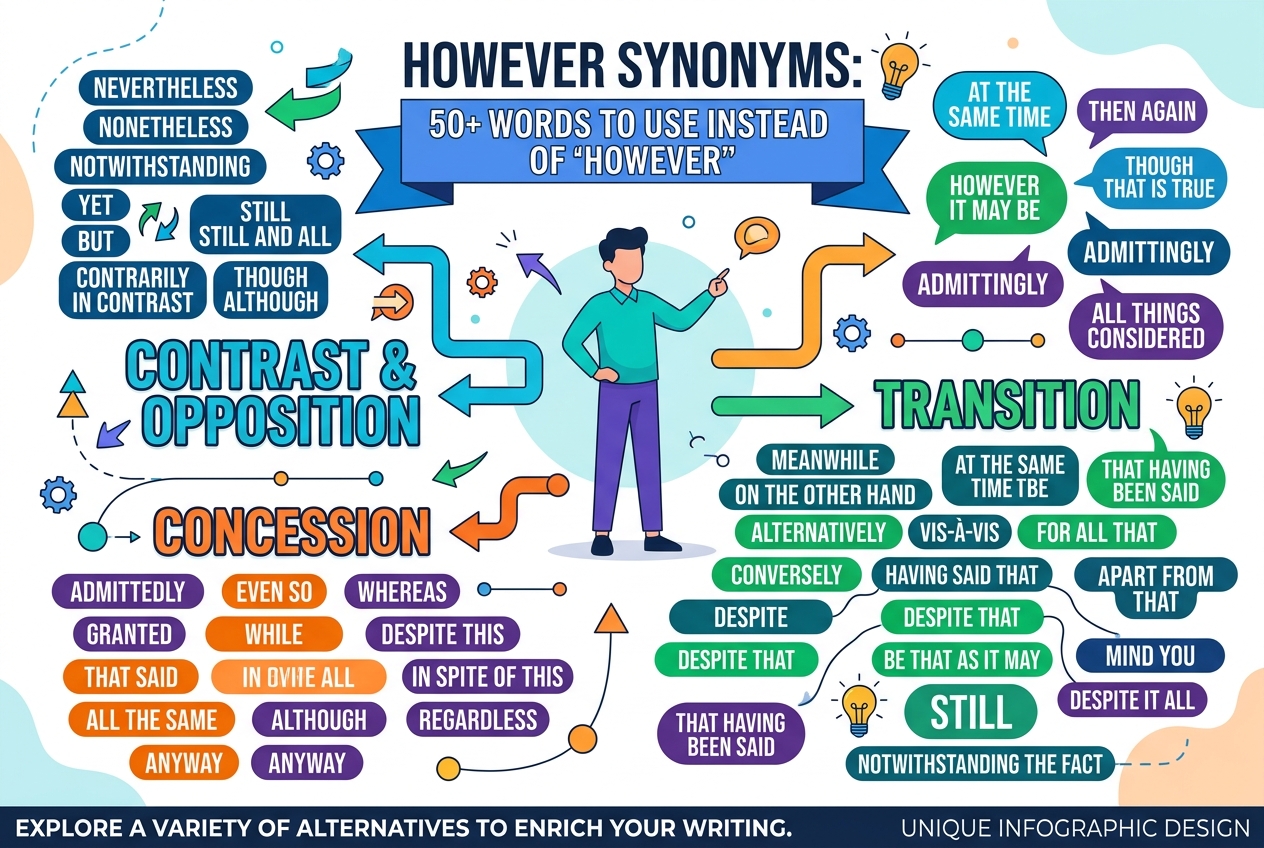
Nevertheless, nonetheless, still, yet, though, but, on the other hand, that said, even so, conversely, in contrast, notwithstanding.
Below, these are organized by context so you can pick the right one instead of guessing.
However Synonyms by Formality and Tone
Formal Alternatives (Essays, Reports, Academic Writing)
These are perfect for academic papers, business writing, formal essays, and other official documents where “however” sounds unprofessional or overused.
- Nevertheless – The results were unclear. Nevertheless, we launched the product.
- Nonetheless – The funds were low. Nonetheless, the project was completed on time.
- Notwithstanding – Notwithstanding the delays, the report was filed.
- Regardless – Regardless of the complications, the committee approved the application.
- That said – The numbers look good. That said, further tests are necessary.
- Despite this – Despite this, sales grew steadily towards the end of the year.
- Despite this – Despite this, the client decided to renew the contract.
- On the contrary – On the contrary, the survey revealed increased customer satisfaction.
- Be that as it may – Be that as it may, the deadline cannot be postponed.
- Even so – The outlook seemed bleak. Even so, the harvest was successful.
Neutral, Everyday Alternatives
These alternatives are great for informal writing, blogging, and day-to-day communication.
- But – It was a cloudy day, but we still went hiking.
- Yet – The terms were clear, yet most participants got confused anyway.
- Still – He knew the risks, still took the job.
- Though – I liked the design, though I thought it was too pricey.
- On the other hand – This option is cheaper; on the other hand, it is not as durable.
- In contrast – Sales grew in Q1, in contrast, Q2 saw a minor decline
- Conversely – Some people enjoy working from home; conversely, others prefer the office.
- At the same time – The suggestion makes sense; at the same time, we need more funding.
- Even though this is true – Even though this is true, we should check the source.
- Alternatively – You can wait a week; alternatively, you can ask for an extension.
Casual/Conversational Alternatives
These are ideal for blogging, emailing, social media posts, and other informal styles of writing and speaking.
- Still, though
- Thing is
- That being said
- Anyway
- Either way
- All the same
- Even still
- Having said that
- In any case
- Mind you
- Example: “The trip was expensive. Thing is, we would do it again in a heartbeat.”
However Synonyms by Sentence Position
One reason that writers struggle with ‘however’ is that it’s very versatile. It can be used to begin a sentence, be placed in the middle of a sentence, or even follow a semicolon. Not all synonyms for it can do that. Let’s look at each situation and see how to properly place them.
Beginning of a Sentence
It usually works well when the writer puts a comma after it. Here are some examples of correct usage:
- However, the numbers tell a different story.
- Nevertheless, the team pushed on.
- That said, there’s room for improvement.
- Even so, the plan worked out.
- Conversely, the opposite happened in the second trial.
In the Middle of a Sentence (Set Off by Commas)
- The results, however, were not what we expected.
- The results, nevertheless, were not what we expected.
- The results, still, told a different story. (This usage isn’t common. It’s much better to put ‘still’ at the beginning of a sentence or use it as a transition word.)
Note: This does not apply to all synonyms for ‘however’. ‘But’ and ‘yet’ rarely go in the middle of a sentence. They’re usually at the beginning or used as transition words.
As a Conjunction Between Two Independent Clauses
Either a semicolon or a comma can work, depending on the word:
- The forecast was accurate; however, no one prepared for it.
- The forecast was accurate, but no one prepared for it.
- The forecast was accurate, yet no one prepared for it.
Note: When writing ‘however’ (or ‘nevertheless’, ‘nonetheless’, or ‘therefore’) between two independent clauses, a semicolon should be placed right before it. Also, a comma should go after it, unless it’s attached to the first word in a sentence. This is different from ‘but’ or ‘yet’, which are coordinating conjunctions and only require a comma. A lot of people mix these up, so it’s best to be careful whenever you’re using these similar words.
However: Meaning in Different Contexts
“However” doesn’t always signal contrast. Context changes its job.
| Context | Meaning | Example |
| Contrast/transition | Introduces a contradicting idea | The plan was risky. However, it worked. |
| Degree/manner | Means “to whatever extent” | However hard you try, some things take time. |
| Concession | Softens a prior statement | It’s expensive. However, it’s worth it. |
If you’re replacing “however” in the degree/manner sense (not the contrast sense), synonyms like “nevertheless” or “but” won’t work. Instead, you’d use phrasing like:
- No matter how – No matter how hard you try, some things take time.
- Regardless of how – Regardless of how you slice it, the numbers don’t add up.
- Whatever way – Whatever way you look at it, the outcome is the same.
This is a common mistake: swapping in a contrast-only synonym for a sentence that’s actually using “however” to mean “to any degree.” Always check which job “however” is doing before you replace it.
However Synonym Essay Writing: Practical Tips
If you find yourself writing essays and always using “however”, here’s a helpful guide on ways to vary your sentence structure besides a thesaurus.
- First, try reading your draft out loud.
If you hear yourself using “however” multiple times per paragraph, then you definitely need to vary your conjunctions. Hearing your draft makes it easier to catch repeated words than looking at it on paper.
- Make sure to use the correct synonym for the right context
Sometimes, you might want the sentence to say the exact opposite. In that case, you should use “but” rather than “nevertheless”. “That said” is used when your sentence accepts the previously made claim, but still wants to prove an argument against it. All in all, make sure to change your words to reflect the degree of your disagreement.
- Strong Contrast: but, on the contrary, in contrast
- Average Contrast: however, nevertheless, yet
- Accepting / Mild contrast: that said, even so, having said that
- Don’t just replace “however” with a thesaurus every time
Using a thesaurus for every instance of “however” will lead to poor variation, since it’ll be apparent that you are just copying and pasting. You want to avoid that, trust me. Instead, try changing the structure of sentences like in tip 4.
- Change the structure of your sentences.
Sometimes, the best way to avoid repeating words is to not repeat words. For example:
- “The results were strong. However, the sample size was small.”
- can be changed to
- “Despite the strong results, the sample size was small.”
- or
- “The results were strong, though due to the small sample size, those results cannot be generalized.”
I personally think that changing the structure of the sentence is more effective than using a thesaurus for your contrasting word.
However, Sentence Examples: Before and After
Judging from the given examples, one can see that the context plays a critical role in determining what substitute to pick. Here are a handful of replacement suggestions in various genres.
Business email
- We reviewed the proposal. However, we need more details on the budget.
- We reviewed the proposal. That said, we need more details on the budget.
Academic writing
- The theory explains most cases. However, it fails to account for outliers.
- The theory explains most cases; nevertheless, it fails to account for outliers.
Blog/conversational
- I loved the movie. However, the ending felt rushed.
- I loved the movie. Still, the ending felt rushed.
Narrative/creative writing
- She trusted him completely. However, something felt off that night.
- She trusted him completely. And yet, something felt off that night.
Formal report
- Revenue increased in Q3. However, operating costs also rose.
- Revenue increased in Q3; conversely, operating costs also rose. (Apply “conversely” only when two trends go in opposite directions rather than both being simply notable.)
Common Mistakes When Using However Synonyms
- The misused transition words in writing include treating all synonyms as equal. In fact, the term “conversely” refers to the reverse and only applies to the exact opposite situations. For instance, it would be wrong to write “Sales grew. Conversely, the team celebrated,” because they did not celebrate in the opposite sense.
- Such a common transition mistake is misplaced punctuation. When using “however,” it should alwaysAvoiding the use of synonyms for the word ‘however’. While the expression ‘on the flip side’ is correct, ‘conversely’ means something entirely different. It suggests an inverse correlation, or relationship of opposition – a far stronger degree of contrast than simply ‘in comparison’.
- Using the wrong forms of punctuation. Words such as ‘however’ and ‘therefore’ should be preceded by a semicolon and followed by a comma when applied to two complete sentences. Words such as ‘but’ and ‘yet’ do not require such punctuation.
- Starting sentences with a transition word too often. Even if you vary your phrases with ‘Nevertheless’, ‘That said’, ‘In contrast’, ‘On the other hand’, etc. It can still end up becoming distracting. In some cases, using no transition phrase at all and using only a period to separate sentences is even better. A period followed by a contrasting sentence will often be enough to imply a shift in direction.
- Using formal synonyms in informal writing, or vice versa. Words such as ‘Notwithstanding’ will seem out of place in casual writing. Meanwhile, something like ‘thing is’ will seem unprofessional in a formal paper.
Final Thoughts
“However” is not a word that should be forbidden. It’s a great transition word that was created for a purpose. Of course, you cannot use it every time you want to give a contrasting idea, but it’s not necessary to use it anyway. All you have to do is to pay attention to such things as formality, placement in a sentence, and the actual strength of the opposition. As soon as you start analyzing these things, you will be able to choose the most appropriate replacement without having to think of a list of however synonyms.