40+ Synonyms for Interesting: Better Words for Every Context
“Interesting” is one of the most flexible words in English. You can use it for a documentary, a job offer, a neighbor’s haircut, or a scientific finding. That flexibility is also its weakness. The word says something held your attention, but not why or how.
Choosing a better word is mostly a matter of asking a question first: what exactly made this interesting? Was it surprising? Strange? Beautiful? Useful? Hard to put down? Once you know, the right synonym is usually easy to find.
This guide organizes more than 40 synonyms for interesting by meaning and context instead of dumping them into one long list. You will also find adverb options for “interestingly,” a set of opposites, common mistakes, and a few quick tests for choosing well.
Why “interesting” often falls flat
Three things make the word ‘interesting’ weak in writing, and in speech, perhaps, too.
- It is vague: “The lecture was interesting,” might have been exciting, informative, or merely different.
- It is overused: The word appears so often that it invites skimming.
- And it can be used as a polite word for something not exciting at all.
A conversational “Hmm, that’s interesting” can signal disinterest and an urge to move on. Listeners know this, which is why they’re likely to hear a polite “interesting” as anything but excitement. None of which means the word ‘interesting’ is a bad word — a neutral word is sometimes exactly what is needed. What it does mean is that one should be aware of using it, perhaps, habitually.
Quick reference: pick a synonym by meaning
| What you mean | Try |
| Hard to stop paying attention to | gripping, riveting, absorbing, engrossing |
| Makes you want to know more | intriguing, curious, tantalizing |
| Beautiful or attractive in a memorable way | captivating, enchanting, alluring |
| Different from the usual | unusual, offbeat, unconventional, distinctive |
| Makes you think | thought-provoking, stimulating, insightful |
| Worth noting in a professional setting | noteworthy, significant, substantive |
| Casual and enthusiastic | cool, neat, wild, fun |
The rest of the article explains each group, with examples.
Synonyms for interesting that mean “holds your attention”
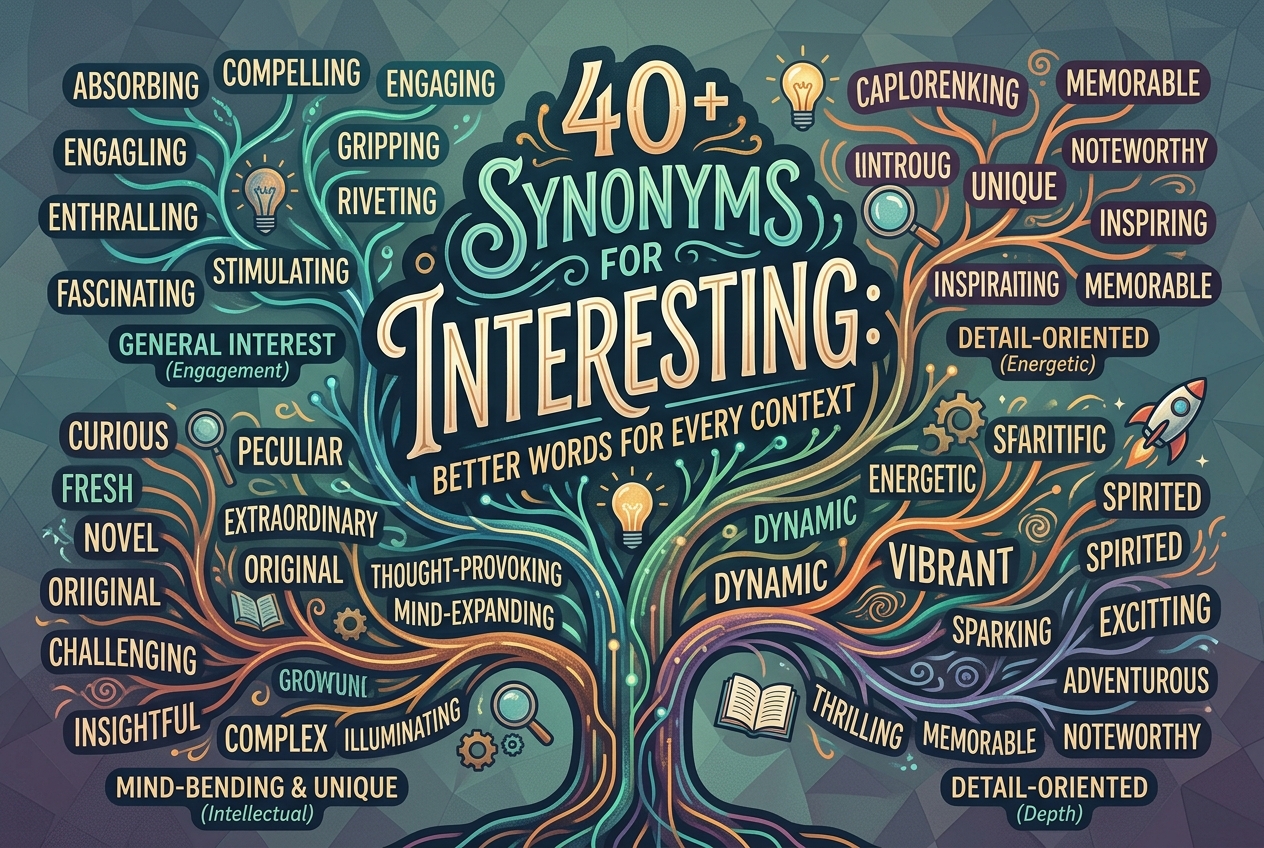
These words help to say that something cannot grab your attention. They are often used to describe books, movies, speeches, games, and stories.
- Engaging is a friendly and general word that implies something that attracts people without pushing them away. She gave an engaging lecture on urban gardening.
- Absorbing means that one loses track of time while being engaged. It was an absorbing novel, and I read it in two sittings.
- Engrossing is a similar word to absorbing but implies something more involved. It is used for more detailed and immersive activities or things. An engrossing history of the postal system.
- Gripping is suitable for tense events or those that involve high stakes. It is used for thrillers, courtroom dramas, and sports. The last chapter was gripping.
- Riveting is a more intense version of gripping, and it implies that one was almost mesmerized by something. One should probably use it for things that actually deserve it. Her testimony was riveting.
- Compelling suggests something that convinces one of something. It may be used for arguments or stories. The report provides a compelling argument for change.
- Captivating implies something that attracts with beauty or charm. It is a bit less common than engaging but similar in meaning. A captivating performance by the lead singer.
- Enthralling is a bit more formal and powerful word for captivating that implies something that holds one spellbound. An enthralling account of the expedition.
Practical tip: “Compelling” is probably the most versatile word on this list and is the best to use in most professional settings, as it can be used for both arguments and narratives.
Synonyms for interesting that mean “makes you curious”
Some things are intriguing because they raise many questions. Such words are appropriate for puzzles, riddles, and even mysteries.
- Intriguing suggests a puzzle to solve. There is an intriguing gap in the records between 1932 and 1936.
- Curious may mean “arousing interest,” but it also means “odd,” so you should probably avoid using it if you want to keep your statements clear. A curious detail in the report. If you wish to avoid the ambiguity, you should probably use intriguing.
- Tantalizing implies that there is something just out of reach, something that you cannot follow up on right now. A tantalizing clue.
- Stimulating is all about stimulation. It works well for discussions, conferences, talks, meetings, and chats of any kind. It was a stimulating exchange of ideas.
- Alluring suggests a certain attractive mystery. The alluring idea for a new project.
Synonyms for interesting that mean “unusual or different”
The word interesting could mean “not what I expected.” These adjectives are more specific.
- Unusual is neutral and safe. An unusual combination of ingredients.
- Remarkable means deserving of special mention, and has a positive nuance. A remarkable recovery.
- Striking connotes making a strong visual or emotional impression. A striking resemblance
- Distinctive emphasizes being easily recognized as different from others. A distinctive style.
- Unconventional applies to ideas, methods, and lifestyles that defy normal standards. An unconventional approach to teaching mathematics.
- Offbeat is informal and often used with affection. An offbeat little museum.
- Quirky is friendly and light-hearted, often used about people, shops, etc. A quirky cafe with mismatched chairs.
- Peculiar has a negative cast, implying something is odd. Use it when oddity is a plus. A peculiar odor in the hall.
- Unexpected is similar to surprising but has less of a positive implication. An unexpected twist.
- Novel means new and original, and is often used with ideas and methods. A novel approach to energy storage.
Practical tip: Words like peculiar or curious applied to persons may have a negative implication. For persons, opt for quirky or distinctive if you mean it in a positive sense.
Synonyms for interesting that mean “makes you think”
These terms can be applied to essays, reports, books, and discussions.
- Thought-provoking is the standard choice for ideas that stick around. A thought-provoking essay on public transport.
- An insightful review of consumer habits.
- Illuminating is similar, but has a sense of a “lightbulb” moment. An illuminating look at how the food is distributed.
- Eye-opening implies you learned something that gave you a new perspective. An eye-opening look at how the food is distributed.
- Revealing suggests that previously hidden information is now known. A revealing interview.
- Provocative means that it deliberately provokes debate or strong reactions. It can be positive or negative. A provocative opinion piece.
- Enlightening is similar to illuminating, but has a slightly more formal tone.
Synonyms for interesting in professional and academic writing
In contexts such as reports, emails, reviews, and research, using the word ‘interesting’ could be seen as vague or non-committal. Words that convey interest could be used to express specificity and credibility.
- The word noteworthy notifies the reader that something is worth noting. One of the noteworthy discoveries was the decrease in yields.
- The word notable is a slightly shorter alternative to noteworthy. A notable exception.
- The word significant means something of a large or major importance. However, be careful when using this word, especially in research contexts, as it could be seen as a technical term (e.g., statistically significant). Use the word significant sparingly and with caution.
- The word relevant links the interest to some relevance to a specific purpose. A relevant example for this audience.
- The word worthwhile infers that something is worth the time and effort. A worthwhile read for new managers.
- The word promising suggests an optimistic future. A promising start to the research.
- The word substantive means that something has solid or worthwhile content. A substantive proposal.
- The word compelling could also work in these contexts, especially about arguments and evidence.
- A useful re-wording of “The results were interesting” could be to specifically state what was interesting. For example:
- “The results of the survey were interesting”.
- “The results of the survey were surprising (most respondents preferred the older design).”
- “The results of the survey were noteworthy (contradicted our expectations).”
- Specifying why something is interesting is usually more effective than using one word to replace another.
Casual and conversational alternatives
In everyday speech and informal writing, short and warm-sounding words seem more natural.
- Cool: That’s a cool idea.
- Neat: A neat trick for how to fold shirts.
- Fun: A fun fact about octopuses.
- Wild: That’s a wild story! (or it’s shocking/extravagent),
- Juicy: There are some juicy details in the news today. (gossipy),
- Entertaining: An entertaining video.
- Memorable: A memorable trip.
- Edgy: An edgy new design. (unusual/risky) .
Use these words to match the voice you want to convey. Don’t say “juicy” and “wild” in a formal report.
Another word for interestingly (interestingly synonym options)
“Interestingly” is a sentence adverb that introduces a fact you find noteworthy. It is often filler. Before replacing it, ask whether the sentence needs it at all. If the fact is interesting, the reader will likely see that without being told.
When you do want an adverb, choose one that matches the meaning:
| Instead of “interestingly” | Use when |
| Notably | the point is important or worth attention |
| Remarkably | the fact is impressive or surprising |
| Curiously | something is odd or slightly puzzling |
| Surprisingly | it goes against expectations |
| Strikingly | the contrast or detail is vivid |
| Tellingly | the fact reveals something deeper |
| Oddly or oddly enough | it is strange but not important |
| Significantly | the fact has real consequences |
Example: “Interestingly, the smallest team produced the best results.” could become “Surprisingly, the smallest team produced the best results.” The second version tells the reader how to react.
Opposite of interesting
If you want to say the opposite of engaging, then the choice depends on whether you want to say ‘not engaging’, ‘non-adventurous ‘, or ‘tiring in a boring sort of way’.
- Boring: the default option
- Dull: lacking in quality
- Tedious: like a waiting room
- Monotonous: samey
- Mundane: ordinary
- Humdrum: boring day
- Bland: tasteless
- Tiresome: weariest
- Unremarkable: nothing to note
- Uninteresting: the literal opposite, which is actually pretty dull
A common mix-up is uninteresting versus uninterested. Uninteresting is the quality of being boring, while uninterested is a person’s feeling. Disinterested, however, actually means impartial, although it’s often confused with the above, so be careful.
How to choose the right word: three quick tests
- The Why test. Complete the following sentence: It was interesting because -. Whatever you write there will most likely be the best synonym for the word interesting. Because it was surprising, that is unexpected and remarkable. Because it kept me reading, that is engaging. Because it opened my eyes, that is enlightening.
- The tone test. Ask yourself if the occasion or place where the paper will be presented can tolerate the word. “Riveting” would be inappropriate for a formal memo, while “cool” would be inappropriate for an abstract.
- The strength test. Some synonyms are stronger than others. Say you want to say that something was pleasing, but it was not extraordinary. “Engaging” sounds better than “spellbinding.”
Common mistakes to avoid
- Replacing “interesting” with “fascinating” every time. You will simply create a new overused word. Vary your choices based on meaning.
- Using “curious” without checking ambiguity. In some sentences, it reads as “strange,” not “interesting.”
- Using strong words for ordinary things. “A riveting spreadsheet” will make readers doubt your other praise.
- Forgetting the “so what.” A synonym does not replace an explanation. If space allows, add a detail.
- Using “significant” loosely in research or data writing. Readers may assume you mean a technical result.
- Overusing “interestingly” as a transition. Cut it when the fact speaks for itself.
Examples: before and after
| Original | Improved | Why it works |
| “It was an interesting book.” | “It was a gripping book.” | Tells the reader it held attention |
| “She has an interesting style.” | “She has a distinctive style.” | Says what is notable about it |
| “That’s an interesting idea.” | “That’s an unconventional idea worth testing.” | Adds a judgment and a next step |
| “The interview was interesting.” | “The interview was revealing.” | Suggests new information emerged |
| “Interestingly, sales rose in winter.” | “Surprisingly, sales rose in winter.” | Signals expectation was reversed |
| “An interesting little shop.” | “A quirky little shop.” | Adds warmth and personality |
Final takeaway
You do not need to learn 40 synonyms for interesting. You need to adopt the habit of asking yourself Why did this happen? Then name the word that explains it. Use gripping to suggest pace, intriguing for mystery, distinctive for character, eye-opening for new meaning, and noteworthy when you wish to sound professional. If in doubt, add a detail.
Frequently asked questions(FAQs)
What is the best synonym for interesting?
There is no best synonym for interesting: use engaging for general writing, compelling for business documents, and intriguing to call something strange.
What is another way to say that’s interesting for a conversation?
Other ways to say that something is interesting include that’s fascinating, that’s a good point, I hadn’t thought of it that way, and tell me more. The last two are especially good because they imply that you are paying attention.
Is interestingly a word?
Interestingly is a word, but don’t use it. You can replace interestingly with adverbs like notably or surprisingly, depending on the context.
What is a better word than interesting?
Other words for interesting include fascinating, riveting, captivating, and compelling. All of these words imply different degrees of interest – use the one that appeals most to you.
What can I say instead of interesting when I am not?
You can say something like That’s a different approach or I hadn’t considered that. Don’t use words that imply that you are interested if you are not.