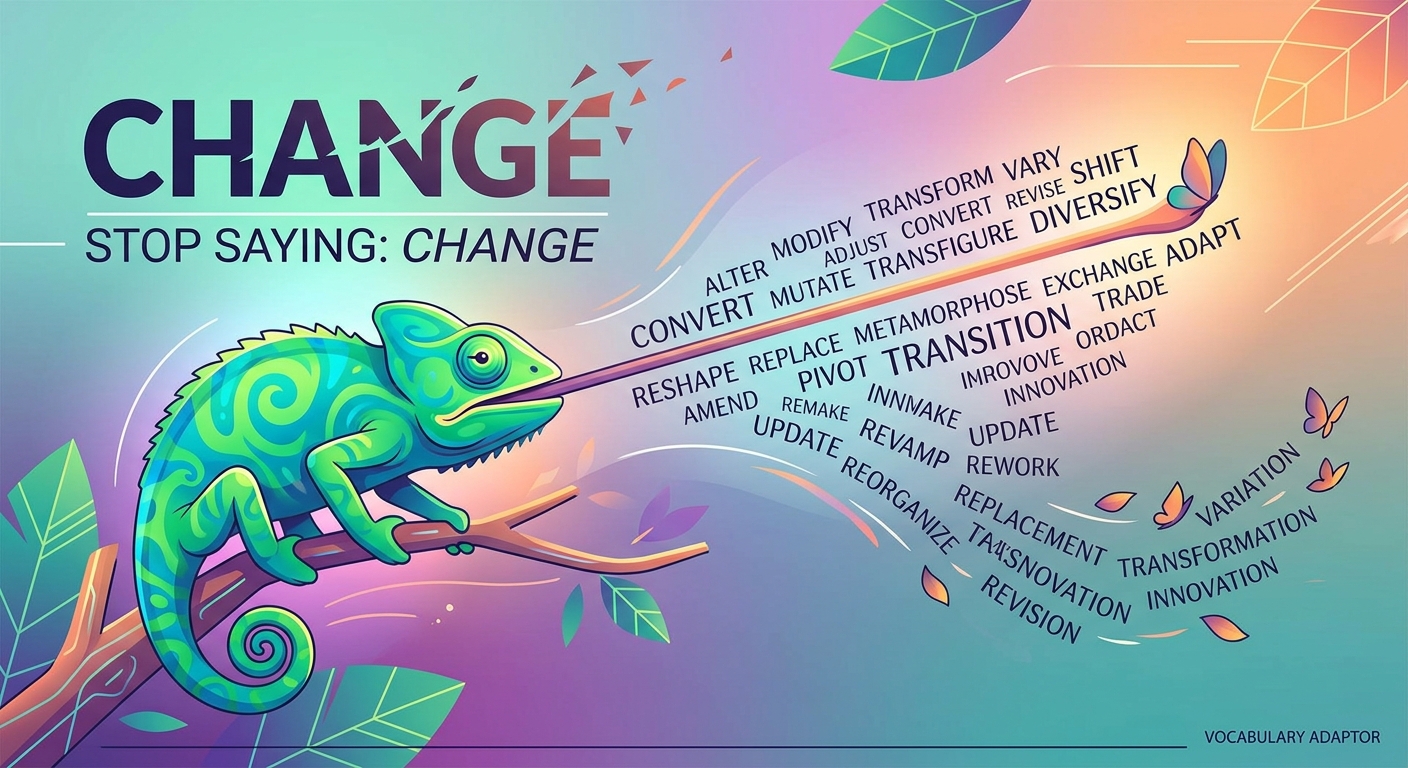
Change Synonym: 30+ Words to Use Instead of Change
Few words do work as well as the word ‘change’. It describes a new haircut, a career change, a change in climate, a change to a sentence, and many other things. While this is helpful in conversation, it makes writing vague. When you are writing “We have changed the process,” your reader has no idea if you improved it, replaced it, or just happened to remove half of it.
Here you will find over 30 change synonym, organized by intent. In addition, you will find a small paragraph on the word ‘change’ itself, some examples in writing, and some common errors that even the best writers make.
Change Meaning: What the Word Actually Covers
As a verb, the word “change” means to cause to be different or become different. As a noun, it means the state of being different, the fact or process of becoming different for someone or something, a replacement of one for another (change of clothes), or coins and money returned upon payment.
This wording is the main issue here. “Change” is a kind of “empty” word that tells the reader that something is going to happen but doesn’t say what. So, there is change, but we don’t know if it is for the better or worse and what it will be like. The best synonym to be used depends on what you want to say: slight or major, planned or unplanned, temporary or permanent, and for the better or worse.
Quick Reference: Another Word for Change by Situation
If you are in a hurry, use this table, then read the sections below for nuance.
| What you mean | Best options |
| A small adjustment | adjust, tweak, modify, fine-tune |
| A complete transformation | transform, overhaul, revolutionize, convert |
| Swapping one thing for another | replace, substitute, swap, exchange |
| Improving something | refine, improve, upgrade, revise |
| A gradual shift | evolve, shift, adapt, progress |
| Altering a text or plan | amend, edit, revise, rework |
| Something becoming different on its own | vary, fluctuate, turn, develop |
Change Synonym Verb Options, Grouped by Meaning
Small or Minor Changes
When the difference is subtle, “change” is overly dramatic. These words suggest degrees of change.
- Adjust: to alter slightly to improve a fit or achieve a desired effect. She adjusted the seat before driving.
- Tweak: informal, slightly fiddling, adjustment of something, often minor but time-consuming. I tweaked the headline and the click rate jumped (unfortunately, this is an example of wishful thinking).
- Modify: a more formal word than tweak for making minor changes. The contract was modified to include a new deadline.
- Fine-tune: to tune something down to an exact degree of precision. He had been fine-tuning the recipe for three weeks.
- Amend: used when something official, such as a document or an agreement, is changed. The committee amended the policy.
- Alter: to make something different. It is a general word but used often in relation to clothes and plans. The tailor altered the sleeves.
Large or Complete Changes
Here “change” is too weak. These words tell the reader the difference is major.
- Transform: to change in form, appearance, or nature, usually dramatically. The renovation transformed the old warehouse into apartments.
- Overhaul: to examine and rebuild or reorganize thoroughly. The company overhauled its onboarding process.
- Revolutionize: to change something fundamentally. Use it sparingly, because it implies a major break from the past.
- Convert: to change something from one form, use, or system to another. They converted the garage into an office.
- Reinvent: to change so completely that the result feels new. The band reinvented its sound.
- Remodel: to change the structure or form of something, especially a building or room.
Replacing One Thing with Another
Sometimes “change” does really mean “swap”. It is always better to be specific to avoid confusion, such as in the case of “change the battery,” which could include replacing, recharging, or even altering it.
- Replace: to put something new in place of something old. Replace the filter every few months.
- Substitute: to use one thing in place of another, often as a stand-in. You can substitute honey for sugar.
- Swap: informal, a direct exchange. We swapped seats.
- Exchange: a more formal swap, often between two parties. They exchanged contact details.
- Switch: to move from one option to another. She switched banks last year.
Changes That Improve Something
If the difference is for the better, say so. Readers gain information from that single word choice.
- Improve: to make or become better.
- Refine: to improve by removing flaws or making small, careful adjustments. The team refined the design after testing.
- Upgrade: to replace or enhance with a higher-quality version.
- Revise: to reconsider and alter, especially written work or an opinion. He revised his draft twice.
- Enhance: to increase quality, value, or effectiveness.
- Rework: to change something to make it better suited to a purpose.
Don’t Miss: Help Synonym: 25+ Other Words for Help and Their Meanings
Gradual or Natural Change
Some change happens slowly or without anyone directing it.
- Evolve: to develop gradually over time. Her views evolved as she gained experience.
- Shift: to move or change position, direction, or emphasis. Public opinion shifted after the announcement.
- Adapt: to adjust to new conditions. Many businesses adapted to remote work.
- Develop: to grow or change into a more advanced state.
- Mature: to reach a fuller stage of development, used for people, ideas, and products.
- Fluctuate: to rise and fall irregularly, common with prices and moods. Temperatures fluctuated all week.
- Vary: to differ from one instance to another. Prices vary by region.
Change Synonyms for Direction and Position
- Turn: to move in a new direction, literally or figuratively. The conversation turned to money.
- Pivot: to change strategy or approach while keeping a core goal. Common in business writing, but easy to overuse.
- Deviate: to depart from a standard or plan. The route deviated from the map.
- Diverge: to split off from a shared path. Their interests diverged over time.
Another Word for Changing (and Changes Synonym Options)
Readers frequently want the “-ing” and the plural form, so here you go.
Another word for changing could be an adjective or a participle:
- shifting: shifting priorities
- evolving: an evolving market
- fluctuating: fluctuating prices
- transitioning: a transitioning workforce
- developing: a developing situation
- variable: variable weather
Changes synonym options, when “changes” is a noun:
- Adjustments: small corrections
- Modifications: formal, partial alterations
- Revisions: changes to written or planned material
- Updates: changes that bring something current
- Shifts: movements in direction or trend
- Transformations: major, deep differences
- Alterations: general or physical changes
- Amendments: formal changes to documents or laws
As a noun, “change” itself also has alternatives for the idea of a new situation: transition, turning point, conversion, and upheaval (the last for sudden, disruptive change).
How to Choose the Right Synonym
Ask yourself four quick questions:
- How big is the difference? Small points toward “tweak” or “adjust.” Large points toward “overhaul” or “transform.”
- Was it deliberate? “Modify” and “revise” suggest intention. “Fluctuate” and “evolve” often do not.
- Is the result better, worse, or neutral? “Improve” and “refine” are positive. “Deteriorate” and “degrade” are negative. “Alter” and “shift” are neutral.
- How formal is the setting? “Amend” and “modify” suit official documents. “Tweak” and “swap” suit casual writing.
Common Mistakes to Avoid
Using a more complex word than necessary. Saying that a company “revolutionized” its logo because it changed the font makes your other assertions seem less credible.
Interchangeable words with different meanings. Though largely overlapping, “substitute” and “replace” are not entirely synonymous. One uses a different word for a temporary or permanent replacement.
Homophones with different meanings. “Alter” and “altar” sound the same but have different meanings. Though both words are connected to religion, an altar is a table, and alter means to change.
Overused business words. Using words such as “pivot” and “transform” too much can make them sound unimpressive. If you can explain the changes you’re making, it’s usually better to do that rather than use a buzzword.
Using a different word for “change” inappropriately. In some cases, changing “change” to a synonym can result in a phrase that doesn’t make sense. “Climate change” or “change of address” are examples of set phrases that shouldn’t be changed.
Before and After Examples
Seeing the difference in action is the fastest way to build the habit.
- Before: We changed the website last month.
- After: We redesigned the website last month. / We updated the pricing page last month.
- Before: The manager changed the schedule.
- After: The manager rearranged the schedule. / The manager postponed the meeting.
- Before: Her attitude changed after the trip.
- After: Her attitude softened after the trip. / Her attitude shifted after the trip.
Each “after” version tells the reader something the original left out.
Quick Takeaways
- The word “change” is too general or imprecise. Choose your synonym according to the degree, intent, direction, and tone of change.
- Use
- adjust/tweak/modify for minor changes.
- transform/overhaul for major changes.
- replace/swap/substitute when one thing is used instead of another.
- evolve/shift for gradual or incremental change.
- and
- always use “change” in set expressions and when precision is not necessary.
Frequently Asked Questions(FAQs)
What is the most common change synonym?
“Alter,” “modify,” and “adjust” are among the most common general change synonyms, but the appropriate choice depends on the context.
Is there a single best synonym for change?
No, each synonym has slightly different meanings, so it is better to distinguish between them depending on the context rather than rely on just one option.
What is a good change synonym verb for formal writing?
“Modify,” “amend,” “revise,” and “alter” can all be used in formal writing contexts. “Amend” and “revise” are more commonly used with documents.
Can I use “shift” and “change” interchangeably?
“Shift” can often be substituted for “change,” but it typically implies a directional or positional movement.