“Help” is a very versatile word. We use it when we need assistance, when we offer our services, when we express gratitude for aid provided, or when we read instructions. Due to its extreme versatility, “help” tends to be overused, and a description with multiple instances of this word may sound bland.
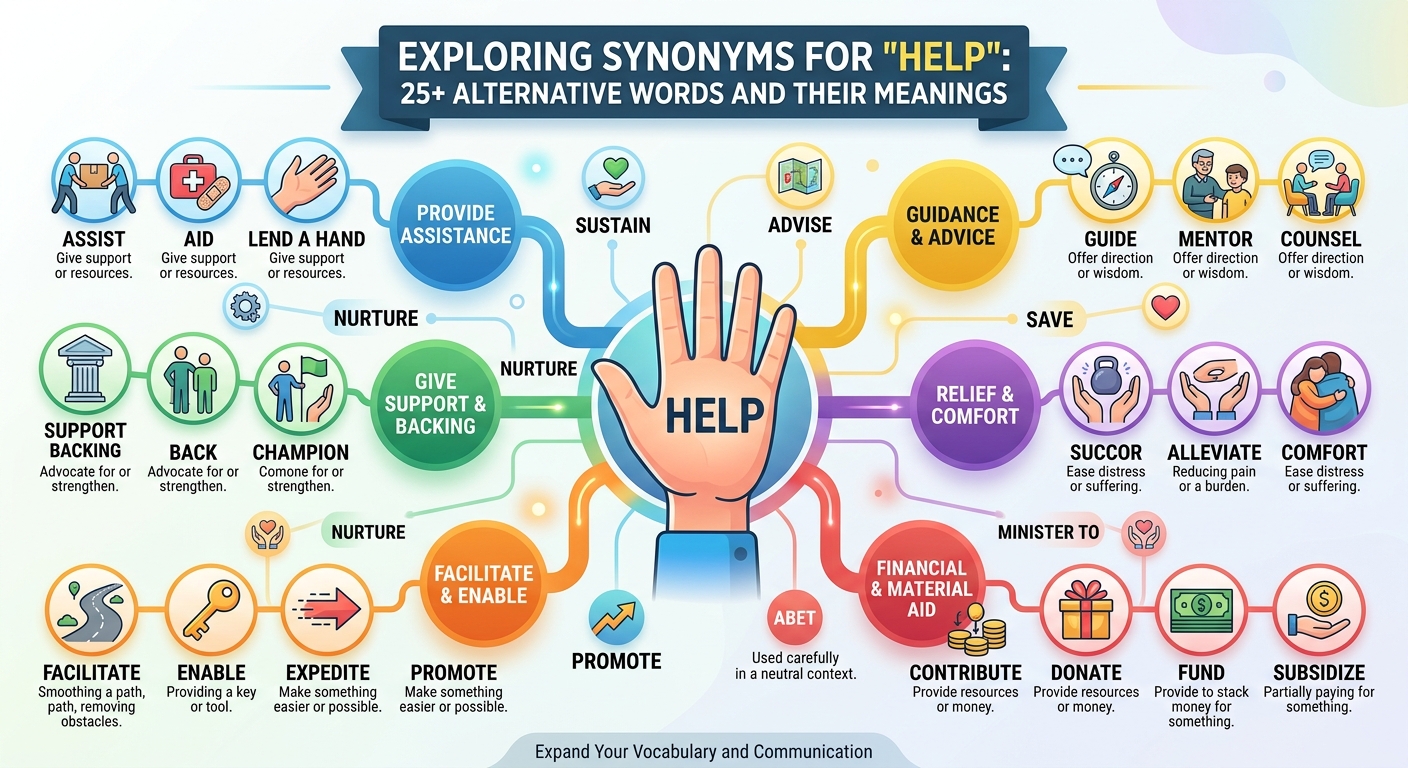
Luckily, there are multiple alternatives to this word. However, not all of them are interchangeable since synonyms have shades of meaning. For instance, “aid” and “pitch in” are interchangeable, but “facilitate” and “comfort” are not. The following list provides more than 25 help synonym or phrases that can be used as synonyms for “help” and categorizes them based on the context of the sentence.
What does “help” mean?
At its core, to help means to make something easier, possible, or better for someone. It can describe a small favor (helping a neighbor carry groceries), a professional service (helping a client file taxes), or emotional care (helping a friend through a hard week).
It works as a verb (“She helped me move”), a noun (“I need some help”), and an interjection (“Help!”). Each form has its own set of alternatives, which is why a single list of synonyms rarely works well. We will cover all three.
Quick reference: help synonyms at a glance
| Word | Best for | Example |
| Assist | Professional, polite contexts | The clerk assisted me with the form. |
| Aid | Serious need, formal tone | Volunteers aided the flood victims. |
| Support | Ongoing or emotional backing | Her family supported her through college. |
| Pitch in | Casual teamwork | Everyone pitched in to clean up. |
| Lend a hand | Friendly, informal | Can you lend a hand with this box? |
| Facilitate | Making a process easier | The tool facilitates faster reviews. |
| Back | Public or financial support | Investors backed the project. |
| Guide | Showing the way | A mentor guided him through the process. |
| Relieve | Reducing pain or burden | The medicine relieved her headache. |
| Serve | Providing a service | The library serves the whole community. |
Another word for help as a verb
Everyday and informal options
All these words and phrases are perfectly fine for use in conversation, texting, and even in writing!
- Lend a hand is a phrase that means to offer to help with something practical. “Would you be able to lend a hand with these groceries?”
- Pitch in is when you join others to accomplish something. “We all pitched in and finished up the garden.”
- Chip in is also when you join others, but typically this phrase is used when small contributions of time or money are needed. “We all chipped in for her gift”
- Give a hand is basically the same thing as to lend a hand.
- Back up is when you help or support someone or something. “My co-worker backed me up in the meeting”
- Help out is almost like to help, but it has a more casual sound to it. “She helps out in the shelter on the weekends.”
Professional and formal options
These suit emails, reports, cover letters, and business writing.
- Assist: the most popular formal equivalent of “help.” Often implies working in tandem with somebody else, perhaps in a subordinate capacity. “Our team will assist you with onboarding.”
- Aid: somewhat more solemn than assist and often implies charity or help in a context of need. “Our charity aids children in need.”
- Facilitate: to make something easier or smoother. Often used in the context of enabling or smoothing a process. Does not imply direct intervention. “The software facilitates communication between departments.”
- Enable: to give somebody the tools or opportunities to achieve something. “The grant enabled her to complete her research.”
- Accommodate: to provide lodging/accommodation for somebody. Sometimes used more generally to mean “to cater to” or “to adjust for.” “The hotel accommodated our late arrival.”
- Serve: to provide service or assistance. Often implies a certain level of dedication. “The clinic serves low-income households.”
- Contribute: to add something to a common fund, effort, or project. “Each member contributed to the project.”
- Cooperate: to work together. This word implies a degree of mutual effort as opposed to contribution or assistance.
Emotional and supportive options
When help is about feelings rather than tasks, these words carry more warmth.
- Support: to be there for someone over time, emotionally or practically. “He supported his sister through her recovery.”
- Comfort: to ease someone’s distress. “She comforted the crying child.”
- Encourage: to give confidence or motivation. “Her teacher encouraged her to apply.”
- Reassure: to remove doubt or worry. “He reassured the team that the deadline was safe.”
- Stand by: to remain loyal and supportive during hard times.
- Be there for: an informal phrase for emotional reliability.
Guidance and improvement options
Sometimes help means showing someone how, not doing it for them.
- Guide: to lead or direct someone through a process.
- Coach: to train or develop someone’s skills, usually over time.
- Mentor: to offer long-term advice and guidance from experience.
- Advise: to recommend a course of action.
- Counsel: to give thoughtful advice, often on personal or serious matters.
Relief and problem-solving options
These apply when help reduces something negative.
- Relieve: to reduce pain, pressure, or stress.
- Ease: to make something less difficult or painful.
- Alleviate: a more formal word for lessening suffering or difficulty.
- Remedy: to fix a problem. “The update remedied the login error.”
That is already well over 25 words. Which one you choose depends on tone and relationship, which we will get to shortly.
Helped synonym: past tense options
If you are searching for a helped synonym, you can use the past tense of almost any verb above:
- assisted
- aided
- supported
- backed
- guided
- facilitated
- enabled
- contributed to
- pitched in
- lent a hand
- benefited (when something helped as a result, not a person)
Compare these two sentences:
- Weak: “The course helped me improve my writing.”
- Stronger: “The course sharpened my writing and gave me a clear editing process.”
When you replace “helped” with a more specific verb, you often end up saying what the help actually did. That is a better habit than just swapping in a fancier word. “Aided my writing” is a synonym swap. “Sharpened my writing” is more informative.
Word for helping: nouns for people and things
If you need a word for helping in noun form, here are the common choices.
For a person who helps:
- helper
- assistant
- aide
- ally
- supporter
- backer
- partner
- benefactor (usually someone who gives financial help)
- volunteer (someone who helps without pay)
For the help itself:
- assistance
- aid
- support
- backing
- relief
- service
- guidance
A small tip: “aide” is usually an official role (a teaching aide, a nurse’s aide), while “ally” is more about shared goals or values. They are not the same, even though both describe someone on your side.
How to choose the right word
Synonyms are indeed only as good as they seem helpful, and that is when they are applied appropriately. To know how to use the word properly, the following criteria may be applied:
1) Read the context in which the synonym is required – for instance, “lend a hand” implies a friendly and familiar setting, whereas “facilitate” is more corporate, so using the latter in a casual conversation with a friend would sound odd, and using “pitch in” in a formal contract would be out of place;
2) Consider whose action it is – for instance, “assist” can be used only when someone helps another person complete some task, whereas “enable” is used when one creates opportunities another person may use for completing some task, and “facilitate” is when one removes some of the obstacles another person has to overcome on their way to complete a task;
3) Think about the implications – “aid” implies a need, “comfort” implies affection, “support” implies reliability;
4) Check if it sounds right – if a sentence sounds too worded or pretentious, a simple synonym such as “help” may sound better in a given context, and there is nothing wrong with it.
Examples: the same sentence, different choices
Look at how one idea shifts with different words.
- “He helped her through the loss.” (neutral)
- “He comforted her through the loss.” (emotional care)
- “He stood by her through the loss.” (loyalty)
- “He supported her through the loss.” (steady, practical and emotional)
Or in a work setting:
- “I helped the client with the report.” (plain)
- “I assisted the client with the report.” (formal, supporting role)
- “I guided the client through the report.” (teaching or leading)
- “I contributed to the client’s report.” (shared authorship)
None of these is better in general. Each says something slightly different, so choose the one that matches the truth.
Common mistakes to avoid
- Swapping words that don’t have the same connotations. Alleviate is for things, not people. You can’t alleviate a friend; you can alleviate a problem.
- Using fancy words inappropriately. Your resume should contain a healthy mixture of both fancy and straightforward words. Words such as “facilitated,” “enabled,” and “leveraged” can be used excessively, giving the opposite effect of what is intended.
- Not following grammar conventions. You should be most concerned with the ways you can and cannot use the word. You can assist a friend with a task, but you can’t assist in a task. You can aid a friend in a task.
- Mixing up between aide and aid.
- Using a thesaurus as your only reference. A thesaurus is meant for finding synonyms, but a thesaurus doesn’t give you the exact word you need. You should look up an unfamiliar word in a thesaurus to find its connotations, and then check its connotations in a dictionary.
Key takeaways
- There Isn’t One Best Help Synonym, However
- Therein lies the rub. Based on the context, the intention, and the involvement of the person giving the help may affect which word is better.
- In many cases, using specific verbs may be more effective instead of using a synonym. Specific verbs clearly describe what the helper did to help the helpee.
- Use a more coarse word or a more formal word based on the situation and the persons involved.
- Be careful about the grammatical category of the word as well as the implication of the word. For instance, helping a friend is different from helping a client. Similarly, finding a solution is different from describing a process.
- The word “help” isn’t a bad word to use. We just recommend using other words to convey more precise meaning.
Frequently asked questions(FAQs)
What is the most common synonym for help?
“Assist” is the most widespread formal alternative, while “aid” is common in cases of real need; in everyday speech, people often say “lend a hand” or “help out.”
Is assist more polite than help?
It sounds more formal and restrained, but not necessarily more polite. In fact, a courteous “Let me help you with that” sounds more attentive and friendly than “Allow me to assist you.”
What do you call helping someone emotionally?
Support, comfort, encourage, reassure, and stand by are all possible options depending on how you want to sound – offer general help and sympathy or emphasize your steadfast friendship.
Can you use support and help interchangeably?
In many cases, yes, but support often implies help of a more lasting or underlying nature.