Synonyms for Crazy: 50+ Words to Use Instead
Consider the last time you used the word crazy. Perhaps it was in reference to a hectic week at work, your friend’s latest idea, a ridiculous price tag, or your favorite song. Same word. Four different meanings.
It’s for this reason that we’re here. Crazy is a word that sounds great on paper, but fails miserably when forced into an essay or a conversation. It’s too good. It means too many things at once. Someone reading or listening has to do a little extra work to determine what you actually mean by crazy: excited, Dumb, wrathful, or incredible.
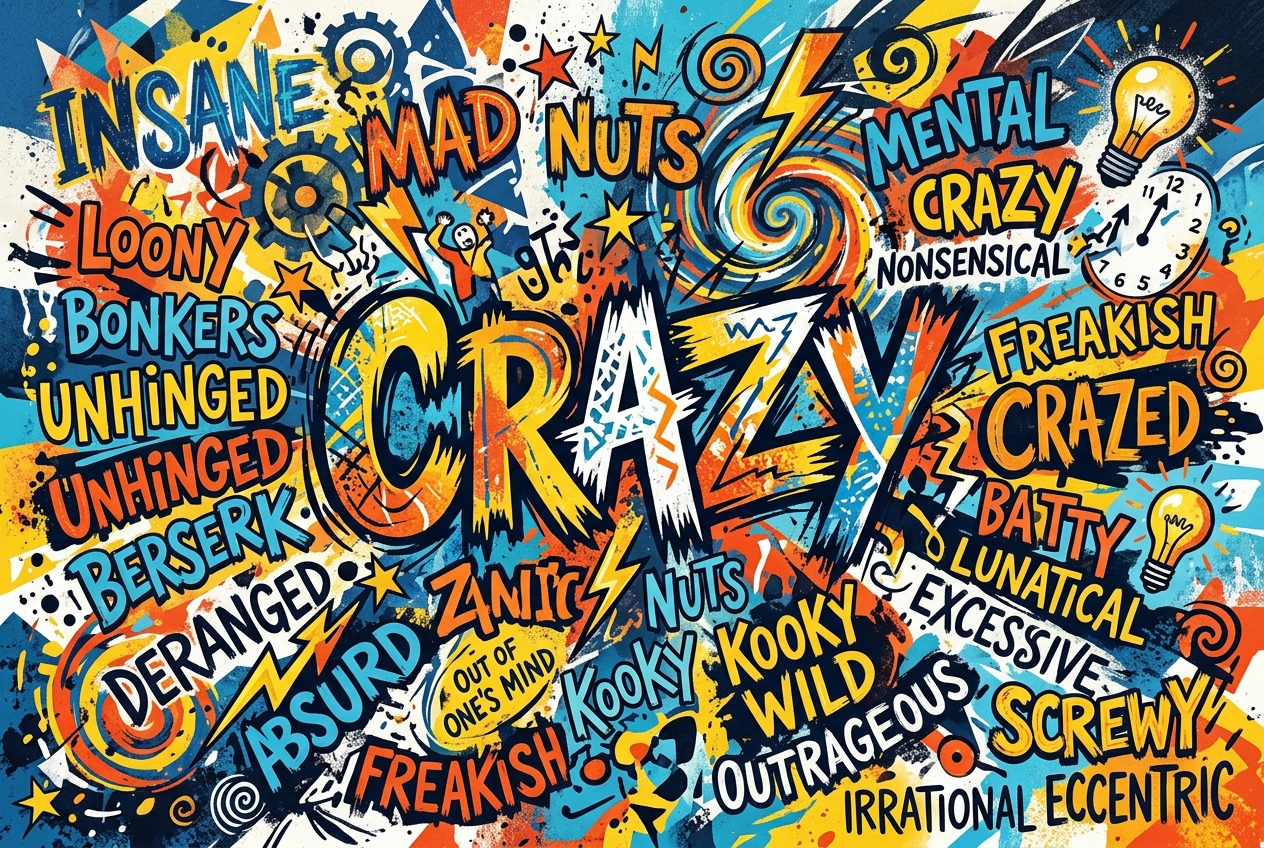
This list has over 50 synonyms for crazy. Organized by meaning. Think of this as a better thesaurus entry. Plus some notes on where each synonym is best used. What tone it fits. And a few examples of times when it’s just not the word you need.
What Does “Crazy” Mean?
The meaning of ” crazy ” is often different according to the context. Usually, there are several meanings, which can be observed in the dictionaries:
- mentally ill or irrational (the oldest and the most sensitive meaning)
- wildly foolish or nonsensical, for example, a crazy plan
- very enthusiastic or obsessed about something, for instance, crazy about soccer
- extremely, for example, crazy prices or crazy traffic
- impressive or astonishing, mostly in casual speech, for example, that goal was crazy
- angry, for example, “it drove me crazy”
The word crazy came from the word craze, which was the Old English verb meaning to crack or to shatter. The crazy meaning included the idea of something being cracked, and that is why there are some slang words nowadays, like cracked or crackers. The exact dates of when the word crazy implied those meanings are not identified, so it is better to check the dictionaries, like Merriam-Webster or Oxford English Dictionary.
Insane: Meaning and How It Differs From Crazy
Many people looking for a synonym for insane are interested in knowing whether it is simply a stronger synonym for crazy. In colloquial practice, that is mostly the case. Words like insane traffic or crazy traffic would be perceived as equivalent.
However, historically, the variant insane has a more formal and clinical connotation. It comes from the Latin insanus, meaning something similar to unsound or unhealthy. In the past, it was commonly used in the medical and legal fields, which is why it has a more stuffy image nowadays. Medical professionals no longer use either term to refer to a condition; instead, they use more precise language.
In casual situations, you will find that the word insane is used as a synonym for extreme (insane prices, insane comeback). The word crazy is more versatile and expressive, and it often implies a positive meaning (you are crazy, but I like it). For most of the listed crazy synonyms, insane would be an appropriate substitute, but it is better to choose the word based on context before making a substitution.
Why Swap Out “Crazy” at All?
There are three practical reasons:
- “A crazy day” tells me little. “A frantic day” or “an exhausting day” tells me much more.
- In professional writing, “crazy” can read as sloppy or dismissive.
- Using “crazy” to describe people can trivialize mental health conditions. More on that below.
None of this means “crazy” is banned. It is a normal word. It just works better when you choose it on purpose.
Synonyms for Crazy, Sorted by Meaning
1. When you mean wild, hectic, or out of control
Use these for situations, schedules, events, and energy levels.
- Chaotic:“The kitchen was chaotic during the dinner rush.”
- Hectic:“I have a hectic week ahead.”
- Frantic:“She made a frantic search for her passport.”
- Frenzied:“A frenzied crowd rushed the doors.”
- Feverish:“They worked at a feverish pace to meet the deadline.”
- Wild:“It was a wild night.”
- Tumultuous:“A tumultuous year for the company.”
- Turbulent:“Their relationship was turbulent.”
- Manic (informal use):“The shop was manic on Saturday.” Note that “manic” is also a clinical term, so use it with care.
- Mad (British and informal):“It was absolutely mad in there.”
Tip: “Hectic” and “chaotic” are usually the safest swaps for describing a busy day. “Frantic” fits when people are rushing in a stressed way.
2. When you mean silly, quirky, or eccentric
These have a similar meaning but tend to be used in a slightly more affectionate context.
- Zany: “A zany comedy featuring lots of slapstick.”
- Wacky: “He has a wacky sense of humour.”
- Kooky: “Her kooky taste in decor makes the house unforgettable.”
- Goofy: “A goofy grin.”
- Madcap: “A madcap adventure in three countries.”
- Eccentric: “An eccentric inventor.”
- Quirky: “A quirky little bookshop.”
- Offbeat: “An offbeat film that deliberately avoids clichés.”
- Whimsical: “A whimsical garden with lots of strange sculptures.”
- Daft (more common in British English): “That’s a daft idea, but I quite like it.”
- Loopy (slang): “I felt a bit loopy after staying up too late.”
Tip: Note that ‘quirky’, ‘eccentric’ and ‘offbeat’ are all quite mild and often used in a complimentary way. ‘Daft’ and ‘loopy’ are more slang expressions that still have affectionate undertones.
3. When you mean foolish, unreasonable, or ill-advised
Use these words when criticising actions or ideas – not people.
- Absurd -It’s absurd to think that we will see results overnight.
- Ridiculous -The bill was ridiculous.
- Preposterous -A preposterous statement with nothing to back it up
- Senseless -A senseless risk
- Irrational -An irrational fear of making small decisions
- Nonsensical -The instructions were nonsensical.
- Harebrained -A harebrained scheme to make a lot of money fast
- Reckless -Reckless driving
- Foolhardy -A foolhardy attempt to cross the river in the storm
- Ill-advised– An ill-advised investment.
- Unreasonable -An unreasonable request
- Outlandish -An outlandish justification
In business writing, you might want to avoid words such as harebrained and preposterous. Ill-advised, unrealistic, and unreasonable sound better in many cases.
4. When you mean amazing, intense, or extreme
Modern-day slang uses crazy/incredible as superlatives.
- “An incredible performance”
- “The view was unbelievable.”
- “An astonishing recovery.”
- “A staggering amount of work.”
- “A remarkable achievement.”
- “An extraordinary stroke of luck.”
- “A mind-blowing finale.” (slang)
- “Outrageous prices” (negative connotation) or ” an outrageous talent” (positive)
- “Extreme heat”
- “Intense competition”
Tip: Use staggering or astonishing when discussing large numbers. Insane price is perfectly acceptable in speech but not nearly as effective in print as a staggering price.
I think that’s it.
5. When you mean passionate or obsessed
This is the ‘crazy about you’ or ‘crazy about soccer’ sense.
- Obsessed: ‘She’s obsessed with vintage cameras.’
- Passionate: ‘He is passionate about teaching.’
- Fanatical: ‘A fanatical supporter of the local team.’
- Devoted: ‘A devoted gardener.’
- Smitten: ‘He was smitten from the first meeting.’
- Infatuated: ‘She was infatuated with the idea.’
- Enthusiastic: ‘An enthusiastic volunteer.’
- Wild about/mad about: ‘I’m mad about this series.’
Tip: ‘Fanatical’, ‘obsessed ‘, etc. can sound negative depending on tone; use ‘passionate’ and ‘devoted’ if you want a more positive slant.
6. When you mean angry or driven to frustration
“It’s driving me crazy” is undoubtedly one of the most widespread word combinations. The word mad and its derivatives are used in various contexts.
- Furious: “I was furious about the delay”.
- Livid: “He was livid when he saw the bill”.
- Enraged: “The decision enraged residents”.
- Irate: “An irate customer”.
- Exasperated: “She was exasperated by the constant interruptions”.
- Fed up: “I’m fed up with this noise”.
- Maddening: “A maddening delay”.
Tip: if the feeling is not very strong, use exasperated or frustrated; if something makes you angry, furious and livid should be used.
7. Informal and slang options
These are most suitable for everyday conversation, chatting, posts on social media, or just easy writing.
- Bonkers: This schedule is bonkers.
- Nuts: That plan is nuts.
- Bananas: The crowd went bananas.
- Cuckoo: He’s gone a bit cuckoo.
- Batty: A batty old aunt, in the loveliest way.
- Crackers (British): You must be crackers.
- Barmy (British): A barmy idea.
- Off the wall: An off-the-wall suggestion.
- Over the top: The party was over the top.
- Wild: That’s wild.
Tip: Slang is often used in a particular area, such as “barmy” and “crackers” are more common in British English, and “bananas” and “nuts” are more American. So be careful while choosing words if you are writing for an international audience.
Quick Reference: Which Word Fits Which Situation
| What you mean | Better choices | Good for |
| Busy and stressful | hectic, chaotic, frantic | Work, schedules, events |
| Playful and odd | zany, quirky, madcap | Humor, personality, design |
| Unwise | ill-advised, reckless, unrealistic | Decisions, plans |
| Impressive | astonishing, remarkable, staggering | Achievements, numbers |
| Passionate | devoted, passionate, obsessed | Hobbies, fans |
| Angry | furious, livid, exasperated | Emotions, reactions |
| Casual and punchy | bonkers, nuts, bananas | Speech, social posts |
A Note on Describing People
This is what a lot of those vocabulary lists leave out. Using crazy, insane, psycho, or mental to describe a person with mental illness can reinforce stereotypes and is not encouraged by many mental health organizations. If you’re doing any sort of research on mental health, chances are you’ve stumbled across a resource that recommends ditching terms like crazy in favor of more specific clinical terms. If you’re writing anything that will be taken seriously, go with the more specific, careful word that mental health advocates recommend. Now, in your casual writing, it’s much simpler to just describe what the person in question is doing, without diving into the contents of their mental state.
Instead of saying “my ex is crazy”, maybe “my ex was unpredictable” or “my ex’s behavior was hurtful”
- Instead of saying “that guy is insane”, maybe “that guy takes huge risks”
- Instead of “I’m going crazy,” try “I’m overwhelmed” or “I’m at my limit”.
See how much better that sounds?
Common Mistakes When Replacing “Crazy”
- Using a synonym that has an inappropriate strength: “Furious” is not an interchangeable term for “annoyed.”
- Using a more sophisticated word than needed:“That film was preposterous!” is probably not the response you would give to a friend about a movie.
- Using slang words inappropriately: “Bonkers” should probably not be used in a formal business setting. You might want to use “unrealistic” or “unexpected” instead.
- Over-correcting: Not every word needs a more sophisticated replacement. “That’s crazy!” is a totally fine phrase. You don’t need to change it simply because it’s not as sophisticated as “that’s irrational.”
- Not being aware of other regional variations: Sometimes slang words aren’t actually interchangeable. “Mad” can mean angry in American slang, but it can also mean ecstatic or surprised in British slang.
- Using clinical language inappropriately: Terms such as “manic,” “psychotic,” “delusional,” or “paranoid” should be used carefully and should be replaced with less intense terms if used in writing.
Examples: Before and After
Seeing the swap in context helps.
- Before:“It was a crazy week.”
- After:“It was a relentless week.” or “It was a hectic week.”
- Before:“That’s a crazy idea.”
- After:“That’s a risky idea.” or “That’s an unconventional idea.”
- Before:“The price is crazy.”
- After:“The price is steep.” or “The price is staggering.”
- Before:“He’s crazy about jazz.”
- After:“He’s devoted to jazz.”
- Before:“The crowd went crazy.”
- After:“The crowd erupted.”
- Before:“This noise is driving me crazy.”
- After:“This noise is wearing me down.”
Notice that the replacements often add information. That is the real benefit of moving beyond one catch-all word.
Key Takeaways
- ” Crazy” has at least five different meanings, so you would never pick one synonym that will suit all your needs
- First, decide which it is- hectic, foolish, impressive, passionate, or angry.
- Next, try to think of what your intended audience would relate to. The more casual it is, the easier slang would be. “Unrealistic” or “Extreme” work for a more professional setting.
- When writing about people, focus on what they do, rather than what’s on their mind.
- In general, the more specific word you can think of, the better it is for your sentence.
Frequently Asked Questions(FAQs)
What is another word for crazy
Depending on the context, synonyms can include wild or hectic for chaotic activities, absurd for ridiculous ideas, eccentric for quirky characters, or astonishing for impressive achievements.
Is “insane” the same as “crazy”
They are both informal and can have negative connotations when relating to a person’s mental state, but insane may sound more severe and is considered more proper than crazy.
What is a more polite word for crazy?
Unconventional, unexpected, eccentric, ambitious, or unrealistic are all somewhat neutral terms that can be used to describe something crazy.
What is a slang word for crazy?
Bonkers, nuts, bananas, cuckoo, crackers, and off-the-wall are all slang terms for crazy.
What is a more professional word for crazy in writing?
Unrealistic, unpredictable, extreme, volatile, or unusually demanding can be used in a professional setting depending on what you mean by crazy.
Can “crazy” be used as a compliment?
It can be used in casual settings as a compliment, such as saying “that was crazy good,” but it should not be used to describe a person’s mental state. Remarkable or exceptional might be better words to use in writing.