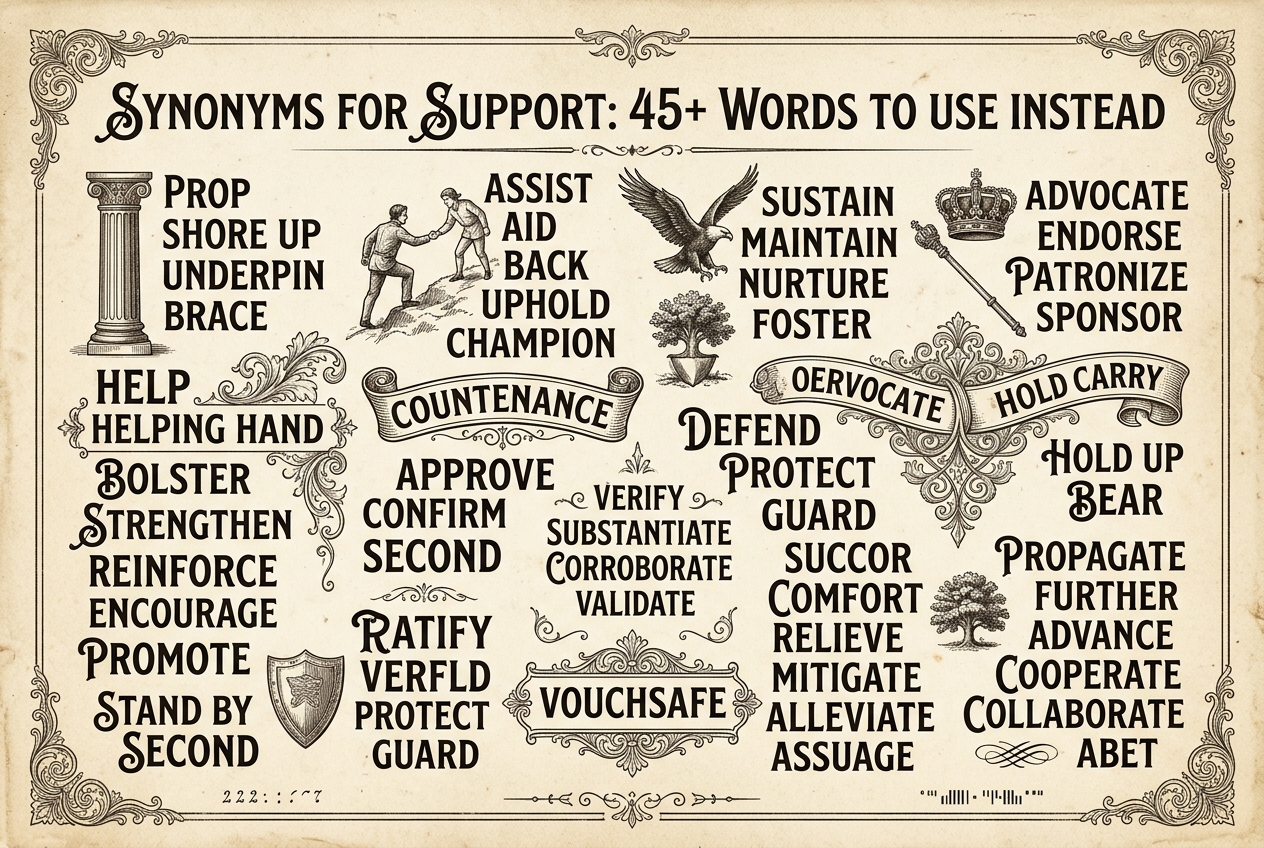
Synonyms for Support: 45+ Words to Use Instead
“Support” is one of the most versatile words in the English language, which is part of why it’s one of the most abused. A manager supports a team. A beam supports a roof. A study supports a theory. A friend supports you through a difficult month. The same word applies to all of these examples (which is why they’re all included here), but rarely do any two of them actually share the same meaning.
The right substitute depends on your intended meaning — the best synonyms include “encourage” and “underwrite,” but you’ll never find either used in place of the other. This guide organizes possible options by their meanings, gives them in context with example sentences, and notes the differences so you know which ones fit your needs most closely. Here are 45+ synonyms for support to improve your vocabulary and your writing.
What Does “Support” Mean?
Before you think about replacing it with another word, try specifying what you mean by support in your sentence. As a verb, support has five different meanings:
- to give comfort or encouragement
- to provide practical help
- to give money
- to agree with or be in favor of
- to hold something up or give evidence for it.
As a noun, it can mean help, backing, encouragement, a physical structure which holds weight, or a department which helps customers (technical support). Most often, weak verbiage occurs when “support” is used to mean more than one of the above. Pick out the meaning that you want to use, and then refer to the following lists:
Quick Reference: Another Word for Support by Meaning
| If you mean… | Try… |
| Emotional comfort | comfort, encourage, reassure, stand by |
| Practical help | assist, aid, help, pitch in |
| Money | fund, finance, sponsor, underwrite |
| Agreement or advocacy | back, endorse, champion, advocate for |
| Holding something up | prop up, brace, bear, reinforce |
| Evidence | substantiate, corroborate, back up, bear out |
Synonyms for Support: Emotional Encouragement
Use these synonyms when seeking to provide help/care, not logistics. These words feel more personal.
- Comfort: to help a person in distress. “He sat with her and tried to comfort her.”
- Encourage: to spur sb on, give confidence. “Her teacher encouraged her to apply.”
- Reassure: to free from doubt, misgiving or fear.
- Console: to comfort someone in sorrow or disappointment. “Friends consoled him after the defeat.”
- Uplift: to raise, as in cheering someone up. “The music uplifted the whole room.”
- Hearten: to cheer up, or give courage (a slightly more formal synonym than cheer).
- Stand by: to be loyal to someone in a time of need. “She stood by her brother throughout the trial.”
- Be there for: colloquial phrasing. “I’ll be there for you whatever happens.”
- Sustain: to nourish, or keep up, support, or strengthen someone or something over a period of time. “Faith sustained them through the winter.”
- Nurture: To care for and help grow. Best used in the context of long-term care, like a child, a talent, or a relationship.
A practical note: console and comfort often refer to a response to a problem that has already occurred, whereas encourage refers to looking towards the future. Mix them up, and you’ll end up with “I consoled her to start the business” instead of “I encouraged her,” which isn’t likely to happen.
Synonyms for Support: Practical Help
This list answers the queries millions of individuals ask on the web about the word for helping others. The terms below suggest a person engaged in something beneficial for another person or activity.
- Help: the most common option that does not require any additional explanations.
- Assist: a slightly more complex substitute used mostly in formal or service industry contexts. Example: “Two engineers assisted with the installation.”
- Aid: the term is usually more formal and is used for charity, medical, or humanitarian assistance. Example: “Aid workers arrived within days.”
- Pitch in: a phrase used in informal contexts that implies collective help. Example: “Everybody pitched in and moved the furniture.”
- Lend a hand: is a variation of the previous one and is also used in casual talk. Example: “Can I lend a hand with your luggage?”
- Contribute: refers to a specific input into a certain activity. Example: “Each member contributed ideas to the project.”
- Facilitate: make something easier. Example: “The coordinator facilitated the negotiations.”
- Serve: help somebody/something. Example: “The clinic serves remote families.”
- Accommodate: provide collective support for someone in need. Example: “The school accommodates children with special needs.”
- Relieve: help someone by taking some of their responsibilities. Example: “A volunteer relieved the night nurse.”
Helped synonym options for past tense
These words can be used as synonyms for helped depending on the context they are used in:
- Assisted (more formal or professional)
- Aided (more formal, frequently used in official and medical contexts)
- Backed (implies support)
- Boosted (suggests a significant improvement)
- Contributed to (suggests a share in a larger result)
- Facilitated (suggests an effortless process)
- Chipped in (more informal, refers to a small contribution, usually in money)
The phrase “helping another” could similarly be phrased as “assisting another” in a more formal context or “coaching another” if the assistance is in the form of teaching. A sentence describing a process involving helping another student would be phrased differently in a formal and informal context; for instance, “She is helping another student” in a casual conversation may be stated as “She is assisting another student” in a formal report or “She is coaching another student” if the help being provided is in the form of teaching.
Note on the word helping.
The word “helping” can also refer to a portion of food, as in “a second helping,” so if the sentence refers to helping in the sense of a portion of food, synonyms would include portion, serving, or plateful rather than the words listed above. This is a common mix-up many people have when looking for a synonym for helped.
Synonyms for Support: Financial Backing
When it comes to money, the word support can often be misleading and vague. For instance, the audience may not understand if you mean a donation or a loan, so it is better to pick more relevant and specific synonyms.
- Fund – provide someone with the money needed for a particular purpose. Example: “A local foundation funded the program.”
- Finance – fund something, usually on a larger scale or for commercial purposes. Example: “The bank financed the purchase.”
- Sponsor – provide financial support; patronize or endorse publicly or by association; also, to sponsor somebody means to assist them in a public way, for example, with a tournament. Example: “A local business sponsored the tournament.”
- Underwrite – formally agree to pay for something or to cover a financial risk. Example: “The university underwrote the expedition.”
- Subsidize – to provide funds, usually from a governmental or corporate source, to support something, usually by lowering the costs.
- Endow – to give somebody a permanent source of income, for example, for a scholarship or a professor position.
- Bankroll – to fund something, usually bigger than the scale of the speaker/writer suggests; a bit informal and colloquial.
- Back – to support somebody or something, especially financially; the word has many meanings, so make sure the context makes the meaning clear. Example: “Investors backed the startup.”
It is essential to note that sponsor should only be used when a sponsoring relationship is apparent. Also, the words donate, give, and contribute should be used whenever there is no expectation of a reward or public association. The wrong choice of words may confuse the audience and mislead them into drawing incorrect conclusions.
Synonyms for Support: Agreement and Advocacy
These words are similar. They all relate to opinions, policies, candidates, and causes.
- Back: To publicly or financially stand behind. “The mayor backed the proposal.”
- Endorse: To officially approve or recommend. This word is mostly used for products, candidates, and proposals.
- Champion: To actively promote a cause. “She championed access to libraries.”
- Advocate for: To speak or act in favor of something. “Nurses advocated for safer staffing levels.”
- Uphold: To maintain or defend. “The court upheld the ruling.”
- Defend: To protect against criticism or attack.
- Favor: a mild, neutral way of saying you lean toward an option.
- Second: To formally support a motion in a meeting.
- Vouch for: personally confirm someone’s character or ability.
- Stand behind: accept responsibility for and publicly support.
Strength differs.”Favor” is mild while “endorse” is formal. “Champion” suggests passion and action. If you write “she championed the idea” when she simply mentioned it approvingly once, you have overstated her role.
Synonyms for Support: Holding Something Up
For physical and structural meanings, you have a greater variety of more concrete choices.
- Hold up: the plain physical sense. “Four posts hold up the porch.”
- Prop up: to keep from falling, often with some temporary aid; used also in a more pejorative sense about institutions and systems.
- Brace: to strengthen by means of a stiffener.
- Bear: to carry weight (as a bridge does).
- Carry: simple and direct. “These shelves carry the weight of the books.”
- Reinforce: to make stronger by adding material or help.
- Buttress: to strengthen by an added structure, literally or figuratively.
- Shore up: to provide additional support to something weak or failing.
- Underpin: to provide a foundation, literally or figuratively. “Trust underpins every good partnership.”
“Prop up” and “shore up” imply a weakness that needs correcting–use them with caution if that’s not what you mean.
Synonyms for Support: Evidence and Proof
In essays, reports, and research summaries, the word support’ is often used when describing evidence. Using strong verbs for support helps your claims.
- Substantiate – to provide evidence to prove something. Example: The authors substantiated their claims.
- Corroborate – to confirm with additional evidence. Example: Another witness corroborated her statement.
- Back up – informal, but commonly understood. Example: Can you back up that claim?
- Bear out – to prove something. Example: The results bear out the previous findings.
- Validate – to verify something is accurate or legitimate.
- Confirm – to verify something is true.
- Bolster – to strengthen an argument or claim.
- Verify – to check something and confirm it is accurate.
Be humble when stating the strength of your claims. Instead of saying, ‘The data proves the theory,’ say, ‘The data supports the theory.’ In many cases, the data doesn’t prove anything. In fact, in most scholarly and professional writing, the words support,’ suggest,’ is consistent with, or bolster are often used in place of prove.
Noun Synonyms for Support
When “support” works as a noun, here are the usual alternatives:
- Help or assistance for general use.
- Backing for approval or funding
- Encouragement for emotional support
- Aid for formal or relief contexts
- Backup for a reserve resource or help in reserve
- Reinforcement for added strength or extra personnel
- Sponsorship for financial or promotional support
- Advocacy for speaking up on someone’s behalf
- Succor for help given in times of distress, a literary or formal word
- Foundation or base for something that holds structure up
That gives you well over 45 options across the categories above.
Common Mistakes to Avoid
- Use of words which have the same meaning but different connotations is quite common. There are several lists of synonyms which imply that words have equivalent meanings. The truth is that most often they do not. “Fund” and “sponsor” are not the same. Neither are “console” and “encourage”.
- Use of words with more complex or rare meanings than necessary. There is nothing wrong with using the word “help”, but your readers should never need to look up a definition while reading any academic paper.
- Overstatement of certainty. “Prove” and “substantiate” are stronger than “support”. Save them for when the text you are discussing actually proves what it is supposed to prove.
- Use of the same substitution over and over. While replacing “support” with “assist” every time in a paper would not be the worst thing in the world, it is still not good writing. Sometimes substitution is the only solution. At times, however, you will need to use different wording. It is important to recognize the difference.
- Failure to distinguish between a noun and a verb. “Backing” is a noun. Not always a verb. Therefore, it cannot always be used in place of other verbs. Try reading the sentence out loud to see if it works.
Key Takeaways
- The word “support” has a number of different meanings, so it’s important that you pick up on your preference first.
- Divide the options into categories, such as emotional (comfort, encourage), practical (assist, help), financial (fund, sponsor), advocacy (back, endorse), structural (brace, bear), and evidence (corroborate, substantiate).
- Pick up words that are in the right tone and potency based on both your audience and the facts of the matter.
- As “help” is an everyday word, you might find that using it is more effective than trying out more impressive variations.
- If you can, always attempt to substitute the word with a specific description of what actually took place.
Frequently Asked Questions(FAQs)
What is another word for support?
Depending on the context, help, assist, back, and encourage are the most widely used synonyms. Corroborate, confirm, or back up is suitable for evidence, while fund or finance is more appropriate for money.
What is a good synonym for helped?
Depending on context, assisted is suitable for formal writing; aided is used for official or humanitarian activities; and chipped in or pitched in are more colloquialisms.
What is a word for helping someone emotionally?
To comfort, reassure, or encourage are appropriate for providing emotional support. Console or stand by are also synonyms, depending on the context of showing solidarity or offering confidence.
Is “support” the same as “help”?
Both words are synonyms, but support can also mean to agree or financially contribute, while help is usually an action-oriented word. Support can also mean to provide a basis for something, while help refers to a specific action of giving aid.
Can I use “assist” and “support” interchangeably?
Both words can occasionally be used interchangeably, but assist usually implies active involvement in the process, while support can also mean financial contribution or agreement. Check the context of your sentence to see if both words are appropriate.