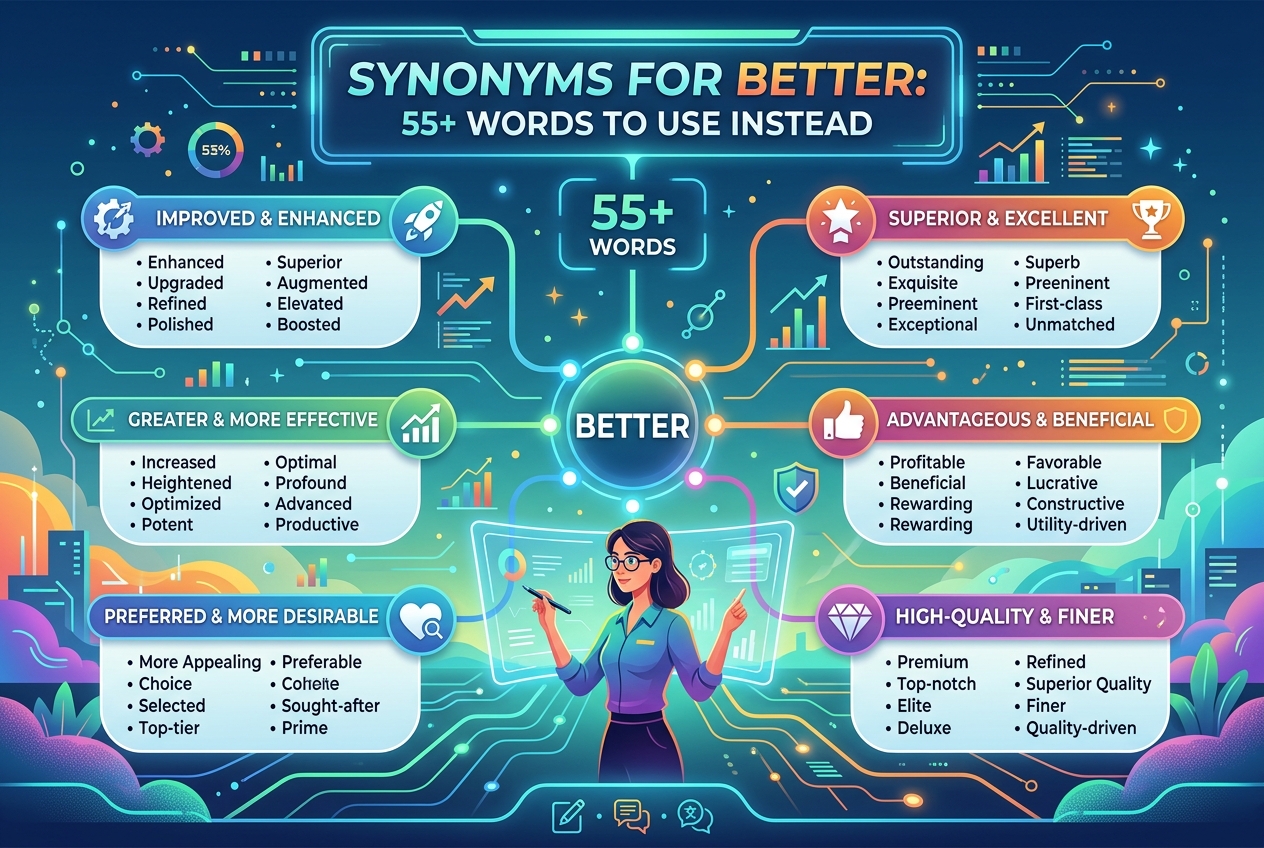
Synonyms for Better: 55+ Words to Use Instead
” Better” is one of those words you learn early on, but rarely use later in life. It’s versatile, fitting in many places: a better phone plan, a better grade, a better mood, being better at something. Which is also part of the issue. The word is so widely applicable that it can often confuse the reader as to exactly what you’re trying to convey.
This guide contains over 55 synonyms for better, organized by type of improvement being expressed. It also includes an in-depth look at thesaurus entries for the word itself, related terms such as best, examples of correct usage, and common pitfalls to be aware of.
What does “better” mean?
If you are looking up the meaning of ” better ” before using a synonym, you have come to the right place. “Better” is the comparative of “good” and “well” and has several meanings:
- adjective, higher in quality: “This is better than the first draft.”
- adjective, healthier, or recovered: “I felt better after a night’s sleep.”
- adjective, more appropriate or judicious: “It would be better if you waited until Monday.”
- adverb, in a better manner: “She explains things better than anyone I know.”
- verb, to improve: “He is trying to better his chances for the promotion.”
- noun: “She always gives way to her betters,” (those with higher rank) or “for the better,” an improvement.
Each of these meanings has different words associated with it. Using a word that describes a good quality will most likely not have the same effect as a word that means healed or improved. This is why a simple list of synonyms will only confuse you, and why we grouped them according to better meaning.
Quick list: another word for better
If you searched “better syn” or “another word for better” and just want options fast, here are the most common ones:
superior, finer, improved, stronger, preferable, more effective, healthier, improve, enhance, refine, surpass, wiser, more suitable
The sections below explain when each one works and when it does not.
Synonyms for better when you mean higher quality
Use these synonyms when comparing two items and stating that one is better than the other.
- Superior: More fit or better in function or quality; used formally. “The newer model has superior battery life”
- Finer: Better in quality or workmanship; implies delicacy. “A finer grade of leather.”
- Higher–quality: Straightforward synonym that is probably safe for any product.
- Stronger: Can be used for arguments, people’s positions, and materials. “Stronger support for the bill.”
- More effective: Best synonym for showing the outcome of an action. “A more effective study habit.”
- Improved: Implies that there was a previous version. “An improved design.”
- Upgraded: Similar to improved, but often used for electronics and services. “An upgraded plan.”
- Advanced: Better developed. “A more advanced skill set.”
- More refined: More skillful or delicate. “A more refined taste.”
- Preferable: Something you would choose over another option. “Working from home is preferable for her.”
- Greater: Higher in amount, value, or degree. “A greater chance for success.”
Tip: Superior sounds pretentious or elitist in some contexts, so try stronger or higher-quality instead.
Synonyms for better when you mean more suitable or wiser
In this case, however, “better” is used in a sense of judgment or fitness, rather than quality.
- Advisable; A wiser choice would be to save the money.
- An advisable thing to do would be to back up your files first.
- Smarter; it’s a bit more casual and punchy: “A smarter way to budget.”
- More sensible: “A more sensible schedule.”
- More suitable: “A more suitable candidate for the role.”
- More appropriate; more likely to appear in a formal or professional context.
- More fitting; “A more fitting title for the book.” It has a slightly more literary feel to it.
- More desirable; “A more desirable option for a vacation destination.” (Something that appeals more to the senses or is more appealing.) “A more desirable location.”
- More favorable; “More favorable terms” (often used in connection with conditions or outcomes), etc.
For example, “It would be better to ask first” could be phrased more advisedly as “It would be wiser to ask first” or more formally as “It is advisable to ask first.”
Synonyms for better when you mean healthier or recovering
This is the sense in “I’m feeling better today.” A thesaurus will often hand you “superior” here, which would be absurd. Use these instead.
- Healthier: “The patient looks healthier this week.”
- Improving: Suggests ongoing progress. “Her condition is improving.”
- Recovering: Implies a process underway.
- Recovered: Implies it is complete.
- On the mend: Warm and informal. “He’s on the mend after surgery.”
- Mending: A shorter, slightly old-fashioned version of the same idea.
- Well again: Gentle and conversational.
Mistake to avoid: Do not use “superior” or “finer” for health. Also be careful with “recovered” if the person is only partway there. “Improving” is more accurate when the process is not over.
Synonyms for better when it is a verb
When “better” is used to indicate “make something improve”, there are several more or less common alternatives to the verb “to improve”.
- Better/Improvement: the most neutral alternative
- Enhance: to improve something already good. Example: enhance the user experience.
- Refine: to improve by making subtle changes. Example: refine your argument.
- Upgrade: to replace something with an improved form of itself.
- Advance: to move something forward. Example: advance your career.
- Boost: to improve, usually informally. Example: boost your confidence.
- Elevate: to raise something or someone to a higher level. Example: elevate the dish with fresh herbs.
- Strengthen: to make something stronger.
- Polish: to improve something by removing minor flaws. Example: polish your resume.
- Perfect: to improve so that it reaches an ideal state.
- Amend: to change or improve a law, a document, etc.
- Reform: to improve a system, an institution, etc.
- Develop: to improve gradually. Example: develop your skills.
The other alternatives to “to do something better than someone else” are:
- Surpass: to do or achieve something better than before. Example: She surpassed her own record.
- Outdo: to do something better than someone else. Example: he outdid himself this time.
- Exceed: to go beyond something or someone.
- Outperform: to perform better than others, common in business contexts.
- Beat: a very common word meaning to perform better.
- Top: a short word meaning to beat. Example: that is hard to top.
An example of a non-preferred alternative to the phrasal verb “to better” is “I want to better my writing”. The reason is that it may be seen as an overly correct phrase. It may be better to say “I want to sharpen my writing” or “I want to improve my writing”
Synonyms for better as an adverb
When someone does something ‘better ‘, we need a more specific description of how
- More skillfully: “She negotiates more skillfully now.”
- More effectively: Focus on the results
- More thoroughly: Focus on the completion.
- More capably: Focus on the competence.
- More successfully: Focus on the outcome
- More precisely: Focus on the accuracy
- More ably: Sounds a bit more formal, but is still correct.
Observation: Adverb replacements are where writing improves most. “He explains it better” tells us little. “He explains it more clearly” tells us just what has improved. If you can name the quality, name it.
Synonyms for better as a noun or in set phrases
These are less common but worth knowing:
- Superiors: The noun sense of “betters.” “She was polite to her superiors.”
- Advantage: “The better of two options” can become “the advantage.”
- Upper hand: “He had the better of the argument” can become “he had the upper hand.”
- Edge: Informal. “That gave us the edge.”
- Improvement: “A change for the better” becomes “a change that was an improvement.”
A few fixed phrases deserve a note. “Had better,” as in “You had better go,” is an idiom meaning “should.” Alternatives include “ought to,” “should,” or “would be wise to.” “Better off” can become “in a stronger position” or “more fortunate.”
Another word for best
Many people searching for “better” are also curious about “best.” The two are related. “Better” compares two things, and “best” picks the top one among three or more. This also answers a common question: what is best? Grammatically, “best” is the superlative form of “good” and “well.” It means the highest in quality, or the most suitable or effective option.
Here are alternatives for “best,” grouped loosely by tone.
Everyday
- Top: “Her top pick.”
- Greatest: “The greatest meal I’ve had.”
- Finest: “The finest bakery in town.”
- First-rate: “A first-rate performance.”
- Top-notch: Informal. “A top-notch team.”
Formal or professional
- Optimal: “The optimal solution given the budget.”
- Premier: “A premier research institution.”
- Supreme: Implies top rank.
- Unsurpassed: Not bettered.
- Foremost: First in importance.
Describing the ideal
- Ideal: “The ideal candidate.”
- Perfect: Use sparingly, since it implies perfection.
- Best-in-class: Used in business; usually for products.
Caution: “Optimal” has a particular meaning. It suggests the best possible solution within a given context, so it works best when you have limitations. “The optimal route” makes sense if you are trying to balance time and money. But “my optimal sandwich” doesn’t make much sense.
Better vs. best: a quick comparison
| Word | Compares | Example |
| Better | Two things | “This laptop is better than that one.” |
| Best | Three or more | “This is the best laptop in the store.” |
| Superior | Two things, formal | “The first option is superior.” |
| Finest | Three or more, elevated | “The finest option available.” |
In casual speech, people often use “better” for groups, and few listeners object. In formal or edited writing, keeping the distinction is safer.
Read More: Synonyms for Unique: 50+ Alternatives for Different Contexts
How to choose the right synonym
A thesaurus provides alternate words but offers no guidance as to which is appropriate. A simple method for choosing the best synonym for better is to answer the following three questions.
- What type of “better” is it?
Is it quality, health, judgment, skill, or some other area? Each of these categories would have different synonyms that would be more appropriate than others. This question focuses on making sure your synonym matches the intended meaning.
- Who will be reading your document?
Most technical or business writing will probably use “more effective,” “optimal,” or “outperform” rather than “smarter.” Less formal documents might use “stronger” or “beat” instead.
- Can you use something more descriptive?
In some cases, the best synonym for better might not actually be a synonym at all. It might take the form of a descriptive phrase that identifies what has been improved. The following example illustrates this point.
“The new process is better.” vs.”The new process is faster and produces fewer errors.”
The second option provides specific information about what has improved. It better informs the reader or listener about the changes and is, therefore, a more effective substitute for the word better.
Common mistakes to avoid
- Rephrasing words without considering their meanings. ‘Superior’ and ‘improved’ are not synonyms because ‘superior’ means ‘better than something else,’ while ‘improved’ means ‘changed for the better.’
- Using too many fancy words. A paragraph full of terms such as “superior,” ‘optimal,’ and ‘enhance’ could sound more like a sales brochure than a scholarly article. It is best to minimize the use of such intensifiers and use simple, straight talk whenever possible.
- The careless use of intensifiers. Writing such overused words as ‘perfect,’ ‘unsurpassed,’ and ‘peerless’ should be avoided as much as possible. Use intensifiers only when the reader needs additional clarification.
- The construction ‘more + adjective.’ The phrase ‘more better,’ for instance, is not a correct combination of two comparatives. ‘More’ is used only with ungradable adjectives, while ‘better’ is a comparative itself, and should not be mixed with ‘more.’
- The disregard for health-related contexts. Some writers tend to forget that in health-related writing, ‘feeling better,’ for instance, should not be replaced with a synonym expressing a quality. ‘Feeling better’ is a process, and the use of a synonym suggesting a state is wrong in this context.
- Mechanical replacement of ‘better’ with ‘better.’ Sometimes ‘better’ may not need replacement at all. Short and simple words sound better in most cases than their complex counterparts.
Final thoughts
“Better” is not a bad word. It is just a broad one. The most useful habit is to notice when it is doing too little work and replace it with something that tells the reader exactly what improved, whether that is quality, health, judgment, or skill. Keep this list handy, and use it to pick words that fit the meaning, not just the thesaurus entry.
Frequently asked questions(FAQs)
What is the best synonym for better?
Depending on the context, there are many options to choose from. ‘Superior’ is used for comparisons, ‘improved’ – for ongoing processes, ‘healthier’ can refer to the person’s condition, and ‘wiser’ is used when giving advice.
What is the word that means better?
Actually, there is no such word in the English language. ‘Better’ is already a comparative form of ‘good’, so you cannot add ‘more’ to it.
What is the difference between better and best?
‘Better’ is a comparative form, meaning that it is used when you compare two things or people. ‘Best’ is the superlative form, so it is used when you compare more than two things or people.
Can I use the word superior in my writing?
You can, but keep in mind that it is somewhat of an elevated and old-fashioned word. ‘Superior’ can be replaced with ‘stronger’, ‘finer’, or ‘higher-quality’, depending on the context.
What is a good synonym for better?
It depends on the context, but some common options include ‘smarter’, ‘stronger’, ‘beat’, ‘on the mend’ (in reference to health), etc.