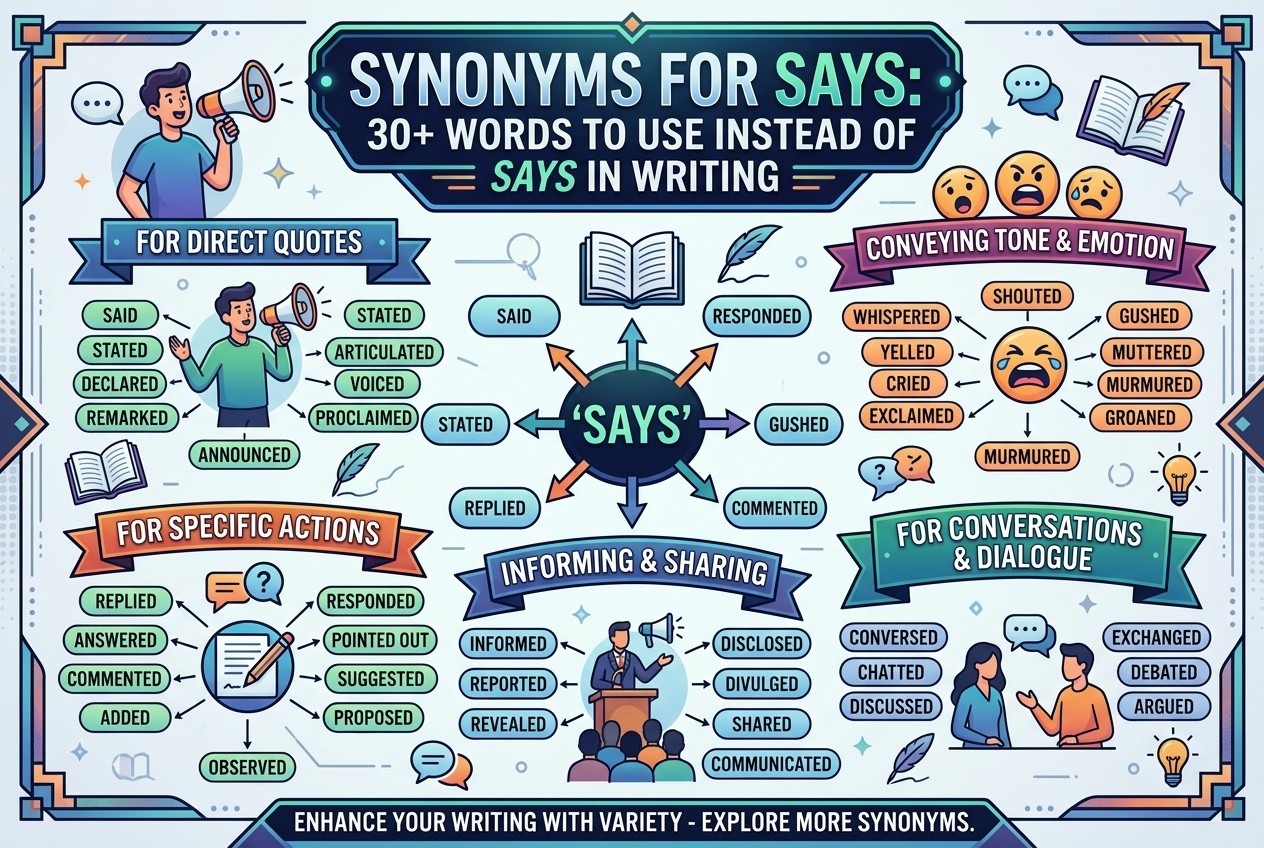
Synonyms for Says: 30+ Words to Use Instead of Says in Writing
You are halfway through a paragraph when you realize you’re using the same word again and again: says, says, says. A few tenses ago, it was said, said, said. It’s bland, so you open up a search bar and look for synonyms for says.
Alternatives to “says” only do half a job, though. They don’t carry the same weight, the same inflection, the same intent. And that’s why this guide has more than 30 synonyms for you to choose from, organized by what the character is trying to convey.
Is “Says” Actually a Problem?
Not as such. ‘Said’ and ‘says’ are both pretty invisible in a sentence. The eyes of the reader pass over them and straight to the speech or the thought. This makes their use almost desirable, and a lot of editors prefer them for regular dialogue.
- The problem with them is repetition without purpose; three things are usually wrong:
- The same tag is attached to all lines, making the rhythm of the piece sound mechanical.
- The word is used to imply a tone or manner that it is incapable of; and in essays and reports, it is overused when ‘the author says’ could be replaced with another verb to show what they are implying through the information.
So the aim here is not to ban the word. It’s simply to encourage the use of ‘said’ as your default word, and to introduce other words into your writing where they earn their place.
Quick Reference: Other Words for Said by Purpose
Here is the short version, followed by more detail on each group.
| Purpose | Words to try |
| Neutral or everyday | stated, remarked, mentioned, noted, added |
| Quiet or private | whispered, murmured, muttered, breathed |
| Loud or intense | shouted, yelled, exclaimed, declared, snapped |
| Asking | asked, inquired, queried, wondered |
| Answering | replied, responded, answered, countered |
| Explaining | explained, clarified, described, pointed out |
| Persuading or arguing | argued, insisted, claimed, maintained, urged |
| Uncertain or hesitant | admitted, conceded, stammered, hinted |
| Playful or emotional | joked, teased, sighed, groaned, pleaded |
| Giving instructions | instructed, ordered, directed, advised |
Neutral Synonyms for Said
Use these when you want variety without adding drama.
- Stated: formal and firm. “The manager stated that the deadline would not move.”
- Remarked: casual and observational. “She remarked that the soup needed salt.”
- Mentioned: light, as if in passing. “He mentioned he might be late.”
- Noted: calm and factual. “The report noted a drop in sign-ups.”
- Added: shows a second thought. “‘Bring a jacket,’ she added.”
“Added” and “continued” are among the most useful tags in dialogue because they signal that the same person is still speaking, which helps with pacing.
Words for Quiet Speech
Volume Words Give The Reader An Imaginary Sound Without Any Additional Description Essay
Each of the following words describes the speaker’s volume, with no additional descriptions:
- whispered: secretive and hushed,
- murmured: indecisive and half-attention,
- muttered: annoyed and unintelligible,
- breathed: awe-struck or fearful.
So, ‘I didn’t want to come,’ she muttered. ‘I didn’t want to come,’ she whispered. Although both sentences begin identically, the imagery presented is entirely dissimilar. In the first case, we can imagine the character to be annoyed at having to be there, whereas in the second, she is likely to be secretly planning something.
Words for Loud or Intense Speech
Rewritten content:
- Shouted and yelled – raised voice, usually anger or distance.
- Exclaimed – sudden surprise or excitement.
- Declared – confident, almost like an announcement.
- Snapped – short and sharp, often irritated.
Example – “Put it down!” he shouted. Exclamation marks are not needed when the verb already carries the force. It would be like shouting twice.
Words for Asking and Answering
Questions already show themselves with a question mark, so “asked” is often enough. When you want more:
- Inquired: polite, slightly formal.
- Queried: brief and professional.
- Wondered: thoughtful, often to oneself.
For responses:
- Replied and responded: neutral, interchangeable in most cases.
- Answered: directly addresses a question.
- Countered: answers by pushing back.
Example: “That price is too high,” Maria said. “It’s the market rate,” he countered.
Words for Explaining
These are particularly useful in nonfiction, interviews, and articles.
- Explained: A reason or process is given.
- Clarified: A misunderstanding is cleared up.
- Described: Something is painted a picture in your mind.
- Pointed out: Something is brought to someone’s attention.
Example: The teacher clarified that the quiz would cover only chapters four and five.
Words for Arguing or Persuading
These words carry different implications, so you have to be precise with them.
- Argued: presented a position and defended it
- Insisted: refused to give in
- Claimed: alleged or asserted
- Maintained: adhered to the same position
- Urged: persuaded someone to do something
For instance, the author of your book probably would not say, ’I claimed that small achievements are more important than great ones,’ because it may sound like he/she is lying. Instead, he/she would use the word ’maintained,’ which implies that the same message was reinforced throughout the narrative. In contrast, the term ’urged’ is closely linked with persuading and convincing.
Words for Hesitation or Reluctance
- Admitted: said with regret or unwillingness
- Conceded: yielded in an argument
- Stammered: spoke with hesitation and uncertainty
- Hinted: suggested indirectly or implied
- Example: “I may have forgotten the tickets,” he admitted.
Words for Humor and Emotion
- Joked and teased: light, playful speech.
- Sighed: tired or resigned.
- Groaned: frustrated or reluctant.
- Pleaded:
Example: “Just five more minutes,” she pleaded.
Words for Instructions
- Instructed: formal, step-based.
- Ordered: carries authority or force.
- Directed: guides someone’s action.
- Advised: recommends rather than commands.
“Says,” “Say,” and “Saying”: Matching the Tense
Many searches for a say synonym, saying synonym, or says synonym are really about tense. The verb changes form, and so should your replacement.
| Form | Example | Replacement ideas |
| say | “I would say yes.” | state, suggest, tell, put it |
| says | “The report says growth slowed.” | states, notes, shows, indicates |
| said | “She said she was tired.” | stated, replied, mentioned |
| saying | “He kept saying no.” | repeating, insisting, stating, murmuring |
“Says” in Essays, Reports and Citations
The word “says” is too informal for formal writing. Instead, pick a word that shows the reader whether you’re supporting, suggesting, arguing, noting, or reporting that the source says something.
- Shows or demonstrates if the source shows evidence of something being true.
- Suggests if something may be true
- Argues if the source is arguing a point
- Notes or observes if it’s a side note.
- Reports if the source merely reports facts or figures
Pick the one you need to best reflect what the source is actually saying. If the source suggests something, you don’t use proves. That’s not a good reflection of what the source is actually saying.
Common Mistakes to Avoid
- Using speech verbs for actions that are not speech: people cannot literally smile, laugh, or nod a sentence into existence. “Sure,” she smiled” is common in casual writing, but many editors would prefer “Sure,” she said, smiling, or a separate action sentence.
- Selecting a fancy word that doesn’t fit: ejaculated and proclaimed in casual conversation could unintentionally produce a comic effect. You should use words that your reader would expect a real person to use
- Loading up on adverbs: “she said angrily” is more effective as “she snapped”
- Using different tags for every line: constant variation draws attention to the tags and away from the story. Plain tags are best.
- Assuming that all “said” tags are the same: they are not. Said is not always appropriate, and it is sometimes not necessary at all
- Forgetting that some lines do not require a tag at all: when it is obvious who is speaking, you can omit the tag, or replace it with an action beat.
Practical Tips for Choosing the Right Word
- Start with “said.” Only replace it when another word will add information.
- Ask what the reader needs to hear. The volume, emotion, certainty, or intent will dictate different synonyms for each point.
- Read the passage aloud. If a verb sounds theatrical, chances are, it is
- Mix in action beats.
- “He put down his fork. ‘We need to talk.’” instead of a tag entirely.
- Keep a short personal list. You’ll get more use out of a list of ten or fifteen words that you actually use rather than a lengthy list you’ll never go through.
- Match your genre. Thrillers tend to use slightly sharper verbs (snapped, hissed) while cozy fiction or business writing err on the side of more calm (remarked, noted).
Key Takeaways
- Keep “said” as your baseline and substitute it with other options only when you have a reason to do so.
- Group your alternatives according to their function – for instance, words that indicate the force of an utterance, the speaker’s emotional state, and intention or degree of certainty.
- In nonfiction, use verbs that reflect how the source is used and how strong its claim is.
- Avoid using speech verbs for actions that people cannot perform physically or emotionally, such as smiling, frowning, or nodding.
- You can also use action beats to make your text sound less repetitive.
Read more: 40+ Synonyms for Interesting: Better Words for Every Context
Frequently Asked Questions(FAQs)
What is the best synonym for says?
There is not one best synonym; rather, it depends on the context of each case. However, ‘states’ is good for formal writing, ‘notes’ is a slight addition, while ‘explains’ is used for clarifications, and ‘argues’ is for opinionated statements that require backing.
What are other words for said in dialogue?
Most commonly used synonyms for ‘said’ in a conversation are ‘asked ’, ‘replied’, ‘whispered’, ‘shouted’, ‘added’, ‘murmured ’, and ‘muttered ’. It is better to use these words sparingly and in combination with the straight ‘said’.
Is it a bad thing to use said a lot?
Not really. Said is a helpful word in the construction of dialogues because it does not sound intrusive. In fact, many writers use it as a default, and the problem only occurs when it has too heavy an emphasis or appears multiple times in one short conversation.
What can I use instead of ‘says’ in an essay?
Depending on the context and weight of the quotation, one can use ‘suggests’, ‘argues’, ‘indicates’, ‘notes’, ‘reports’, or ‘demonstrates ‘.
What is a good synonym for ‘ saying ‘?
It depends on the context again. If it is a noun, one can use ‘proverb’ or ‘expression’, but if it is a verb form, it would be ‘stating ’, ‘remarking ’, or ‘repeating’.