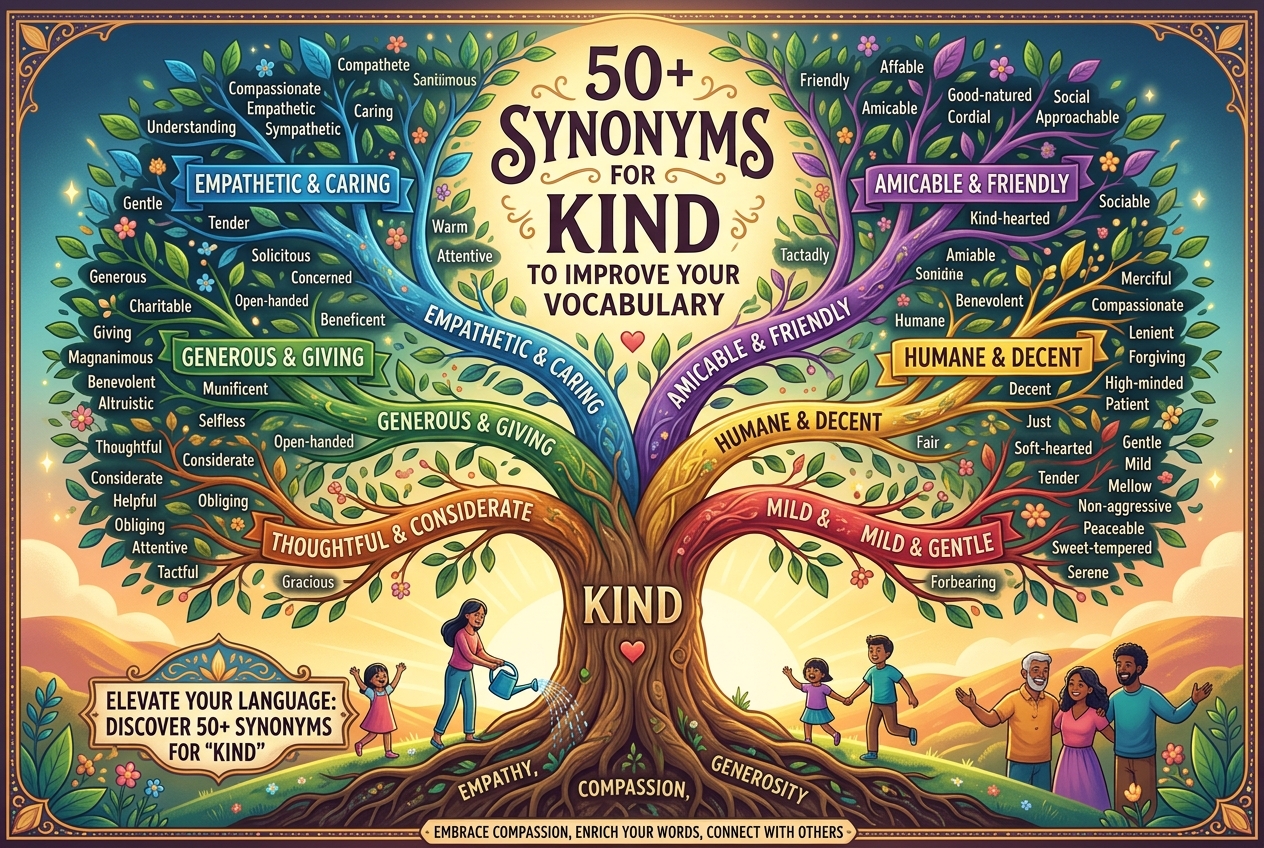
50+ Synonyms for Kind to Improve Your Vocabulary
Calling somebody kind is never wrong.
It’s often vague, though.
Think about a neighbour bringing you soup when you’re sick, a boss telling you when you’ve made a mistake in a way that doesn’t make you feel stupid, and a stranger giving up their seat on the bus.
Each is kind, but in very different ways.
One is compassionate; the other two, tactful and considerate. The word you pick will tell the reader which kind of person you’re talking about.
This guide will give you over 50 synonyms for kind, organised by subtle differences in meaning; notes on which words are appropriate in which context; the opposite of kind; alternatives to ‘kindly’; and some things to avoid.
Kind Meaning: Two Different Words in One
Before presenting synonyms, it is important to note that the word ‘kind’ has two different meanings.
- Kind (adj): a person who is gentle and generous towards others. She is a kind teacher.
- Kind (n): type, category. What kind of bread do you want?
The two meanings of the word are historically interconnected, as the word ‘kind’ is derived from ‘kin’. Furthermore, one of the earlier meanings of the word ‘kind’ implied natural aptitude or belonging to a certain group or family. The association with family and belonging has contributed to the meaning of being generous and understanding towards others.
In this article, I will discuss synonyms for the adjective meaning of the word. If you are looking for synonyms for the noun meaning, the options include such words as type, sort, variety, category, and class. Please note that the words presented above will not apply to the adjective meaning of the word ‘kind’, so double-check the context when substituting one or another.
Synonyms for Kind, Grouped by Meaning
A flat list of synonyms invites misuse. Grouping them by what they emphasize makes it easier to pick the right one.
Warm and Affectionate
These words relate to a feeling of warmth. They can be applied to interpersonal relationships, family life, and character traits.
- Kindhearted: having a kind heart. This is an inherent quality in someone’s character. It has nothing to do with a specific action that the person may or may not have done. “My kindhearted nurse knew each patient’s name.”
- Warmhearted: is similar to the previous word but emphasizes friendliness.
- Tenderhearted: sympathetic and easily upset for others’ distress. It has a negative undertone and can sometimes mean that the person is a drama queen.
- Good-hearted: is a more straightforward and common word for kindhearted.
- Warm: can be used independently or put together with other words. It is a more straightforward and common word for warmhearted. “He gave me a warm welcome.”
- Affectionate: showing affection. It is usually used in context with family members or loved ones.
- Loving: similar to affectionate but implies a stronger devotion.
- Caring: concerned about a person or a situation. Can be used as an adjective in both informal and formal writing.
- Gentle: indicates softness in approach. “She did not have a harsh word for anyone.”
- Compassionate: indicates understanding and sharing of other people’s pain and suffering. A more serious and stronger word for ‘nice.”
Considerate and Thoughtful
These words focus on awareness of other people’s needs and feelings. They are useful for describing manners and everyday behavior.
- Considerate: thinks about how actions affect others. A considerate roommate keeps the noise down at night.
- Thoughtful: anticipates what someone might need or appreciate, often through small gestures.
- Attentive: pays close attention to others.
- Courteous: polite and respectful, usually in a formal or professional setting.
- Polite: correct in manners. Politeness can be mere habit, so this word does not always imply real warmth.
- Civil: the minimum standard of decent behavior. Civil is a modest word, so it can sound faint as praise.
- Gracious: kind in a dignified, elegant way, especially when you have the upper hand. A gracious winner.
- Tactful: careful to avoid hurting feelings. This is a useful word for honesty delivered gently.
- Obliging: willing to help when asked.
- Accommodating: willing to adjust to meet someone’s needs.
Generous and Selfless
Use these synonyms for kindness as it relates to sharing time, money, or effort.
- Generous: openhanded. Remember that it may also apply to time or attitude (a generous interpretation)
- Giving: a simple, warm word to describe someone who regularly shares
- Selfless: putting others before yourself, without expectation of reward
- Unselfish: the same idea but a simpler word.
- Altruistic: interested in the wellbeing of others as a general rule. Sounds more complex and is more likely to be used in essays and arguments about ethics
- Charitable: generous in giving to people in need. It may also be used to mean forgiving in judgement. (a charitable interpretation)
- Philanthropic: similar to altruistic, but it has more of an implication of organised goodness on a large scale. Too grandiose for day-to-day use.
- Big-hearted: generous, open-minded and easy to get along with
- Benevolent: wishing and promoting good to others. Sounds a little old-fashioned or impersonal when used about people (a benevolent ruler or benefactor). Also occasionally used for animals (a benevolent cat).
- Magnanimous: generous to someone you have beaten or defeated. Exactly the right word in certain contexts.
Sympathetic and Forgiving
These words describe kindness that is shown to a person who is in trouble or who has made a mistake.
- Sympathetic: has a feeling of concern for the misfortunes of another.
- Empathetic: understands the emotions of another person; more concerned with sharing the feelings of another than with the problems themselves. While sympathy looks at the world through one’s eyes, empathy looks at the world from someone else’s point of view.
- Understanding: shows tolerance for the foibles and shortcomings of others.
- Patient: shows tolerance for human frailty.
- Merciful: willing to forgive when punishment seems deserved.
- Lenient: less strict than one might expect. It’s not always a virtue because it suggests a lack of strength of character.
- Indulgent: generous to a fault, like an indulgent grandmother.
- Forgiving: willing to forget and forgive.
- Humane: concerned with the welfare of man and beast; more often used in connection with policies or practices that are humane.
- Softhearted: likely to be persuaded to do something against his will and to be moved to compassion by a pitiful story.
Friendly and Helpful
These are all synonyms for approachable, pleasant people.
- Friendly: open and welcoming
- Amiable: pleasant and easy to get along with
- Genial: cheerful and sociable
- Cordial: polite and warm, but often in a more formal way than a friendship
- Good-natured: easygoing and not quick to take offense
- Agreeable: pleasant and easy to work with
- Hospitable: welcoming to guests and strangers
- Neighborly: friendly and helpful in a community sort of way
- Helpful: willing to help.
- Benign: gentle and harmless. It is often used for things (a benign smile, a benign presence) more than people.
- Nice: the simplest and most casual of all these words. It’s good for spoken language but can be a bit empty when written, since it says less than any other synonym.
- Decent: honest and fair. A decent person is someone you can trust to do the right thing, even if they aren’t particularly warm.
There we go. That’s 51 synonyms, and each one has a slightly different feeling.
Quick Comparison: Easily Confused Pairs
Some synonyms look interchangeable but are not. These pairs cause the most trouble.
| Pair | The difference |
| Sympathetic vs. empathetic | Sympathetic means feeling concern for someone. Empathetic means sharing or understanding their feelings. |
| Generous vs. charitable | Generous describes giving of any kind. Charitable usually points to helping those in need. |
| Polite vs. kind | Polite follows social rules. Kind comes from real concern. A person can be one without the other. |
| Lenient vs. merciful | Lenient means relaxed about rules. Merciful means choosing not to punish. |
| Nice vs. kind | Nice is about being pleasant. Kind involves caring enough to act, even when it is inconvenient. |
The last pair matters in practice. Someone who tells you a draft is “great” to avoid awkwardness is being nice. Someone who points out a real problem gently, so you can fix it, is being kind.
Kindly Synonym Options
“Kindly” is an adverb (she kindly offered to help) and an adjective (a kindly old man). It is also used, usually by formal writers, in the expression “kindly note,” which some readers find chilly.
Your alternatives will vary depending on what you mean by “kindly.”
- If you mean “generously,” you might write, She graciously accepted his apology.
- If you mean “warmly,” you might write, He warmly welcomed the new employees.
- They considerately lowered their voices.
- She generously shared her notes.
- He politely refused.
- The director smiled benevolently. (Benevolent sounds formal and perhaps even a bit disdainful.)
To replace the adjective kindly, try gentle, benign, warm, or good-natured.
To replace the instructive kindly in “Kindly send me the report by Friday,” simple please works better: Please send me the report by Friday.
Another Word for Kindness (Noun Forms)
Sometimes you need the noun, not the adjective. Here are some good options:
- Compassion: caring in response to suffering
- Generosity: being willing to donate
- Consideration: awareness or regard for the feelings of others
- Thoughtfulness: being considerate and giving
- Warmth: friendliness and affection
- Graciousness: dignity and courtesy in manner or behavior
- Benevolence: goodwill that prompts people to act kindly and unselfishly toward others
- Goodwill: friendliness
- Tenderness: gentle affection
- Humanity: basic decency toward others
- Charity: generosity toward those in need or a forgiving attitude toward those who have wronged you
Pick the one that fits the action. A donation is generosity. Waiting patiently for a slow coworker is consideration. Sitting with a grieving friend is compassion.
Read More: 70+ Synonyms for Love: Beautiful Words to Express Your Feelings
How to Choose the Right Word
A simple three-question check helps:
- Is it a trait or an act? Kindhearted, warm, and gentle describe character. Generous, helpful, and obliging often describe what someone did.
- How formal is the setting? In a school essay or business email, considerate, courteous, and benevolent fit. In a text message, sweet, thoughtful, or really nice sound more natural.
- Is it praise or a mild criticism? Indulgent, lenient, and softhearted can all imply too much of a good thing. Tenderhearted can suggest someone is easily upset.
Mistakes to Avoid
- Using a word that is too formal in an informal context, such as calling a friend benevolent.
- Confusing polite and kind with each other, when they have different meanings.
- Substituting one synonym for another incorrectly and using pejorative words instead of complimentary ones (e.g., lenient and indulgent) and vice versa.
- Using the word ‘nice’ too often – while it is perfectly acceptable in speech, in writing, it can be an indication that you have not properly defined your terms.
- Making the reader guess at meaning by forcing the use of seldom-used words (e.g., magnanimous) when a more common word will do.
- Confusing ‘kind’ as a noun with ‘kind’ as an adjective. What kind of person are you talking about? A kind person?
Final Thoughts
A larger vocabulary is not a matter of using more big words. It is a matter of having the right words when you need them. Words such as tactful, generous, or considerate tell the reader about a person’s qualities; the word kind is a general term that tells only what category the person is in.
Frequently Asked Questions(FAQs)
What are the best synonyms for kind?
The best choice depends on what you want to say. Caring, considerate, generous, compassionate, and warmhearted are among the most useful. Considerate fits thoughtful behavior, generous fits giving, and compassionate fits someone responding to another person’s suffering.
What is the meaning of kind?
As an adjective, kind describes a person who is gentle, caring, and considerate toward others. As a noun, it means a type or category, as in “what kind of music do you like?” The two senses are related in origin but are used differently.
What is a synonym for kindly?
It depends on the sentence. For the adverb, try graciously, warmly, generously, or considerately. For the adjective in “a kindly old man,” try gentle, warm, or good-natured. In instructions, a plain “please” often sounds friendlier than “kindly.”
What is another word for kindness?
Common nouns include compassion, generosity, consideration, thoughtfulness, warmth, benevolence, and goodwill. Choose by action: a donation shows generosity, while comforting a grieving friend shows compassion.
What does kindhearted mean?
Kindhearted describes a person who is naturally inclined to be kind. It refers to character rather than a single act. Close alternatives are warmhearted, good-hearted, and tenderhearted.